Your Career Isn't on Pause. It Just Needs a Different Playbook.
Future-Proof Your CareerMarch 5, 20268 min read
working parent career strategycareer growth with kidscareer planning for parents
Your Career Isn't on Pause. It Just Needs a Different Playbook.
A director at a mid-size tech company told her coach she hadn't updated her LinkedIn profile in four years. Not because she had nothing to add — she'd led two major product launches, grown a team from three to eleven, and navigated a full rebrand. She hadn't updated it because she couldn't find forty-five uninterrupted minutes without someone needing something from her.
That's not a career problem. It's a design problem.
Her career was still moving. She just wasn't an active participant in it anymore. Decisions got made by default — accepting the promotion because it seemed wrong to say no, staying in the job because switching required energy she didn't have, skipping the conference because the logistics fell apart. Two years later, she looked up and wasn't sure how she'd gotten where she was.
Most working parents are living some version of this story. Not failing. Not stalled. Just reactive.
This guide isn't about wanting more or being satisfied with less. It's about building a career strategy that accounts for your actual life — the school pickups, the sick days, the 9 PM window when the house is finally quiet and you have twenty minutes to think. That's a real constraint, and it requires a real response.
First, Audit What's Actually Broken
Before making any moves, you need to know what you're dealing with. Not "am I happy at work?" — that question is too broad to be useful. Career health is a system, and different parts of it fail in different ways.
Five dimensions are worth examining separately: whether the work itself feels meaningful, whether your environment supports the way you need to live, whether your skills are still growing, whether you have professional relationships that matter, and whether you're being paid what you're worth.
Most working parents score reasonably well on the first and last. The middle three are where things quietly deteriorate — and where the most fixable problems live.
Competence is the one that surprises people. After a few years raising kids, a lot of mid-career professionals have become very good at the job they had three years ago and quietly stopped building the skills they'll need for what comes next. Not from lack of ambition. Every hour that used to go to professional development now goes somewhere else, and that shift happens gradually enough that most people don't notice it until they're looking at a job posting that asks for things they haven't practiced in a while.
That drift is measurable in one of the small windows you actually have: paste a posting for a role you'd want next, along with your resume, into the match analyzer and get an honest read on where you stand. No scheduling, no account — it takes about a minute and turns a vague worry into a specific list.
What you're actually auditing for isn't satisfaction. It's the places where the structure of your career has drifted from what you need — because those are the places worth addressing.
Try it: Take the free Career Audit to map your five dimensions in about 10 minutes.
The Values You Have Now Aren't the Ones You Think You Have
Career planning tools built for 28-year-olds weren't designed for you. At 28, career growth probably meant advancement speed, visible projects, and upward momentum. At 38, with kids in elementary school and aging parents somewhere on the horizon, the picture shifts in ways that don't always get acknowledged in professional development conversations.
Autonomy usually rises sharply. Parents need schedule control in ways that don't always register as "real" professional requirements — but they are, and careers that don't account for them tend to become unsustainable faster than expected.
Stability is a legitimate professional value. Not a sign of selling out.
What most career coaches avoid saying: stability is a legitimate value. Not evidence that you've lost your edge, not a compromise you should feel sheepish about. If what you want right now is a sustainable role with good pay, good boundaries, and room to show up as a parent — that is a coherent professional strategy. Treating it as a failure of ambition is one of the more counterproductive myths in career development.
The real problem isn't which values you hold. It's when your stated values and your actual career behavior don't match. A parent who values autonomy but stays in a role with mandatory five-day in-office requirements will eventually hit a wall. A parent who values impact but is doing work that produces nothing they're proud of will disengage in ways they can't always name.
You don't have to want the same things you wanted at 30. But you do need to know what you actually want now — and be willing to build toward it without apologizing.
Try it: The Values Prioritization tool walks you through ranking and weighting your values, then identifies where your current career aligns — and where it doesn't.
Plan in 90 Days, Not Five Years
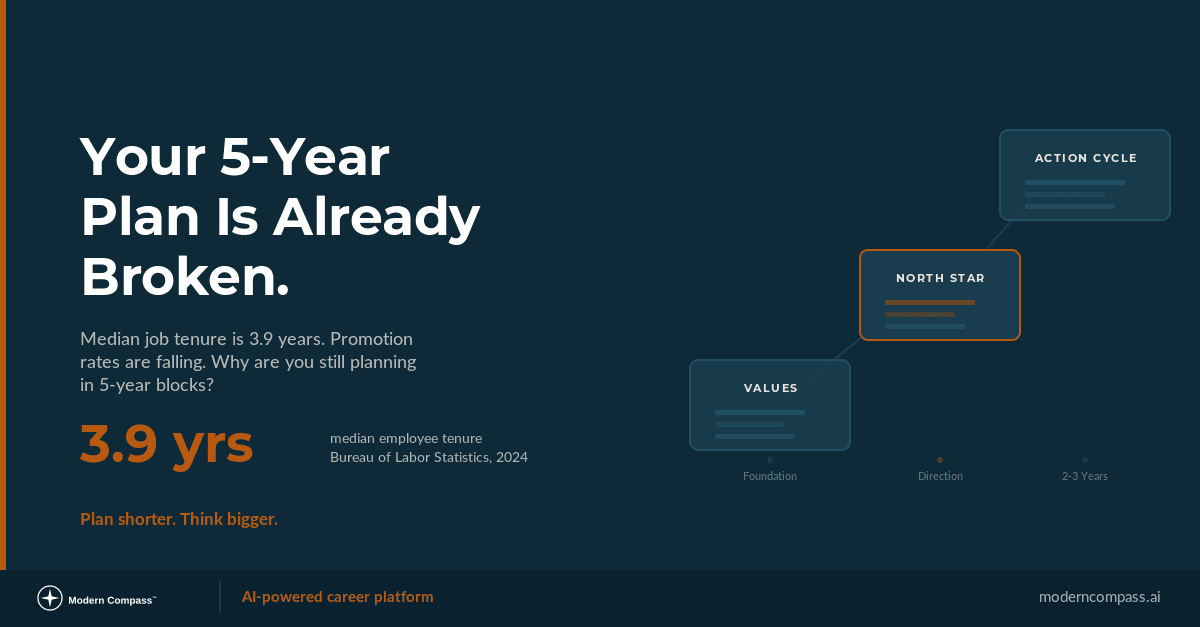
Five-year career plans are aspirational fiction for most working parents. Not because long-term ambition is wrong — it isn't — but because five years from now, the oldest kid is in middle school, your partner may have changed jobs twice, your industry will look different, and some circumstance you can't currently anticipate will have reshaped your priorities in at least one significant way.
Ninety days is a more honest planning horizon. Long enough to make real progress. Short enough to adjust when life shifts — which it will.
The setup phase of a 90-day plan has one job: identify the single biggest gap between where you are and where you want to be, and set one measurable goal to address it. Not five goals. One. The tendency to set comprehensive plans that address everything at once is one of the more reliable ways to ensure nothing gets done.
Execution is where most people stall — not because the plan was wrong, but because there's no accountability mechanism. A coach, a mentor, or a peer who checks in on progress changes this more than any productivity system.
After the quarter ends, you reassess. Values shift. Circumstances shift. The most valuable output of a 90-day cycle is sometimes the discovery that you were solving the wrong problem. That's not failure — that's good data.
Use Your Real Schedule, Not an Imaginary One
Career development advice tends to assume you have free weekday afternoons and a partner who handles pickup. You probably don't.
What most working parents actually have is fifteen minutes before the house wakes up, an occasional lunch break, and thirty minutes after the kids are asleep. The tools that fit those windows are fundamentally different from the ones that assume 90-minute sessions and half-day workshops.
Async tools aren't a consolation prize here. An AI career coach available at 10:30 PM on a Tuesday responds to what you're actually thinking about right now — not to a scheduled agenda set two weeks ago. A resume analyzer that takes a few minutes gives you specific, actionable feedback without requiring you to arrange childcare to attend an in-person workshop.
The worth-asking question isn't whether digital tools can replace human judgment. They can't. The question is whether a human coach you see for 45 minutes once a month is actually more useful than a thinking partner you can access when the problem is live and your thinking is sharp. For a lot of working parents, the answer isn't obvious in the direction they assumed.
The Resume Gap Is Rarely the Problem You Think It Is
Career gaps after parental leave tend to get handled badly in job applications — not because they're damaging, but because most people either over-explain them or try to hide them. Both signals read as anxiety rather than confidence, and experienced hiring managers notice.
The professionals who navigate this well do something simpler. They contextualize without apologizing, and they point forward rather than backward. "I took eighteen months to focus on my family and I've spent the last three months preparing for this transition" is a complete sentence. It doesn't need elaboration unless you want to offer it.
The skills worth naming are real ones. Parenting genuinely accelerates prioritization ability, comfort with ambiguity, and clarity about what actually matters versus what merely feels urgent. These aren't consolation talking points — they're transferable capacities that show up in the work. Managers who've built teams know this.
What actually damages a returning parent's candidacy isn't the gap itself. It's the apologetic register — the tone that implies they're lucky to be considered, or the defensiveness that makes a hiring manager wonder whether the person has fully committed to returning. Neither framing is honest or accurate. Name the gap, provide one sentence of context, and move forward.
What would your career decisions look like over the next ninety days if you treated what you actually want right now as a legitimate enough starting point to build from?
Strategic Career Planning: Why Your 5-Year Plan Is Already Outdated
The 5-year career plan is a relic. Build a strategic career plan with shorter cycles, values alignment, and tools that reveal what you can't see on your own.