7 Work-Life Balance Strategies That Actually Work at the Mid-Career Level
Future-Proof Your CareerFebruary 6, 20269 min read
work-life balance strategieswork-life balance for professionalswork-life integrationmid-career burnoutcareer-growthleadership
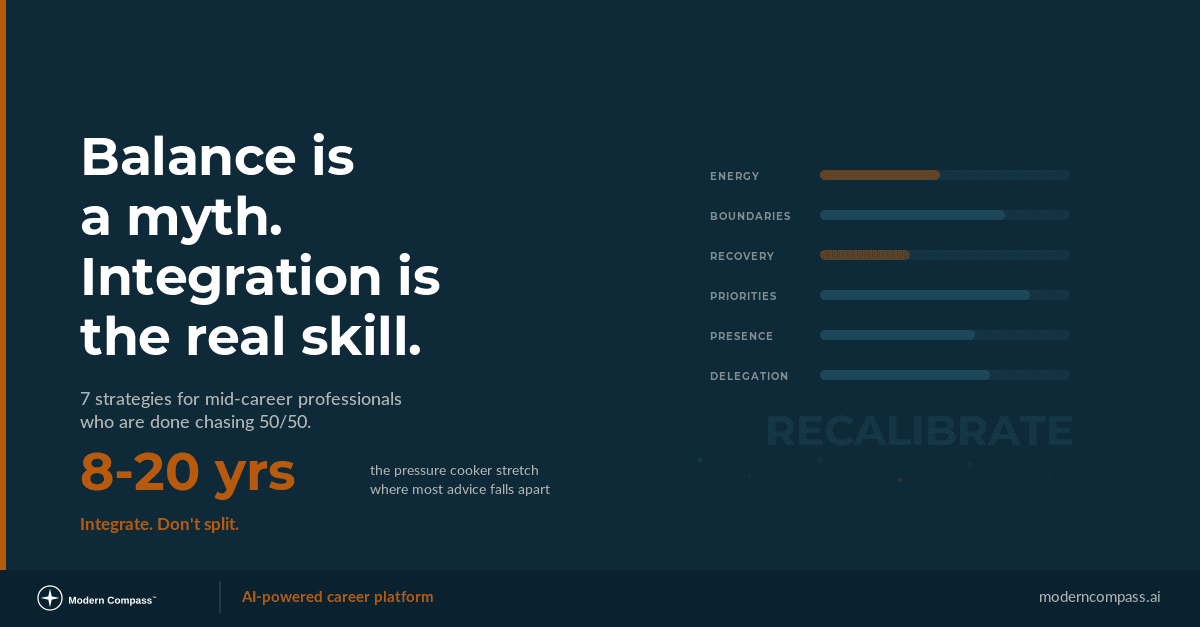
You're not burned out because you lack discipline. You're burned out because you're in the most demanding stretch of a career, and nobody warned you that the years between 8 and 20 would feel like this.
You're leading teams, delivering on aggressive timelines, and navigating organizational politics while also managing a mortgage, kids' schedules, aging parents, or all three. The "take a bubble bath" articles don't land when you've got a product launch in two weeks and your direct report just gave notice.
Most work-life balance strategies are written for people at the beginning of their careers. The advice is real but thin: set boundaries, take breaks, use your vacation days. You already know that. What you need are strategies that account for the specific pressure of mid-career leadership, where the stakes are higher, the hours are less predictable, and the sense of obligation to your team makes it genuinely hard to step away.
These seven strategies come from years of leading product and AI teams at companies like Disney, Salesforce, and Royal Caribbean, through product launches, reorgs, and the kind of peak-demand seasons that swallow weekends whole. They're also informed by patterns from hundreds of career coaching conversations with professionals navigating this exact stretch.
Work-life integration is a more realistic framework than traditional balance for mid-career professionals. Instead of chasing an even 50/50 split between work and personal life, integration means making intentional choices about where your energy goes based on current priorities, and accepting that the ratio shifts week to week.
The phrase "work-life balance" implies a clean divide: work on one side, life on the other, perfectly weighted. That framing falls apart the moment you check a Slack message while making dinner or take a personal call during a slow afternoon. If you're in a remote or flexible role where you're not bound to a desk at particular hours, the lines have already blurred. Pretending otherwise just adds guilt to the mix.
Some weeks, work gets 70% of your focus because you're launching something that matters. Other weeks, you pull back because your kid has a championship game or your partner needs support. Research from Harvard Business Review supports this: balance is a cycle you move through, not a state you achieve. The goal isn't equilibrium on any given day. It's sustainability across months and years.
This isn't permission to let work consume everything. It's permission to stop feeling guilty when the split isn't perfectly even, and to be more intentional about the seasons when you choose to lean harder in one direction.
Protect Your Non-Negotiables (and Actually Defend Them)
Identify three to five things each week that you refuse to sacrifice. Not aspirations. Non-negotiables. The difference matters. An aspiration is "I'd like to exercise more." A non-negotiable is "I run Tuesday, Thursday, and Saturday mornings before anyone in the house is awake."
Here's what a realistic non-negotiable list looks like for a mid-career professional:
Family dinner four nights a week, phones off the table
Three workouts, scheduled like meetings you can't cancel
No work email after 8 PM on weekdays
Sunday belongs to family, not to "getting ahead" on Monday
The challenge isn't identifying these. It's defending them when a VP schedules a 6 PM call or a deadline shifts and suddenly Thursday night looks like a work night. Defending non-negotiables requires saying the thing out loud to your team: "I'm offline after 8 PM unless something is truly on fire." Most of the time, nothing is truly on fire.
Set Boundaries with Technology Before It Sets Them for You
One of the most effective boundary decisions I've made is keeping a separate work phone. When I go on vacation, work doesn't follow me every time I pick up my personal phone to check the weather or text a friend. When I take a neighborhood walk as part of my recovery routine, my work stays at my desk.
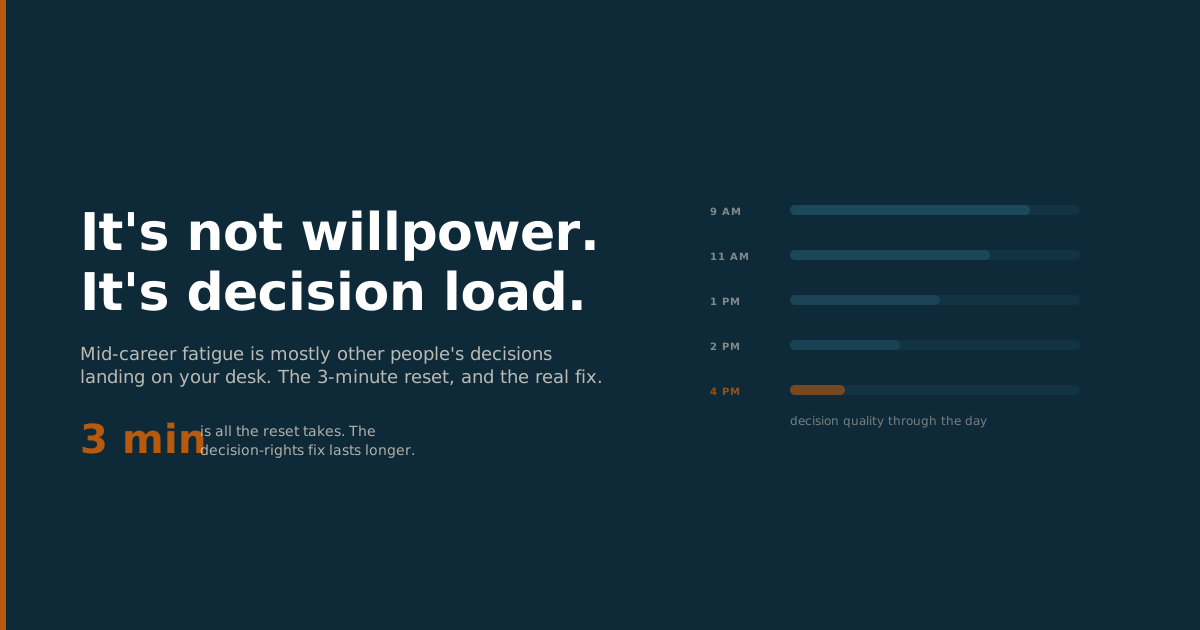
This might sound extreme, but consider what happens without it. Every notification is a context switch. Every context switch burns energy. And your brain never fully enters recovery mode if it's bracing for the next ping.
If a separate phone isn't practical, at minimum remove work email and Slack from your personal device during off-hours. Use scheduled access windows so you check in on your terms, not every time your phone buzzes. Communicate your availability clearly to your team. Most managers discover that their teams function just fine without 24/7 access, and the precedent you set protects your direct reports too.
Boundaries only work, though, when the role is structurally capable of respecting them. If you've started to suspect yours isn't, paste a posting you're curious about and your resume into the match analyzer — it gives you an honest read on whether a different role would fit the life you're protecting, and it takes about a minute.
Learn to Delegate (Even When It Feels Faster to Do It Yourself)
At the mid-career level, delegation isn't a time management trick. It's a leadership requirement. And it's hard, because the thing you need to delegate is often something you're good at, something you could finish in 20 minutes while it might take someone else two hours.
But those 20-minute tasks add up to a full day every week. And every task you hold onto is a development opportunity you're taking away from someone on your team.
Delegation extends beyond the office. Consider outsourcing the things at home that drain you but don't fill you up: cleaning, meal prep, yard work. This isn't about being lazy. It's about being strategic with a finite resource. You have the same number of hours as everyone else. Where you spend them is the only variable you control.
Use Time Blocking to Make Personal Commitments Real
Time blocking only works if you give personal blocks the same weight as work meetings. Most mid-career professionals have a calendar full of meetings they'd never cancel, and personal commitments they routinely push aside.
Block your calendar for focused work, exercise, family time, and recovery. Then treat those blocks like a meeting with your CEO. You wouldn't skip that meeting because an email came in, so don't skip your Thursday run because a project update could wait until Friday.
This requires a mental shift. You're not "taking time off" during a personal block. You're investing in what makes your work performance sustainable. A VP who exercises regularly, sleeps well, and shows up for their family makes better decisions than one running on caffeine and guilt. I've been on both sides of that equation.
Practice the Strategic "Not Now"
Every "yes" carries a hidden cost. Before committing to anything, ask three questions: Does this align with what matters most right now? What will I have to sacrifice to do this? Can someone else handle it?
Here's the nuance most advice misses: a flat "no" can be career-limiting, especially in cultures that reward availability. A more sustainable approach is "not now," framed in terms of priority. "I can't take that on this sprint, but I can pick it up in Q3 when the launch is behind us." This signals strategic thinking rather than disengagement.
It took me a long time to learn this. Early in my career, I said yes to everything because I equated availability with commitment. What I actually demonstrated was that I had no prioritization framework. The professionals who earn the most trust at the senior level are the ones who can articulate what they're choosing not to do and why.
Invest in Recovery, Not Just Productivity
Burnout doesn't come from working hard. It comes from working hard without recovering. Big difference.
Recovery isn't passive. It's a deliberate practice. A neighborhood walk without your work phone. An actual lunch break away from your desk. Using all of your vacation days, not banking them like some kind of corporate savings account.
Hobbies matter here too, especially ones completely unrelated to your career. The director who spends Saturday mornings woodworking comes back Monday with a different kind of energy than the one who spent Saturday "catching up" on email.
One thing I wish someone had told me at the ten-year mark: managing energy matters more than managing time. And one of the biggest energy drains in mid-career isn't workload. It's people. Specifically, the difficult personalities you keep trying to fix or manage around. Stop investing energy there. You'll encounter people at work who drain every room they enter. Minimize your focus on them and redirect that energy toward the people who collaborate, who build, who make the work better. You can't control difficult people. You can control where your attention goes.
Communicate with Your Partner (Weekly, Not When It's Already Too Late)
If you have a partner, weekly check-ins about schedules, upcoming demands, and how you're both feeling aren't optional. They're preventive maintenance for your relationship.
These don't need to be formal. Sunday evening, ten minutes: "Here's what my week looks like. Wednesday is going to be intense because of the board prep. Thursday I can do pickup. How are you feeling about your week?"
The goal is preventing resentment from building. Resentment grows in the gap between expectations and reality. When both partners understand what's coming, they can share the load instead of keeping score.
If you're realizing that your career dissatisfaction is bigger than a scheduling problem, that's a different conversation. The Values Prioritization assessment can help you figure out whether your current role actually aligns with what matters to you now, not what mattered five years ago.
How to Tell When You Need to Recalibrate
Work-life integration isn't something you set once and forget. It requires regular recalibration, especially during transitions: a new role, a new child, a reorg, a health scare.
Watch for these signals in yourself. Constant fatigue even when you're sleeping enough. Dreading Monday mornings consistently, not just occasionally. Missing family events you would have prioritized a year ago. Physical symptoms like tension headaches, insomnia, or a jaw you clench without noticing.
And if you manage people, watch for a subtler signal in your direct reports: the fire drill pattern. It's not always the quality of their work that dips first. More often, it's the planning. Things that should have been mapped out weeks ago are suddenly rushed, turning manageable projects into last-minute scrambles. That pattern usually means someone's bandwidth is tapped out, even if they'd never say it.
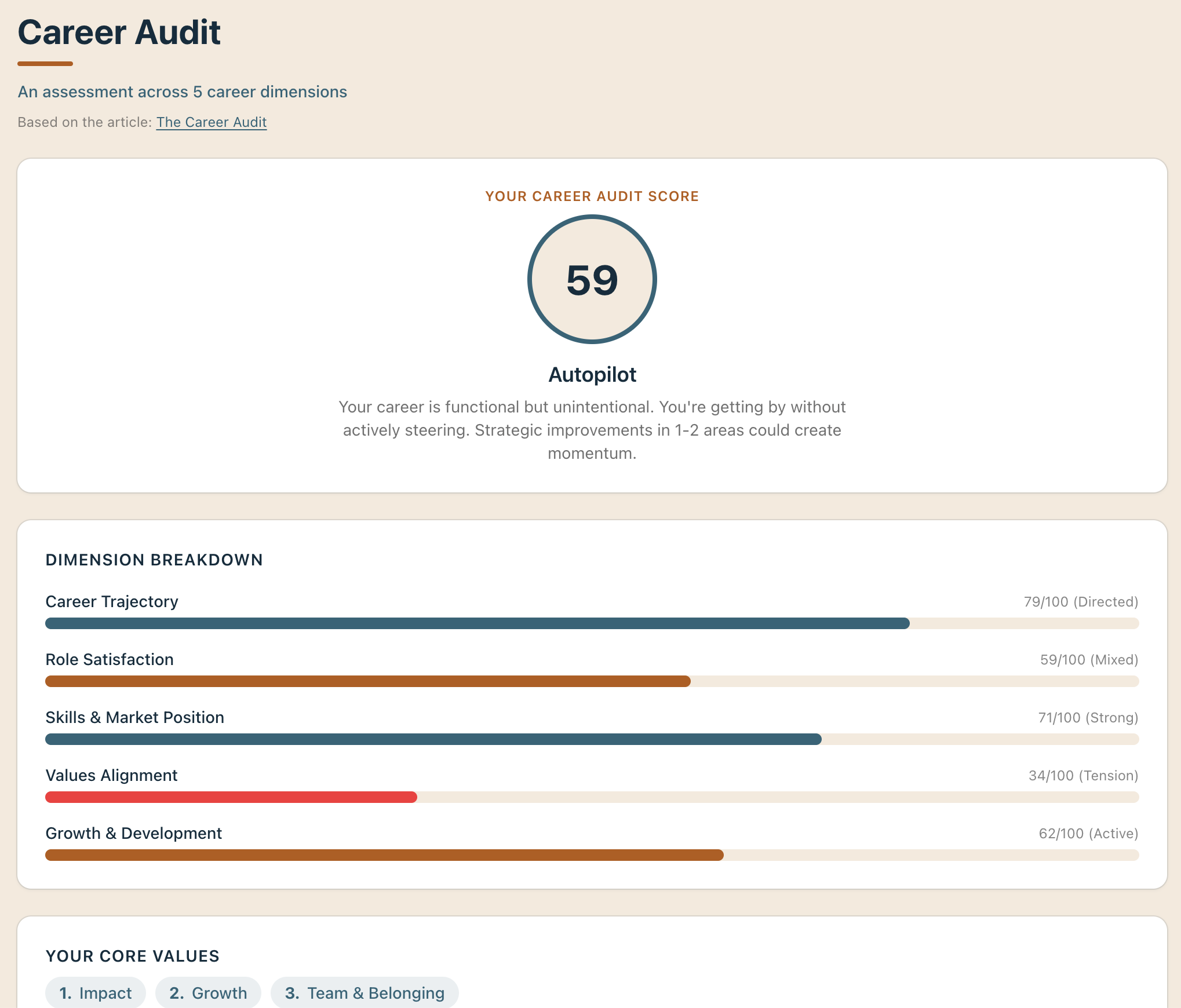
If you're noticing these signs in yourself, the Career Audit takes about ten minutes and helps you step back and evaluate where you actually stand, not where you think you stand. Sometimes the first step toward recalibrating is getting an honest read on your current situation.
Integration isn't a destination you reach. It's a practice you get better at across the different chapters of your career. Pick one strategy from this list and protect it for the next two weeks. Just one. See what shifts.
Grow as a Leader
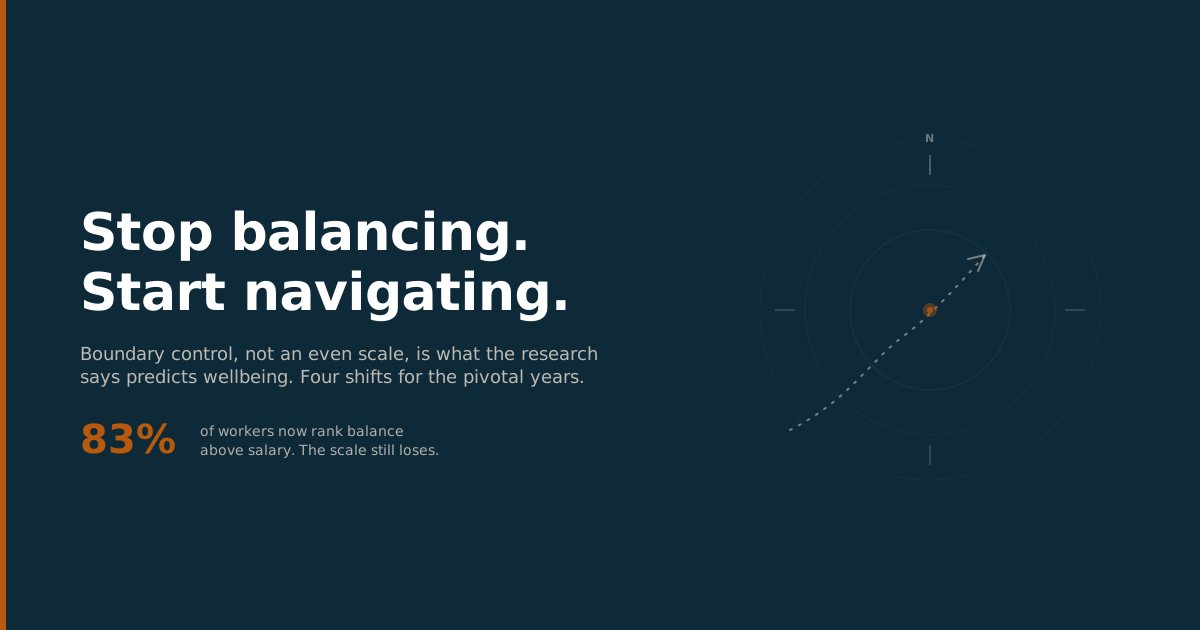
Work-Life Balance Is Dead. Long Live Work-Life Navigation
Balance asks if the scale is even. Navigation asks if you're headed somewhere on purpose. Four shifts for mid-career professionals, backed by boundary research.