You've read the headlines. 92 million jobs displaced by 2030. 76,000 positions already eliminated this year. Weekly layoffs blamed on automation. If you're mid-career with a decade or more of experience, you've probably done the math on your own role.
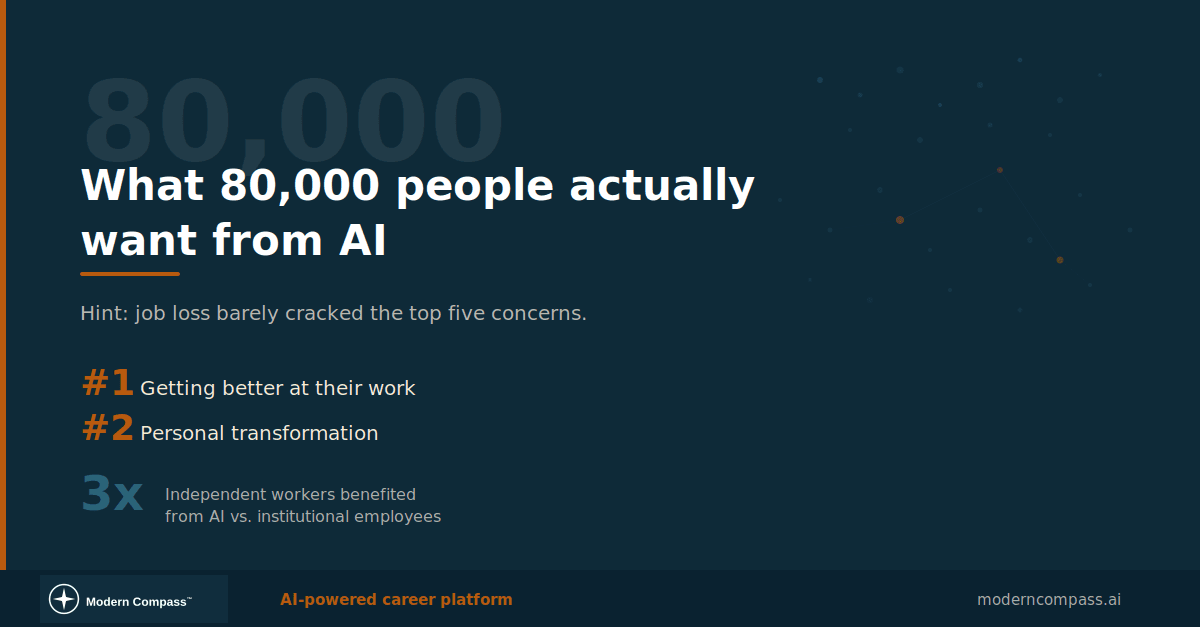
But here's what none of those headlines capture: when Anthropic asked 80,000 people across 159 countries what they want from AI, job loss barely cracked the top five concerns. The number one answer? Getting better at their work. The number two answer? Personal transformation.
The displacement narrative isn't wrong. It's incomplete. And if you're making career decisions based only on fear, you're missing the more interesting data.
The Largest Qualitative Study on AI Ever Conducted Says Something Unexpected
December 2024. Anthropic ran the largest multilingual qualitative study ever conducted. Not survey checkboxes. Open-ended conversational interviews with 80,508 Claude users in 70 languages. The methodology matters because it surfaced what people actually think, not what they select from researcher-approved lists.
The results upend everything.
When asked about their primary vision for AI, 18.8% said professional excellence: automating routine tasks so they can focus on strategic work. Another 13.7% said personal transformation: growth, emotional wellbeing, coaching support. 11.1% wanted time freedom. Only 9.7% cited financial independence. Job displacement as a concern came in at 22.3% when people were asked specifically about fears.
News coverage is dominated by the opposite story. The gap between what people actually want and what they're being told to worry about is enormous.
Fear and Hope Live in the Same Person
The most useful finding from the Anthropic study isn't a single statistic. It's this: hope and alarm coexist within the same individual rather than dividing people into optimists and pessimists.
The Anthropic study found that those who valued AI for emotional support were three times more likely to also fear becoming dependent on it. That ratio tells you everything about where mid-career professionals sit right now. The same person who uses AI to prep for a difficult conversation with their manager also worries they're losing the muscle to handle it alone.
Pew Research Center data confirms it. Among U.S. workers, 52% feel worried about AI in the workplace, but 36% simultaneously feel hopeful and 29% feel excited. Same people. Contradictory feelings.
This changes career strategy. Treat AI as purely a threat, and you optimize defensively: hoard skills, resist change, dig deeper into your current role. Treat it as purely an opportunity, and you chase every new tool without building durable capabilities. The mid-career professionals getting this right hold both realities at once.
The 3x Gap Nobody Is Talking About
One finding buried in the Anthropic data should change how mid-career professionals think about their next move: independent workers benefited from AI at three times the rate of institutional employees. 47% of independents experienced concrete AI benefits. Just 14% of traditional employees did.
Having worked inside large organizations at Disney, Salesforce, and Royal Caribbean, I can tell you exactly why this gap exists. When you're inside an enterprise, you don't get to pick the AI tool that works best for you. You get the one that survived six months of vendor evaluation, legal review, and a partnership deal negotiated by people who will never use the product. By the time it rolls out, it's been configured for the lowest common denominator across the organization, not optimized for how you actually work.
Independent workers skip all of that. They try five tools in a week. They find the one that fits their workflow, not a workflow designed by committee. They take risks that would require a business case and three approvals inside a company. And because they're solving their own problems instead of waiting for IT to solve problems on their behalf, they develop a real relationship with the technology. That's the difference. It's not that independents are smarter about AI. They just have permission to experiment.
The Jobs for the Future survey from March 2026 adds context. Worker sentiment about AI flipped negative in the past year: 44% now say AI is doing more harm than good, up from a minority position just twelve months earlier. But this aggregate hides a crucial split. The people saying AI causes harm are disproportionately those experiencing it as something done to them, not something they're doing with it.
This distinction between passive and active AI relationships may be the most important career variable of the next decade. Not whether AI takes your job. Whether you're using AI as a tool or waiting for your employer to decide how AI will be used on you.
Building an active relationship with AI can start smaller than you think. If there's a role you're weighing right now — or one you're wondering whether you can hold onto — paste the posting and your resume into the match analyzer and get a coach-voiced read on where you actually stand. Free, no account, about a minute.
AI Coaching Isn't a Gimmick. It's What People Asked For.
The part that surprised me most about the Anthropic data: when 80,000 people described their ideal AI future, 13.7% described something that sounds exactly like career coaching. Personal transformation. Growth support. Emotional wellbeing. Another 6.1% said AI had already delivered meaningful emotional support and judgment-free guidance.
Recent research from The Conference Board validates this from the other direction. Their study found AI can deliver approximately 90% of day-to-day coaching functions. 89% of users said their AI coaching sessions produced specific, useful next steps. Skill development speed increased 2.7x compared to self-study.
But clear limits exist. Human coaches remain essential for emotionally charged discussions, working through organizational politics, and senior executive contexts where the stakes are high and the variables are deeply personal.
This isn't either/or. The most effective model emerging from the research is hybrid. AI handles routine check-ins, skill practice, accountability, and pattern recognition. Humans step in for the messy, political, high-stakes moments that require judgment shaped by lived experience.
The Anthropic data backs this up structurally. Coaching sessions that produced specific next steps showed 89% satisfaction. But the study also found that 18.9% of respondents reported unmet expectations, mostly around reliability and capability gaps. The hybrid model works precisely because it covers for AI's weaknesses while scaling its strengths.
For mid-career professionals, this reframes the question entirely. Not "will AI replace my job?". The better question: am I using AI to get better at my job before someone else uses it to make my role redundant?
What the Regional Data Reveals About Career Positioning
The Anthropic study's geographic breakdown contains a strategic insight that most coverage has missed.
In wealthier regions like North America and Western Europe, people wanted AI for life management: reducing complexity, organizing information, reclaiming bandwidth. In developing economies, particularly Sub-Saharan Africa and Latin America, the dominant theme was entrepreneurship. Using AI to bypass traditional capital requirements and build businesses.
The optimism gap is striking. Sub-Saharan Africa showed 75.8% positive sentiment toward AI. Western Europe showed 64.4%. North America's job displacement concerns (24.6%) were nearly double those in Central Asia (15.9%).
If you're a mid-career professional in the U.S. or Europe, your anxiety is partly cultural, not just rational. You're operating in an environment where the narrative is disproportionately fear-based compared to global sentiment. That doesn't mean the fears are wrong. It means the fears are getting more airtime than the opportunities, and that asymmetry distorts career decisions.
This data is exactly why I built Modern Compass with AI career coaching as the center of the platform, not resume generation or job analysis. Look at the top three things people want from AI: professional excellence (18.8%), personal transformation (13.7%), and life management (13.5%). Add time freedom (11.1%) and you're looking at over 57% of people describing some version of "help me manage my career and my life better."
Resume building, job analysis, cover letter generation, those are all means to an end. The end is personal transformation. It's getting your time back. It's feeling like your career is moving in a direction you chose, not one that happened to you. A career coaching AI that understands your full picture and connects the dots between your resume, your job search, and your growth goals, that's what 80,000 people described when they were given a blank page. They just didn't use the word "coaching."
Stop Asking If AI Will Take Your Job. Start Asking What You Want from AI.
The Anthropic study's most powerful contribution isn't any single data point. It's the reframing. When 80,000 people were given an open-ended prompt, roughly one-third of their visions centered on making room for life: time, money, bandwidth. About one-quarter involved doing better work. One-fifth focused on personal growth.
Nobody described wanting to be displaced. Almost nobody described wanting to hide from AI either.
The mid-career professionals who will thrive in the next five years aren't the ones with the best "AI-proof" skills. They're the ones who answered "what do I want from AI?" with something specific and then started building that relationship.
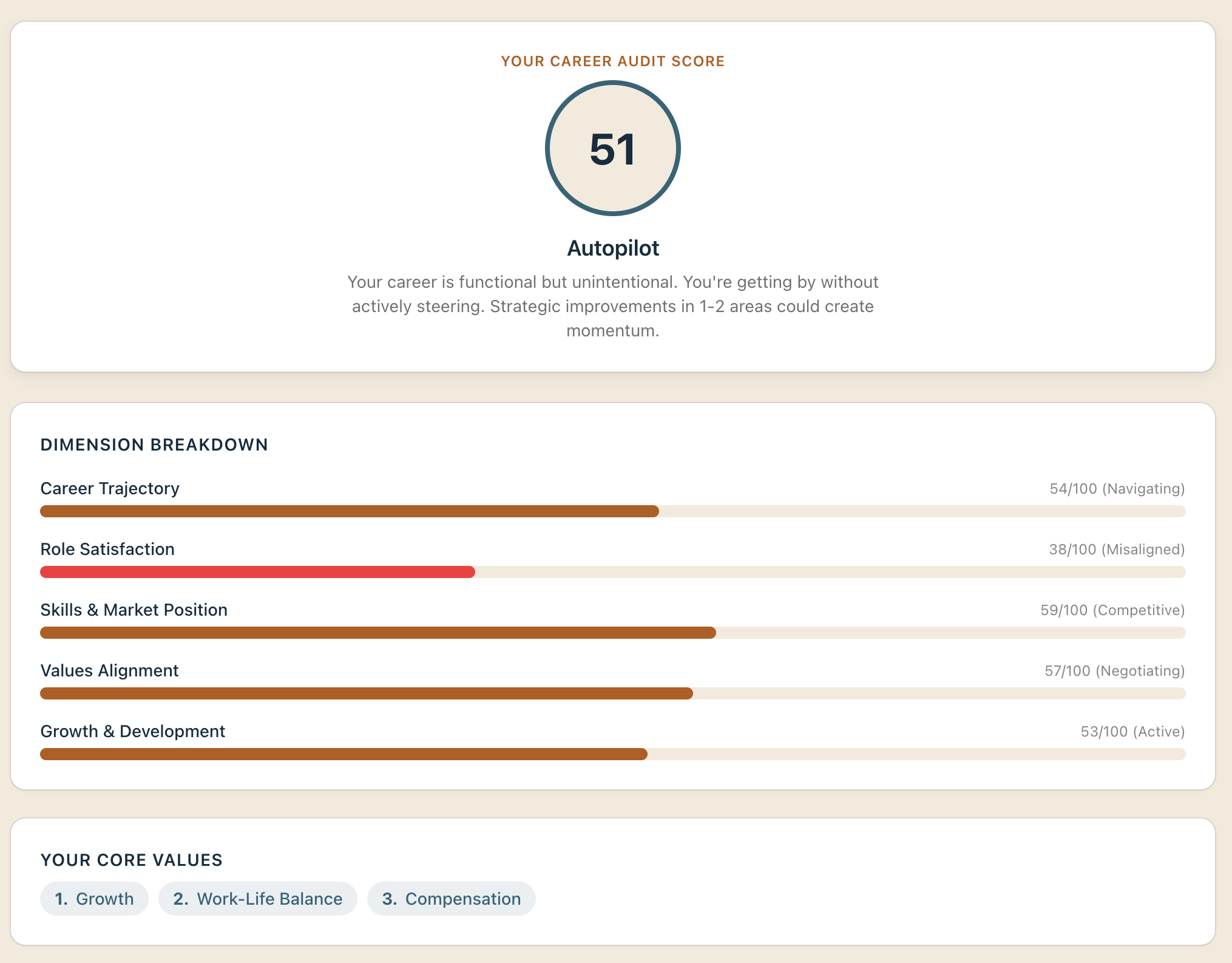
If you haven't articulated your own answer yet, the Career Audit is a good place to start. Ten minutes. Free. It gives you a structured look at where AI fits into your career trajectory. Not as a threat to plan around. As a tool to plan with.