AI Readiness Assessment: How Prepared Is Your Career for the AI Era?
Evaluate your AI fluency across 4 dimensions and get a personalized action plan for staying competitive.
AI is reshaping every industry, and the professionals who thrive will be those who understand how to work alongside it. The AI Fluency Assessment measures your current readiness across four key dimensions, from foundational understanding to strategic vision, so you know exactly where to invest your development time.
Know if you're a match before you apply.
Paste a job description and see how your background scores. Free, no account needed.
What You'll Discover
Dimensions Measured
Foundational Literacy
Your understanding of core AI concepts, terminology, and how AI systems work at a high level.
Practical Application
How effectively you are using AI tools in your actual day-to-day work.
Critical Evaluation
Your ability to assess AI outputs, identify limitations, and make informed decisions about when to trust AI.
Strategic Vision
How well you can anticipate AI's impact on your industry and position yourself for emerging opportunities.
Who This Is For
Built for Mid-Career Professionals
Mid-career professionals wondering whether AI is a threat or an opportunity
Get a clear picture of your current AI readiness and a concrete path forward, regardless of your technical background.
Leaders and managers who need to guide their teams through AI adoption
Understanding your own AI fluency is the first step to leading your team through the transition effectively.
Career changers who want to understand how AI fluency factors into their target field
AI expectations vary by industry and role. This assessment helps you calibrate your preparation for where you are heading.
Anyone who uses AI tools casually but is not sure they are keeping pace
There is a difference between using AI occasionally and being truly AI-fluent. This tool reveals the gap.
Begin Your AI Fluency Assessment
AI Fluency Self-Assessment
Find out where you actually stand, not where you think you stand.
Based on the article: Your AI Fluency Matters More Than Your Job Title Right Now
Why This Matters
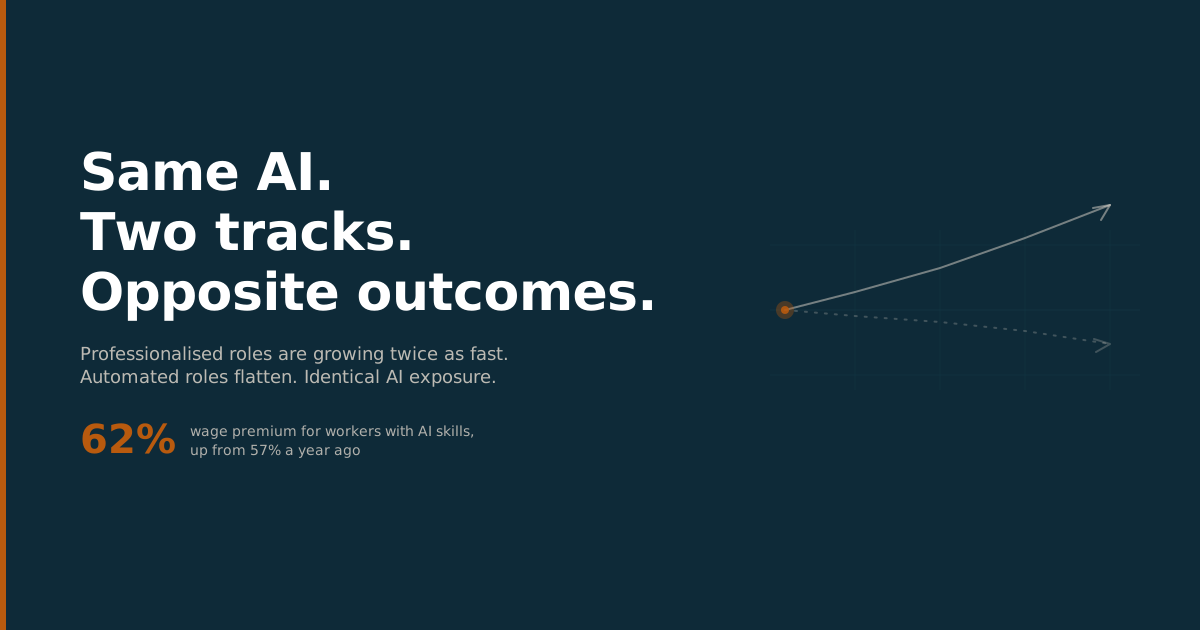
Workers with AI skills command a 56% wage premium. Demand for AI fluency in job postings has grown sevenfold in two years. But most professionals overestimate their readiness because they're benchmarking against the wrong standard. This assessment evaluates four distinct dimensions of AI fluency using workplace scenarios, not trivia questions, to show you exactly where to focus.
How to Use This
Work through 16 workplace scenarios, four for each dimension. Pick the response that honestly reflects how you'd handle the situation today, not the answer that sounds best. The value of this is in its honesty. Takes about 10 minutes.
Conceptual Understanding
Not whether you can define "machine learning" for a cocktail party, but whether you understand enough about how these systems work to make sound decisions about when to trust them and when not to. Can you explain why AI hallucinates? Do you know what a model can and can't do before you hand it a task? This is the foundation everything else builds on.
A colleague shares an AI-generated market analysis and says, "The AI confirmed our strategy is working." The analysis includes specific revenue projections for next quarter.
What's your most honest reaction?
Your CEO announces the company is investing in "agentic AI" for operations. In the all-hands Q&A, someone asks what that means for day-to-day workflows.
How equipped are you to contribute to this conversation?
Your organization is evaluating two AI tools: one claims 95% accuracy, the other 88% on the same task. Leadership leans toward the 95% option.
What would you add to this decision?
A team member says they've been using AI to draft client communications. Another raises a concern about confidentiality.
How would you guide this conversation?
Hands-On Proficiency
Beyond asking ChatGPT to rewrite an email. Can you write prompts that reliably produce useful output? Have you built a workflow that actually saves you hours, not minutes? Do you know multiple tools and when each one is the right choice? The gap between casual use and genuine proficiency is where most mid-career professionals stall out.
You need to prepare a competitive analysis report by end of week. You have access to AI tools but no specific training on using them for research.
How would you approach this task with AI?
You ask an AI tool to summarize a long internal document, and the summary includes a statistic you don't recognize from the original.
What do you do?
Your team wants to automate a weekly reporting process that currently takes you about three hours every Monday morning.
What's your realistic capability here?
A vendor demos an AI tool that could help your department. The sales team makes impressive claims.
How do you evaluate whether it will actually work for your team?
Strategic Vision
This is the dimension that separates people who use AI from people who lead with it. Can you look at your department, your company, your industry and identify where AI creates the biggest shifts in the next two to three years? Your ability to connect AI capabilities to unsolved business problems is career capital that compounds faster than any technical skill.
Leadership asks each department head to identify three processes that could benefit from AI within the next year.
How prepared are you to answer?
You're reading an industry report about how AI will affect your sector. It predicts significant changes to the types of roles most valuable in 3-5 years.
How do you process this relative to your own career?
Your company acquires a startup with strong AI capabilities. You're invited to a cross-functional integration meeting.
What's the quality of contribution you'd bring?
A junior employee on your team is using AI to complete work that previously required your level of expertise.
What's your honest internal response, and what do you do?
Ethical & Critical Judgment
As AI gets more capable, the people organizations trust most won't be the ones who use AI fastest. They'll be the ones who use it most wisely. Can you spot bias in outputs? Do you understand the privacy implications of feeding company data into different tools? Do you know where human judgment is non-negotiable?
Your team considers using AI to screen job applicants. The tool promises to reduce time-to-hire by 60%.
What concerns would you raise, if any?
You realize a widely-used AI tool in your department sometimes produces outputs reflecting cultural biases, consistently using male pronouns for leadership roles.
How do you handle this?
A client asks you to use AI to analyze their customer feedback data. The data includes names, emails, and detailed personal complaints.
What's your process before you start?
You discover a team member has been using AI to generate performance reviews for their direct reports without telling anyone.
How do you respond?
Your Coach
A coach in your corner

A coach in your corner
See your match score first — then Coach Maya can help you decide whether the role is right for you and how to make your move.
FAQ
Frequently Asked Questions
AI is reshaping roles across every industry. Professionals who understand how to work alongside AI tools (and think critically about their output) are increasingly preferred for leadership roles, promotions, and new opportunities. This assessment helps you see where you stand.
AI fluency is about professional competence with AI, not engineering skills. You do not need to build machine learning models. Fluency means knowing when and how to use AI tools effectively, evaluating their output critically, and understanding their strategic implications for your work.
Your score reflects your self-reported comfort and capability across 4 dimensions: Foundational Literacy, Practical Application, Critical Evaluation, and Strategic Vision. Each is scored as a percentage, with your overall score as a weighted average.
There is no universal target; it depends on your role and industry. Generally, scores above 70% suggest strong AI readiness, while scores below 40% in any dimension indicate an area worth developing. The results include specific guidance based on your score pattern.
Especially so. AI is transforming non-technical roles faster than many realize: marketing, HR, finance, legal, healthcare, and education are all being reshaped. This assessment is designed for professionals across all industries, not just tech workers.
Your results include targeted recommendations based on your weakest dimensions. Common next steps include experimenting with AI tools in your workflow, taking short courses on AI concepts, and discussing AI strategy with a career coach who can help you build a development plan.
Explore More
Continue Your Self-Discovery
Career Quick Check
AI readiness is one piece. Check whether the rest of your career dimensions are keeping pace.
~5 minutes
Communication Style
AI fluency changes how you work. Now assess whether how you communicate is keeping up.
~5-7 minutes
Career Audit
Put your AI readiness in context with a full career audit across skills, trajectory, and growth.
~15-20 minutes