A director of operations at a mid-size logistics company told me something last month that stopped me cold. She said she felt like she was watching her own career split into two timelines: one where she figured out AI and stayed relevant, and one where she didn't and slowly became the person younger colleagues routed around.
She has fifteen years of experience. An MBA. A track record of promotions. None of that insulated her from the creeping awareness that the ground beneath her professional identity was shifting.
She is not alone, and her instinct is backed by hard numbers.
The Numbers That Should Change How You Think About Your Career
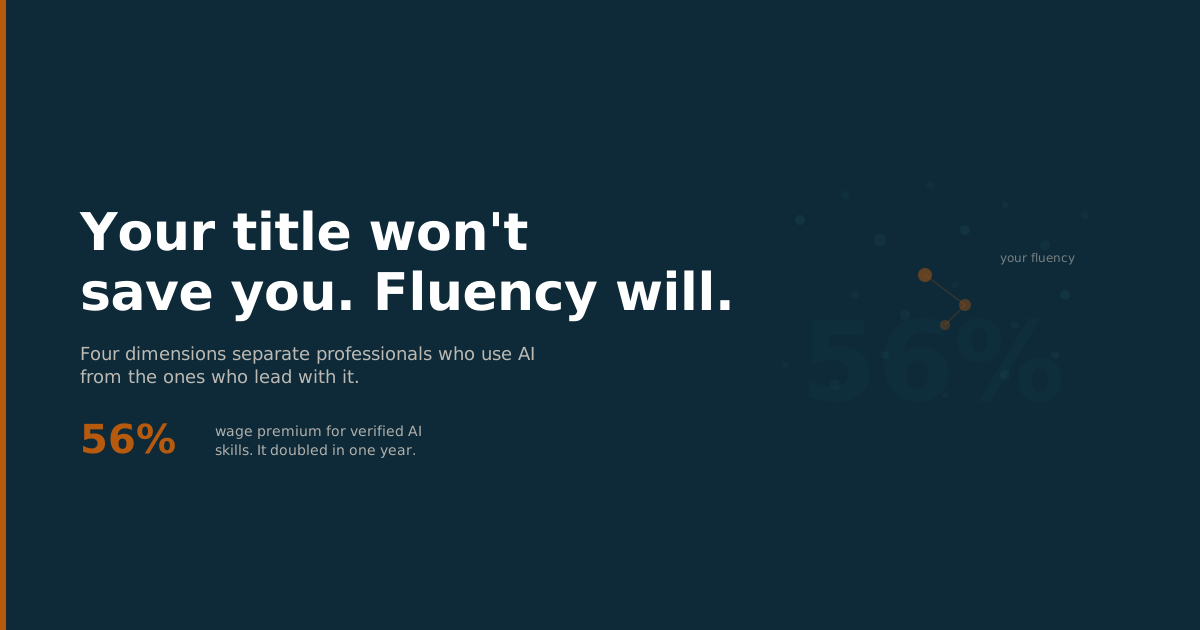
According to PwC's 2025 Global AI Jobs Barometer, which analyzed close to a billion job ads across six continents, workers with AI skills now command a 56% wage premium over peers in the same roles who lack those skills. That number doubled in a single year. Not over a decade. One year.
Meanwhile, the skills employers seek in AI-exposed roles are changing 66% faster than in other positions. If your job touches data, analysis, communication, or decision-making, you are in an AI-exposed role, whether your company has formally acknowledged it or not.
McKinsey's research paints an even more striking picture of how quickly the floor is moving. In 2023, roughly one million workers held jobs where AI fluency appeared as an explicit requirement in postings. By 2025, that number had grown to seven million. A sevenfold increase in two years.
Yet here's where it gets uncomfortable. Universum's Talent Outlook research found that only 6% of employees feel "very comfortable" using AI in their current roles, while nearly a third report feeling distinctly uncomfortable. Most people occupy a murky middle ground: aware that AI matters, dabbling with a tool here and there, but lacking any real confidence that they understand what they're doing or why.
One of the most revealing data points from McKinsey's 2025 workplace report isn't about technology at all. It's about perception. When C-suite leaders were asked what percentage of their employees use generative AI for at least 30% of daily work, they guessed 4%. The actual number, self-reported by employees, was three times higher.
Leaders are underestimating how much AI their people already use. Employees, meanwhile, are underestimating how much more they'll need to use. Almost half of workers surveyed believe AI will handle 30% of their tasks within a year. Their bosses? Only 20% see it coming that fast.
This double perception gap creates a dangerous vacuum. Companies aren't providing training because leadership doesn't realize how far things have already moved. Employees aren't asking for training because they're teaching themselves with YouTube videos and hope. About 75% of knowledge workers already use AI tools in some form, according to Microsoft and LinkedIn's research, and 78% of those people brought the tools in themselves without any formal company deployment.
You are likely already using AI. The question is whether you're using it well.
Here's a fast way to find out what "well" means for your role: pull up a current posting for your job — or the one you want next — and paste it with your resume into the match analyzer. The distance between what the posting asks for and what your resume shows is your actual fluency gap, in the market's own words.
Why "I Use ChatGPT Sometimes" Isn't AI Fluency
There's a meaningful difference between using an AI tool and understanding what you're doing with it. Pluralsight reported that 79% of executives and IT professionals admitted to overstating their AI knowledge. That statistic might sound like an executive problem, but it reflects a pattern that runs through every level of organizations. People conflate familiarity with capability.
Asking ChatGPT to rewrite an email is not the same as understanding which tasks in your workflow AI can meaningfully improve. Generating a summary of a report is not the same as knowing how to evaluate whether that summary missed something critical. Using an AI coding assistant doesn't mean you grasp the security implications of the code it produces.
True AI fluency spans four distinct dimensions, and most mid-career professionals have developed unevenly across them:
Conceptual Understanding
Do you actually know what large language models do and don't do? Can you explain to a colleague why AI "hallucinates" and what that means for trusting its outputs? Understanding the basics of how these systems work, not at an engineering level but at a practical reasoning level, changes how you use them. It's the difference between driving a car and understanding that ice makes roads slippery.
Hands-On Tool Proficiency
Beyond casual use, can you write an effective prompt that produces reliable results? Have you experimented with more than one AI platform? Do you know how to use AI for research, analysis, content creation, and workflow automation in ways that actually save you meaningful time?
Strategic Vision
Can you look at your department, your company, or your industry and identify where AI will create the biggest shifts in the next two to three years? This is the dimension that separates people who use AI from people who lead with it. Your ability to see around corners, to connect AI capabilities with business problems your organization hasn't solved yet, is career capital that compounds.
Ethical and Critical Judgment
Do you know when not to use AI? Can you spot bias in AI outputs? Do you understand the privacy implications of feeding company data into various tools? As AI becomes more capable, the people organizations trust most won't be the ones who use AI the fastest. They'll be the ones who use it most wisely.
The Career Opportunity Hiding Inside the Skills Gap
IDC projects that global skills shortages could cost the economy $5.5 trillion by 2026 through product delays, quality failures, missed revenue, and lost competitiveness. Over 90% of global enterprises will face critical skills shortages. That's a staggering problem for organizations. For you, individually, it's an opening.
Consider what happens when demand far outstrips supply. The World Economic Forum reported that AI represented 67.5% of learning priorities across industries and markets as of late 2025. Companies desperately want people who can bridge the gap between "we bought the AI tools" and "someone actually knows how to make them useful." PwC's data showed that industries most exposed to AI are seeing productivity growth nearly four times higher than those least exposed. Revenue per employee is growing three times faster. The organizations winning this race aren't the ones with the fanciest technology stack. They're the ones whose people figured out how to work differently.
If you're a mid-career professional with domain expertise and you layer genuine AI fluency on top of that, you become exactly the person these organizations are searching for. Not an AI engineer. Not a data scientist. A capable professional who understands both their field and how AI changes what's possible within it.
An Honest Self-Assessment Is Where This Starts
Before you can build a plan, you need an unvarnished look at where you actually stand. Not where you think you stand, and not the version you'd put on LinkedIn. Most professionals overestimate their AI readiness because they're comparing themselves to the wrong benchmark. Your reference point shouldn't be "do I know more than my colleague who has never opened ChatGPT." It should be "am I developing the capabilities my role will require in 18 months?"
We built the Modern Compass AI Fluency Self-Assessment around the four dimensions outlined above. Rather than asking surface-level multiple choice questions, it presents scenario-based situations drawn from real workplace contexts. When your team is asked to evaluate an AI vendor, what's your first move? When a direct report shares AI-generated analysis in a meeting, how do you evaluate its reliability? When leadership asks which processes in your department could benefit from AI, can you give a specific, informed answer?
The assessment produces a personalized fluency profile that maps your strengths and gaps across all four dimensions. No single score, because a single score would hide the nuance that matters. Someone with deep conceptual understanding but limited hands-on experience needs a completely different development path than someone who uses AI daily but can't think strategically about its implications for their industry.
After completing the assessment, resist the urge to immediately sign up for five online courses. The professionals who develop AI fluency most effectively don't try to learn everything at once. They identify the single dimension where closing the gap would create the most leverage in their current role, and they focus there first.
If your conceptual understanding is weak, spend two weeks reading and watching foundational content about how large language models actually work. Not a computer science course. Practical explanations aimed at business professionals.
If your hands-on skills lag behind, pick one recurring task in your weekly workflow and commit to doing it with AI for the next 30 days. Track what works and what doesn't.
If strategic vision is your gap, start a simple habit: every time you read an industry article, ask yourself "where does AI intersect with this?" Write down your observations. Within a month, patterns will emerge that your peers haven't noticed.
If ethical judgment needs work, pay attention to AI failures in the news. Read about bias incidents, privacy breaches, and the companies that handled them well versus those that didn't. Build a personal framework for when you will and won't use AI for sensitive decisions.
The logistics director I mentioned at the start? She took the assessment, discovered her strategic vision was far stronger than she expected but her hands-on skills were holding her back. Three months of focused experimentation later, she led an AI implementation project for her supply chain team that reduced forecasting errors by 22%. Her boss asked where she'd been hiding this expertise.
She hadn't been hiding anything. She'd just finally closed the gap between knowing AI mattered and knowing how to make it matter for her.
Sources: PwC 2025 Global AI Jobs Barometer; McKinsey "Superagency in the Workplace" (Jan 2025); McKinsey Global Institute "Agents, Robots, and Us" (Nov 2025); IDC "Closing the Gap: Verifying AI Skills in the Enterprise" (2025); Universum Talent Outlook 2025; World Economic Forum "The AI Perception Gap" (Jan 2026); Pluralsight AI skills confidence survey (2025); Microsoft and LinkedIn 2024 Work Trend Index.