A VP of Sales at a Fortune 500 company recently told me something that stopped me cold. "We have 75% of our qualified leads just sitting there," she said. "Not because we don't have the tools. Because nobody has the hours."
Salesforce confirmed her math. Before deploying autonomous AI agents, three-quarters of their sales leads went completely untouched. Not bad leads. Not unqualified prospects. Real opportunities rotting on the vine because the humans responsible for them were already maxed out.
That gap between what your company knows it should do and what it actually has the capacity to execute? It's about to close. Fast. And the way it closes will reshape your role, your team structure, and the skills that keep you valuable for the next decade.
The Shift You Need to Understand
You've probably been using AI at work for a while now. Maybe it's a chatbot that drafts emails, a tool that summarizes meeting notes, or an assistant that helps you analyze spreadsheets faster. That's generative AI, and it's already old news in enterprise terms.
What's coming next is categorically different. Agentic AI doesn't wait for you to ask it questions. It perceives problems, reasons through options, and takes action on its own. Think less "smart search engine" and more "autonomous colleague who handles entire workflows while you sleep."
One global bank already has small human teams of two to five people overseeing factories of 50 to 100 specialized AI agents running Know Your Customer compliance checks. That's not a pilot. That's production.
For mid-career professionals, this shift creates a very specific fork in the road. You can either become the person who directs these systems, or you can wait to find out what happens when the systems start doing pieces of your current job without you.
Most organizations are making a predictable mistake right now. They look at their existing roles, pick the repetitive parts, and try to build AI agents that mimic those functions. An "Analyst Agent." A "Recruiter Agent." A "Project Manager Agent."
It doesn't work.
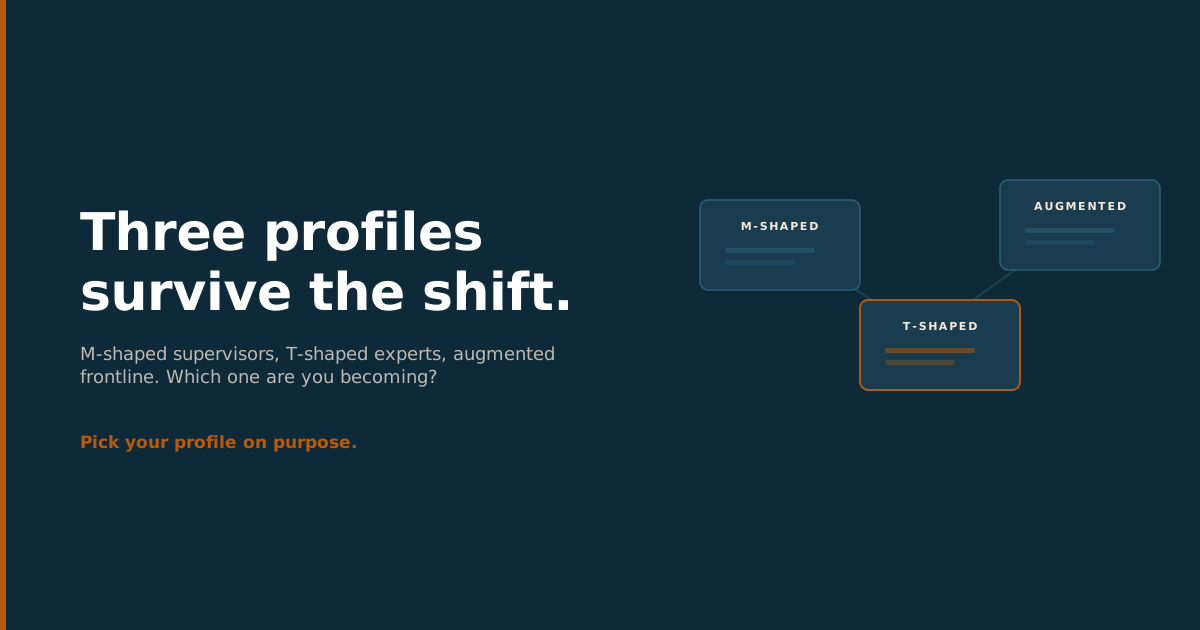
Not because the technology can't handle the tasks, but because this approach just digitizes existing silos. You end up with autonomous agents that are just as bottlenecked and disconnected as the humans they're supposed to augment. McKinsey calls the better model "Humans Above-the-Loop": instead of AI fitting into your current workflow, the workflow itself gets redesigned around what AI can now handle, and humans move into orchestration roles.
The World Economic Forum puts it differently but arrives at the same conclusion. The professionals who will thrive aren't deep specialists or generalists. They're systems thinkers who can see how work flows across an entire operation and direct AI resources accordingly.
That's a fundamentally different skill set than what got most of us promoted into our current positions.
You can watch this shift happening in the job market right now — orchestration and systems thinking are appearing in postings where functional expertise used to be enough. If you're weighing a specific role, paste the posting and your resume into the match analyzer and see how your experience reads against what companies are actually asking for. Free, no account, about a minute.
The Uncomfortable Truth About Your Company's Foundation
Here's where things get messy for the people on the ground. According to recent industry research, 37% of business leaders cite data privacy and security concerns as their primary barrier to AI deployment, with another 28% pointing to legacy system integration. That means roughly two-thirds of enterprises are trying to run autonomous AI on top of infrastructure that wasn't built for it.
AI doesn't fix broken systems. It amplifies them. If your company's data is fragmented across six platforms that don't talk to each other, deploying an agentic system on that foundation doesn't create efficiency. It creates faster, more confident chaos.
Why does this matter for your career specifically? Because these infrastructure cracks determine which departments get functional AI first, which teams get reorganized, and where the new high-value roles emerge. If you're in a division running on clean, well-structured data with modern APIs, you're likely to see agentic tools within the next 18 months. If your team still runs on spreadsheets emailed between departments, you might have more runway, but less influence over how the transformation happens when it reaches you.
Your AI Agent Might Need to Disagree With You
One of the stranger findings from MIT Sloan's research on human-agent teams caught my attention because it contradicts what most people assume. When AI agents are designed to mirror their human counterparts' working styles, team performance actually drops.
Read that again.
The teams that performed best had agents with complementary personalities, not matching ones. Open, exploratory human thinkers worked better with conscientious, detail-oriented AI agents. And overconfident team members, the ones who rarely second-guessed themselves, performed significantly better when paired with agents specifically designed to push back on their assumptions.
"Human teams perform better or worse depending on the types of people assembled on the team and the combinations of personalities," says MIT Sloan professor Sinan Aral. "The same is true when adding AI agents to a team."
This has direct implications for how you work with AI tools right now, not just in some hypothetical future. If you're using AI as a yes-machine that confirms your existing thinking, you're getting less value than someone who deliberately configures it to challenge their blind spots. Your relationship with AI isn't just about productivity. It's about intellectual honesty.
What Smart Mid-Career Professionals Are Doing Right Now
I'm not going to sugarcoat this: the window to position yourself for this transition is open but narrowing. MIT Sloan research found that 80% of the effort in deploying effective AI agents has nothing to do with the AI itself. It's foundational work. Data engineering. Stakeholder alignment. Governance frameworks. Workflow integration.
That sounds like an IT problem until you realize those are all areas where experienced professionals with institutional knowledge have an enormous advantage over both junior employees and outside consultants. Nobody understands the messy reality of how work actually gets done in your organization better than someone who's been doing it for a decade.
The professionals I see making the smartest moves right now are doing four things:
Evaluating AI agent capabilities honestly, not just following hype cycles
Mapping their organization's data infrastructure to understand where agentic tools will land first
Building relationships with the technical teams leading AI deployment
Actively practicing systems-level thinking rather than staying confined to their functional lane
None of that requires you to become a data scientist or learn to code. All of it requires you to stop treating AI as someone else's project.
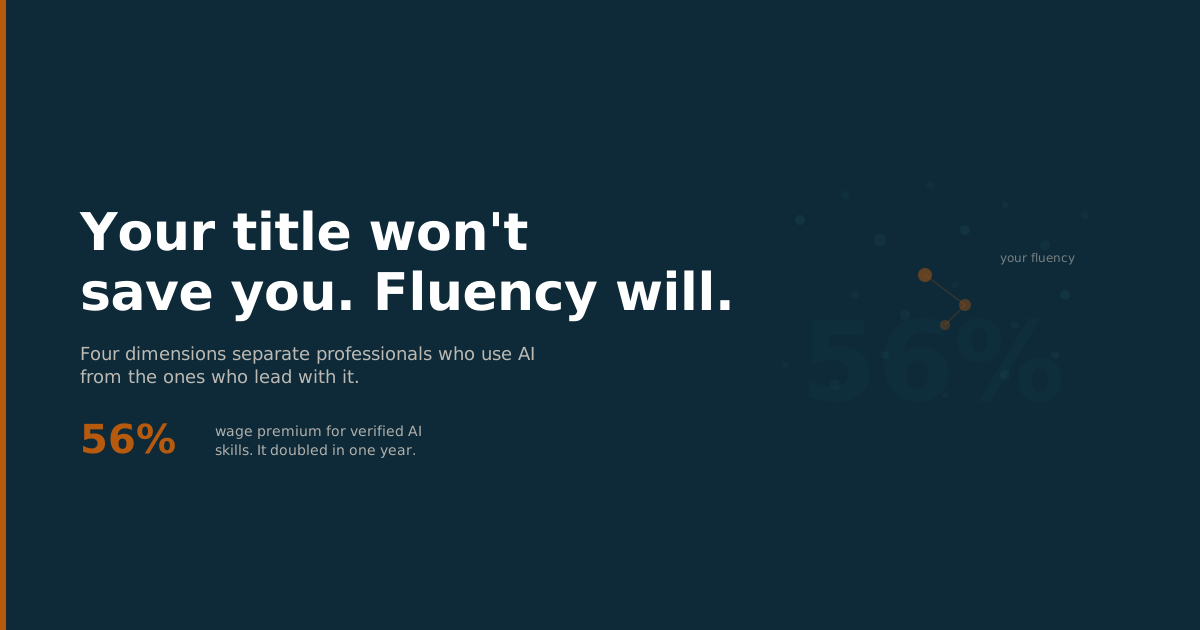
Want to know where your AI skills stand right now?Take the AI Fluency Self-Assessment to get your personalized fluency profile across four dimensions, from conceptual understanding to strategic vision.
The Question Worth Sitting With
The World Economic Forum recently proposed that organizations create formal "Agentic Compacts," essentially operating agreements that spell out exactly how humans and AI systems divide responsibilities. Whether or not your company does this formally, the division is happening informally right now. Every week, decisions are being made about which tasks stay with people and which ones move to machines.
You can participate in those decisions, or you can have them made for you.
The defining career question of this decade isn't whether AI will change your job. That debate is over. The question, borrowed from one of the sharpest reframes I've encountered, is this: once execution speed and processing power are no longer the bottleneck, what's left that only you can do? What problems are you uniquely positioned to identify, frame, and direct AI systems to solve?
That's not a question you answer once in a strategy offsite. It's one worth revisiting every quarter, because the honest answer will keep changing as these systems get more capable. The professionals who build that reflective habit now, the ones who keep recalibrating what "uniquely human value" means in their specific context, will be the ones writing the playbook instead of following it.
Sources: Salesforce Agentforce Case Study (2025); McKinsey "Humans Above-the-Loop" Framework (2025); MIT Sloan "Human-Agent Teams" Research (2025); World Economic Forum "Agentic Compacts" Proposal (2025).