A senior operations manager at a mid-size logistics company told me something last year that I haven't been able to shake. She said, "I spent twelve years becoming the best person in this building at pulling reports, reconciling data, and building dashboards for leadership. And now my company just deployed three AI agents that do all of it in forty-five minutes." She wasn't panicking. She was genuinely confused about what her job was supposed to be next.
That confusion is spreading fast, and it's hitting mid-career professionals hardest. Not because they lack talent or adaptability, but because the rules of professional value are being rewritten in real time. McKinsey's 2025 State of AI report found that 88% of organizations now use AI in at least one business function, with 62% already experimenting with AI agents specifically. The length of tasks AI can reliably complete has been doubling roughly every four months since 2024. By 2027, AI systems may be capable of completing four full days of unsupervised work.
Read that again. Four days without a human checking in.
This isn't a theoretical disruption sitting politely on a Gartner hype cycle. Organizations are actively redesigning their workflows, their team structures, and (most critically for your career) the talent profiles they need. The shift has a name: the agentic enterprise. And it's producing three distinct professional archetypes that will define who thrives in the decade ahead.
What the Agentic Enterprise Actually Means for Your Career
Strip away the consultant-speak and the agentic enterprise comes down to a simple structural change: AI agents handle execution, humans handle direction. That's an oversimplification, of course, but it captures the gravitational pull of what's happening across industries.
Traditionally, organizations built value chains where humans performed every step, from gathering information to analyzing it to making decisions to executing those decisions to reviewing the outcomes. AI agents are collapsing that chain. They can now gather, analyze, execute, and even review, often faster and more consistently than the humans who used to own those steps. What remains uniquely human is the part that was always the hardest to train for anyway: deciding what should be done, judging whether the outcome actually matters, and recalibrating when reality doesn't match the plan.
ServiceNow reported that after deploying their agentic workforce, legal support requests resolved 80% faster. Security risk assessments became 66% more efficient. Sellers' commission questions that used to take four days now get answered in eight seconds. And the company didn't lay people off. They redeployed them into higher-value work.
PwC's research on workforce redesign paints an even more striking picture: AI agents may be able to shave off as much as 50% of current human effort across a typical enterprise. Not by replacing humans wholesale, but by absorbing the execution work that currently fills most people's calendars.
For mid-career professionals, this creates both a threat and an opening. The threat is obvious. If your professional identity is anchored in being the person who does the work, you're standing on ground that's shifting fast. The opening is less obvious but far more valuable: the organizations building agentic enterprises need people who can think across systems, supervise hybrid teams, and bring judgment to situations where AI falls short. They need this desperately. And they're struggling to find it.
Three Talent Profiles, Three Very Different Career Paths
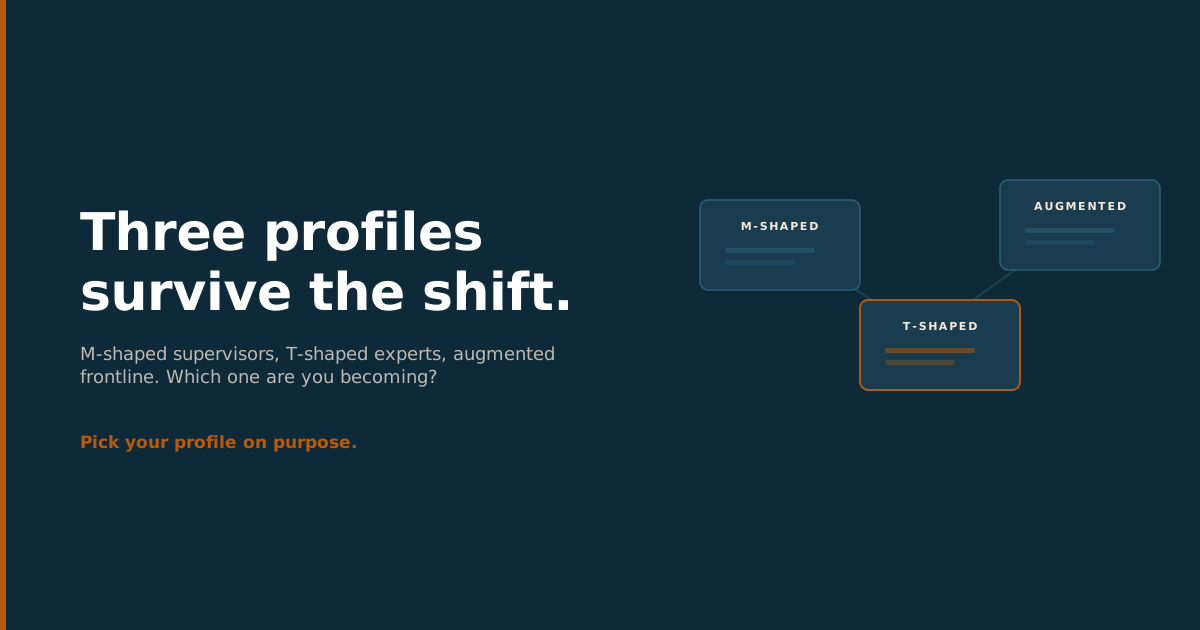
McKinsey's framework for the agentic organization identifies three talent profiles emerging as the dominant human roles. Each one represents a fundamentally different relationship with AI, a different skill set, and a different career trajectory. Understanding which one fits your strengths isn't academic. It's the most important career positioning decision you'll make in the next five years.
The M-Shaped Supervisor: Orchestrating Across Domains
Forget the T-shaped professional model you've been hearing about for the past decade. The M-shaped supervisor is something new: a broad generalist who is fluent in AI and capable of orchestrating hybrid workforces of humans and agents across multiple domains simultaneously.
Picture a marketing director who doesn't just understand brand strategy but also manages a fleet of AI agents handling content generation, audience segmentation, campaign analytics, and media buying. She doesn't do any of those tasks herself. She defines the outcomes, monitors the quality of agent outputs, handles escalations that require human judgment, and coordinates with other M-shaped leaders in product, sales, and customer success. Her value isn't in any single domain of expertise. It's in her ability to see across all of them and keep human-plus-agent teams pointed in the same direction.
The word "generalist" used to carry a faint whiff of criticism in corporate culture. Jack of all trades, master of none. In the agentic enterprise, that connotation flips entirely. The generalist who can span domains, manage ambiguity, and supervise human-AI collaboration at scale becomes one of the most valuable people in the building. McKinsey's research is explicit on this point: there will be high demand for excellent generalists and deep specialists, especially those who span design, software, and business.
If you're a mid-career professional who has always been drawn to cross-functional work, the person who naturally connects dots between departments, who volunteers for the messy projects that don't fit neatly into one team's scope, the M-shaped path may be where your career accelerates fastest. The skills that made you "hard to place" in traditional org charts are becoming the skills that agentic organizations can't function without.
Organizations are already writing postings for this profile — listings that ask for orchestration, AI fluency, and cross-domain judgment in the same breath. If one of them has caught your eye, paste it and your resume into the match analyzer for an honest read on how your generalist track record translates. It's free and takes about a minute.
The T-Shaped Expert: Going Deeper, Not Wider
While M-shaped supervisors orchestrate across domains, T-shaped experts go the opposite direction. They are deep specialists who handle edge cases, safeguard quality, and reimagine workflows within their area of expertise.
Here's why depth still matters enormously even as AI handles more routine work: AI agents are only as good as the systems they operate within. When those systems encounter something unexpected, a regulatory interpretation that doesn't fit the standard framework, a customer situation that falls outside normal parameters, a product failure mode that wasn't in the training data, the T-shaped expert is the person who catches it, diagnoses it, and either fixes it or redesigns the workflow so the agent handles it correctly next time.
Think of a senior compliance analyst at a financial services firm. AI agents now handle the bulk of transaction monitoring, flagging suspicious activity patterns and generating preliminary reports. But when a flagged transaction sits in a gray area between two regulatory frameworks, say, a cross-border payment that triggers both anti-money-laundering protocols and sanctions screening in ways that conflict, the AI doesn't have the contextual judgment to make the call. The T-shaped expert does. And critically, she doesn't just resolve the individual case. She redesigns the workflow rules so the agent handles similar ambiguity better going forward.
McKinsey's research notes that specialists are gaining influence by encoding their knowledge into agentic workflows, particularly in fields like legal, product development, and R&D. That phrase, "encoding their knowledge," is the key. In the agentic enterprise, deep expertise becomes most valuable not when you hoard it, but when you can translate it into rules, guardrails, and decision frameworks that make AI agents smarter.
If your career has been built on accumulating hard-won expertise in a specific domain, the T-shaped path gives you a way to multiply that expertise across an entire organization. Instead of being the person who handles the ten hardest cases a month, you become the person who makes the system smart enough that fewer hard cases emerge in the first place.
The AI-Augmented Frontline Worker: Less Screen Time, More Human Time
This is the profile that gets the least attention in strategy decks but may affect the largest number of mid-career professionals. AI-augmented frontline workers are people in sales, service, HR, or operations who spend dramatically less time interacting with computer systems and dramatically more time engaging directly with humans.
Consider a veteran account executive who currently spends maybe 30% of her week actually talking to clients. The rest goes to updating CRM records, preparing meeting briefs, drafting proposals, reconciling pipeline data, and generating forecasts. In the agentic enterprise, AI agents absorb most of that administrative burden. The account executive now spends 60 to 70% of her week in direct human interaction, building relationships, reading rooms, navigating complex negotiations, handling the emotional dynamics of a deal that's gone sideways.
This sounds like liberation, and in many ways it is. But it also raises the bar on a set of skills that most corporate training programs have chronically underinvested in: empathy, persuasion, conflict navigation, presence, the ability to make a person feel genuinely heard when there's pressure on both sides. These are not "soft" skills in the agentic enterprise. They are the core deliverable.
For mid-career professionals in client-facing or people-facing roles, the AI-augmented path offers a chance to return to what likely drew you into the work in the first place, the human part. But it demands honest self-assessment about whether your interpersonal skills have kept pace with your technical ones, or whether years of screen-mediated work have atrophied muscles you'll need to rebuild.
The Organizational Reshaping You Need to See Coming
These three talent profiles don't exist in a vacuum. They're emerging alongside a wholesale restructuring of how companies organize themselves, and understanding that restructuring matters for anyone trying to plan their next career move.
The traditional corporate pyramid, a small leadership team at the top, a large middle management layer, and an even larger base of individual contributors, is giving way to something flatter. PwC describes it as a diamond shape: a small leadership team, a strong and expanded middle layer consisting of M-shaped and T-shaped professionals, and a narrower base of entry-level roles, many of which have been absorbed by AI agents.
McKinsey's data supports this shift. Their research found that high-performing AI organizations are nearly three times more likely than their peers to have fundamentally redesigned workflows. The agentic organization moves away from hierarchical delegation and toward what McKinsey calls "agentic networks": flat decision structures where human-plus-agent teams operate with high context sharing and are steered toward outcomes rather than managed through layers of approval.
What does this mean practically? Middle management, as a role defined primarily by information brokering (collecting reports from below, summarizing them for above, passing decisions back down), is getting squeezed. AI agents can broker information faster and more completely than any human manager. But middle management redefined as orchestration, coordinating hybrid teams, handling exceptions, maintaining quality, coaching both humans and agents, is actually expanding.
The distinction matters. If you're a mid-career manager whose primary value has been serving as a conduit between your team and senior leadership, the agentic enterprise is going to challenge that role. If you're a manager whose value comes from making judgment calls, coaching your people through ambiguous situations, and figuring out how to deploy resources (human and artificial) against shifting priorities, you're about to become much harder to replace.
How Performance and Career Growth Get Redefined
Perhaps the most disorienting change for mid-career professionals is that the metrics of professional success are shifting underneath established careers. Performance management in the agentic enterprise won't measure task completion. It will measure how effectively you orchestrate outcomes.
That marketing analyst who used to pull data for eight hours a day? Her performance review won't track how many reports she generated. It'll track the quality of the strategic insights she surfaced, the business impact of the decisions she influenced, and how effectively she supervised the AI agents doing the data assembly. Her title might shift from "marketing analyst" to something closer to "revenue impact strategist," and her compensation, career path, and organizational visibility will shift with it.
Organizations building agentic enterprises are also developing dual career advancement paths: one for AI-augmented specialists who go deep, and another for AI orchestrators who go wide. This is genuinely new. Most corporate ladder structures have always rewarded one trajectory. Climb the management chain or plateau. The agentic enterprise creates a legitimate second path where deepening your specialist expertise and encoding it into AI workflows carries the same weight and compensation as broadening into orchestration.
For mid-career professionals who've felt stuck choosing between "become a manager" and "stay technical but cap your growth," this dual-path structure could be the most significant career opportunity in a generation. It rewards both breadth and depth, and it stops forcing people to abandon what they're best at in order to advance.
Upskilling That Actually Matches the Moment
Here's where most career advice about AI goes wrong: it focuses on learning to use AI tools. That's necessary but radically insufficient. Using AI tools is table stakes. The World Economic Forum's Future of Jobs 2025 report found that roughly 39% of current skill sets will be overhauled or outdated between now and 2030. "Overhauled" is doing a lot of work in that sentence.
What the agentic enterprise actually demands is the ability to supervise, critique, and continuously coach AI agents. Not just prompt them. Not just review their outputs. But understand their decision patterns well enough to know when they're producing genuinely good work, when they're confidently wrong, and when they're hitting the boundaries of what they can handle. That requires a fundamentally different relationship with AI than most professionals currently have.
A few specific capabilities separate professionals who will thrive from those who will struggle:
Systems thinking - the ability to see how changes in one part of a workflow ripple through the entire operation. When an AI agent handles customer intake differently, what happens downstream in fulfillment, billing, and retention? The M-shaped supervisor lives in this question.
Exception diagnosis - the ability to quickly identify why an AI agent's output went wrong and whether the fix is a one-time correction or a systemic workflow redesign. The T-shaped expert owns this skill.
Human presence and judgment - the ability to bring authentic attention, emotional intelligence, and ethical reasoning to situations where AI has no framework. The AI-augmented frontline worker depends on this daily.
And one skill that cuts across all three profiles: the ability to articulate what "good" looks like in terms an AI system can act on. If you can't define your quality standards precisely enough for an agent to follow them, you can't supervise that agent effectively. This is harder than it sounds. Most experienced professionals operate on intuition built over years, and translating intuition into explicit criteria is a skill that barely existed before the agentic era demanded it.
Not sure where your AI skills stand?Take the AI Fluency Self-Assessment and get your personalized fluency profile across all four dimensions, from conceptual understanding to strategic vision.
Figuring Out Where You Fit
The honest answer is that most mid-career professionals won't fall cleanly into one of these three profiles, at least not immediately. Career identity doesn't pivot overnight. But you can start making intentional choices that move you toward the profile that best matches your strengths and interests.
If you're energized by connecting different parts of the business, if you find yourself naturally translating between teams that speak different professional languages, if you're the person who sees the second- and third-order effects of decisions before anyone else in the room, lean into the M-shaped path. Volunteer for cross-functional initiatives. Build fluency with AI tools across multiple domains rather than mastering one. Practice orchestrating outcomes rather than delivering outputs.
If you've spent years building deep expertise and you light up when you're solving the problem nobody else can crack, lean into the T-shaped path. Start documenting your decision-making frameworks explicitly. Identify the edge cases in your domain where AI agents consistently fail and position yourself as the person who fixes the system, not just the individual case. Learn enough about AI architecture to encode your expertise into workflows.
If the work you find most meaningful is the human interaction, reading people, navigating difficult conversations, building trust, lean into the AI-augmented frontline path. Invest heavily in the interpersonal skills that AI can't replicate. Look for roles where AI is absorbing the administrative burden and freeing you to spend more time in direct human engagement. Resist the temptation to define your value by how busy your calendar is with system work.
Whatever path resonates, one thing is non-negotiable: waiting is not a strategy. McKinsey's data shows that only about 6% of organizations are currently high performers in AI deployment, but the gap between leaders and laggards is widening fast. The professionals who start building these capabilities now, while the transition is still early, will have a compounding advantage over those who wait until their current role is visibly threatened.
The operations manager I mentioned at the beginning of this piece? She didn't stay confused for long. She spent three months mapping every workflow her AI agents touched, identified seven places where they were producing outputs that looked right but missed critical context, and built a set of quality guardrails that her entire division now uses. She didn't get a new job title. She got something better: clarity about what her expertise is actually for in a world where the machines handle the doing.
That clarity is available to you too. But nobody's going to hand it to you. You'll need to go build it.
Ready to take the next step?Try the Career Audit to assess where you stand across five dimensions of career satisfaction, or explore your AI fluency to find out which skills need your attention first.
Sources: McKinsey 2025 State of AI Report; McKinsey Global Institute "Agents, Robots, and Us" (Nov 2025); PwC "From Potential to Profit: Closing the AI Impact Gap" (2025); ServiceNow Agentic Workforce Case Study (2025); World Economic Forum Future of Jobs 2025.