I remember leaving the office at 5:00 PM sharp one Tuesday a few years ago, determined to finally "balance" my life. I got home, sat at the dinner table with my family, and physically, I was there. But mentally? I was still drafting the email I didn't send and worrying about a project deadline. I wasn't balanced. I was just distracted in two places at once.
That evening convinced me that work-life balance is a trap, and fifteen years of demanding roles since have only hardened the opinion. Balance treats your life as a scale and your job as the weight ruining it. Add enough personal time to the other side and everything should even out. Except it never does, because the metaphor is wrong. Your life isn't a scale. It's a voyage, and what a voyage needs isn't equilibrium. It's a heading.
Why doesn't work-life balance work?
Work-life balance fails because it measures the wrong thing: equal time instead of intentional direction. It ignores that careers move in seasons, that knowledge work follows you home in your head, and that a 50/50 split is the wrong target in both your heaviest quarters and your lightest ones. The research-backed variable that actually predicts wellbeing is boundary control: whether you decide when work enters your life.
That last clause deserves the emphasis, because the 2026 boundary research is unusually clear. The problem with hybrid work isn't that boundaries got blurry. It's who controls the blur. A third of hybrid workers say separating work and home is harder now, yet workers with high control over their own boundaries report sustainable integration, and the ones without it burn out. Same blur, opposite outcomes. Control is the variable. Balance was never the variable.
This matters more at mid-career than at any other stage. You're in the years Harvard Business Review calls the pivotal stretch, when work demands peak at the exact moment family demands do. A perfectly balanced week was never on offer. A deliberately navigated one is.
The balance model treats every week as the same week. Navigation accepts that careers move in seasons. A product launch quarter is an 80/20 season and an aging parent's health crisis is a 20/80 season, and neither is a failure. The failure mode is drifting between seasons without ever choosing one.
The practical shift: name your current season out loud, with the people it affects, and give it an end date. "Until the March launch, I'm heads-down, and I'm taking the week after off" beats a year of vague guilt in both directions. Seasons without end dates aren't seasons. They're just your life now, and that's how hustle culture wins without your consent.
Sometimes, though, the honest read is that the misalignment isn't the season — it's the role itself. If there's a specific posting you keep coming back to, paste it and your resume into the match analyzer for a straight answer on whether it fits the heading you've chosen. No account needed, and it takes about a minute.
Manage energy and attention, not the clock
You can have five free hours and be too depleted to use them. The dinner-table story above wasn't a time problem; I was home on time. It was an attention problem, and attention is what the always-on workplace actually takes from you.
Two practices do most of the work here. First, protect your peak hours for the work that deserves them; spending your sharpest morning brain on email is a tradeoff you'd never make on purpose. Second, build a transition ritual where the commute used to be. Fifteen minutes, same trigger every day: the dog walk, the podcast, the gym bag by the door. The ritual isn't a wellness garnish. It's the off-ramp that tells your brain which world it's in, so you're actually wherever you are.
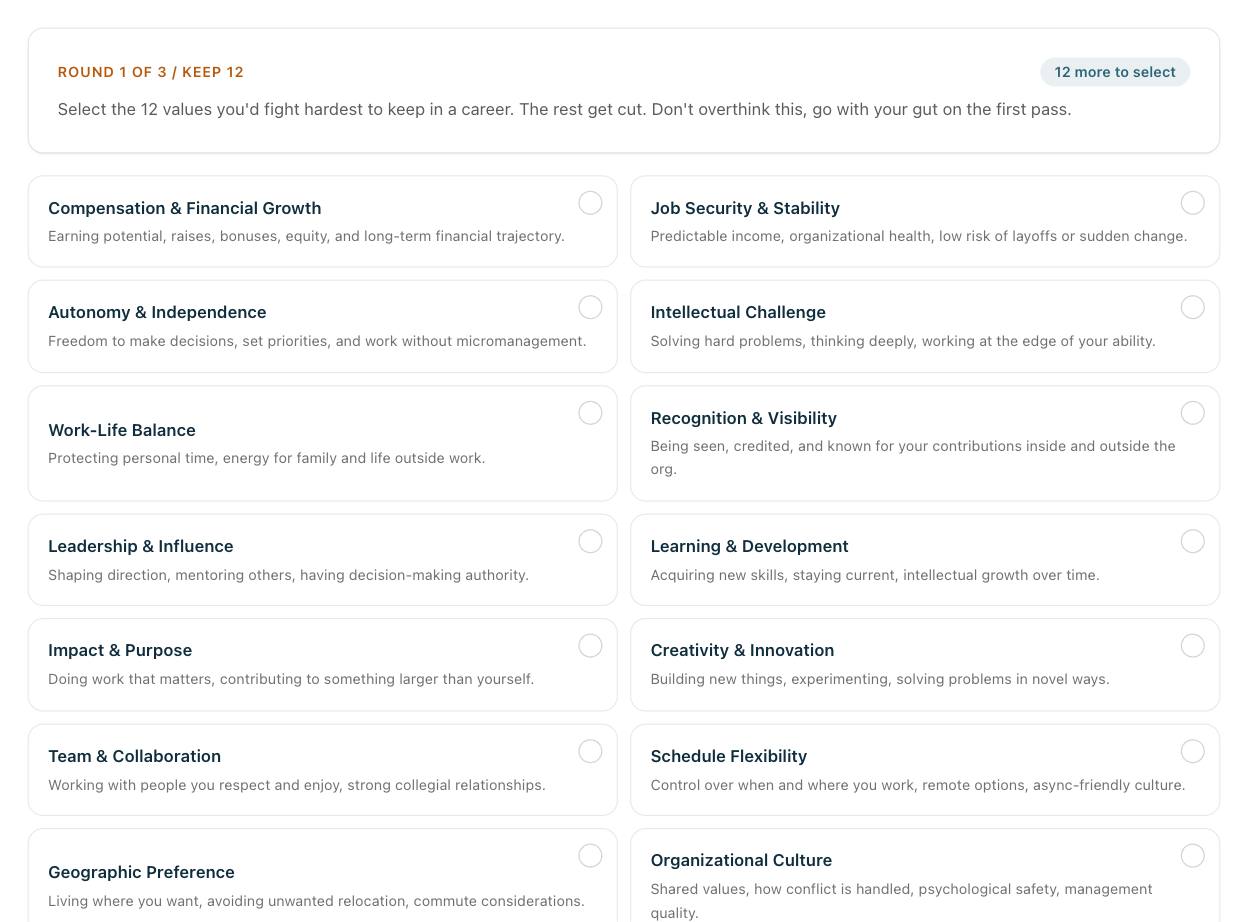
Round one of the values prioritization exercise: twenty values, keep twelve. The forced cuts are the point. Your calendar makes these tradeoffs daily whether you choose them or not.
Use a compass, not a map
Maps promise a route. Compasses give you a direction and let the route change, and your route will change.
Pick your North Star for this season. Not your life purpose, just the current heading: the promotion, the kids' last summer at home, your health, the company you're building on the side. Then run the only audit that matters: once a week, hold your calendar against your stated heading. If you say family is the priority and you've accepted 6 PM meetings four nights running, you're not balancing badly. You're navigating toward something you didn't choose.
This check takes five minutes and it's uncomfortable in the way that useful instruments are. Most people who feel "out of balance" are actually out of alignment, and no amount of leaving at five fixes a heading problem.
Broadcast your coordinates
Boundary control isn't just an internal state. It's negotiated, and nobody can respect a position you haven't broadcast.
The upgrade is specificity. "I'm offline after 5" is a rule people test. "I'm in deep focus until 11, open for meetings after, and offline Thursday afternoon for my kid's game" is a schedule people plan around. Vague boundaries read as preferences. Specific ones read as how you operate. And when you flex a boundary by choice, say so explicitly: clarity about the exception protects the rule.
If you manage people, this doubles as culture-setting. Your team can't hold boundaries you visibly don't hold yourself. The 9 PM email you send "just to clear your head" sets everyone else's expectations, whatever your intentions.
The bottom line
The goal was never a zen state where work and life stop colliding. They collide constantly. The goal is to be the one steering when they do: choosing the season, guarding the energy, checking the heading, saying the coordinates out loud.
Here's the navigation check to run this week: write down your actual current priority, the honest one, then open your calendar and count how many hours agree with you. If the two don't match, that gap is your real to-do list. And if you're not sure what the priority even is right now, that's the most common mid-career drift of all. The values prioritization tool takes about ten minutes and forces the ranking your calendar has been making for you. The career audit goes deeper if the misalignment feels structural.
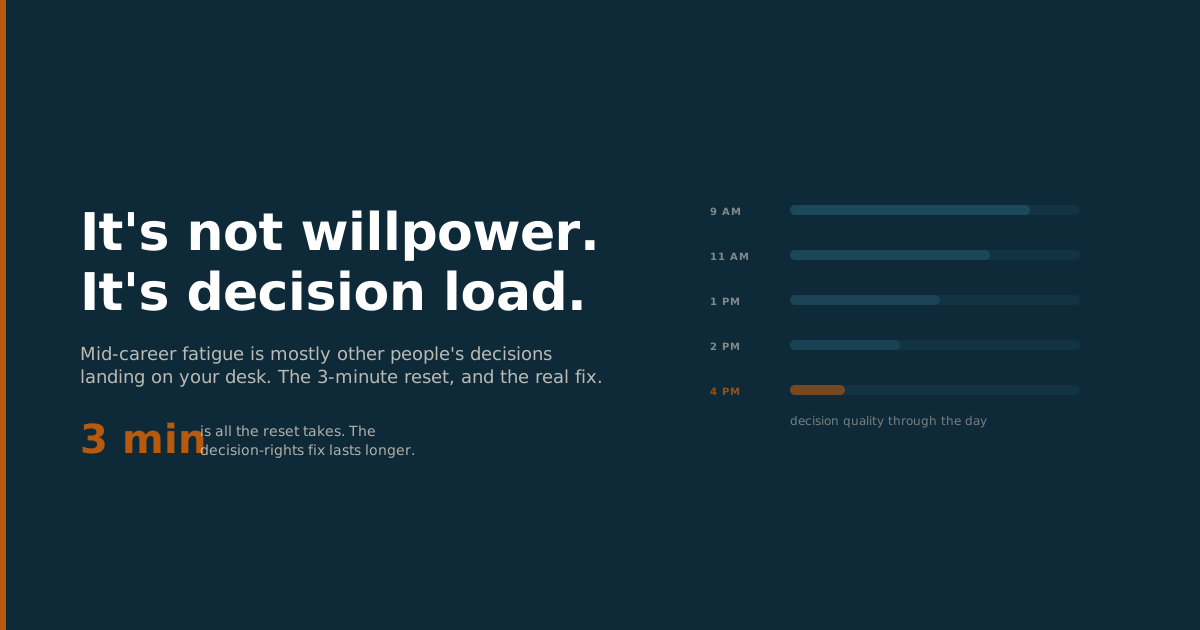
Decision Fatigue Is Real: Here's How to Hit the Reset Button
Decision fatigue isn't a willpower problem at the mid-career level. It's a decision-rights problem. The 3-minute reset, plus the fix nobody talks about.