A director of product at a mid-size fintech company told me something that stuck with me for months. She'd just turned down a VP offer at a competitor, more money, bigger team, the title she'd been chasing for three years. Her husband thought she was crazy. Her mentor thought she was crazy. She wasn't sure they were wrong.
"Every time I tried to get excited about the offer," she said, "I kept coming back to this feeling that I'd be solving someone else's problem. Like I'd be living out a version of success that my 28-year-old self designed."
She couldn't articulate what was wrong with the opportunity. On paper, it checked every box. But she'd never actually written down what her boxes were, not the ones she inherited from business school case studies or absorbed from LinkedIn thought leaders, but the ones that reflected who she'd become after 14 years of actual work, two kids, a cross-country move, and a pandemic that rearranged her relationship to ambition.
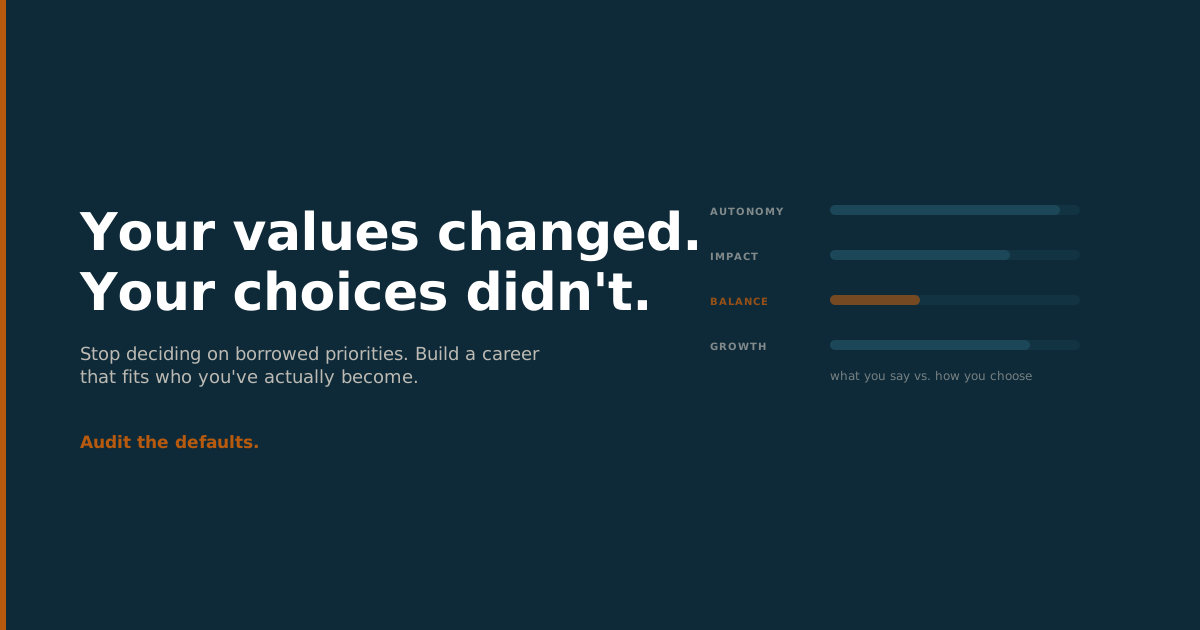
That gap between the values you think you hold and the values you actually live by? It's where most bad career decisions get made.
The Borrowed Values Problem
Ask a room of mid-career professionals what they value in their careers, and you'll hear the same handful of answers: growth, impact, work-life balance, meaningful work, good leadership. These aren't wrong answers. They're just not specific enough to be useful.
Saying you value "growth" is like saying you value "good food." Okay, but do you mean a seven-course tasting menu or a perfect bowl of pho eaten alone at a counter on a Tuesday? The specificity is the whole point, and without it, you end up evaluating opportunities against a vague checklist that could belong to anyone.
I see this pattern constantly. Someone says they value "autonomy," but when they actually get a role with high autonomy and minimal structure, they feel unmoored and anxious. Someone else insists they care about "impact" but turns down a nonprofit leadership role because the compensation doesn't reflect their experience. These aren't hypocritical decisions. They're the predictable result of never doing the hard, specific work of figuring out which values actually drive your behavior versus which ones you like the idea of.
There's a useful distinction here between aspirational values and operational values. Aspirational values are what you'd put on a vision board. Operational values are what you'd reveal if someone followed you around for two weeks and watched how you spend your time, what makes you angry, what you negotiate hardest for, and what you're willing to sacrifice.
Most people have never compared the two lists.
Why This Gets Harder at Mid-Career
Early in your career, values conflicts are relatively quiet. You're in accumulation mode: building skills, earning credibility, paying off debt, proving you belong. The default career script ("get promoted, make more money, expand your scope") works well enough because you haven't yet encountered enough of your own data to question it.
Then somewhere around year eight or ten, the conflicts start getting louder. You've been promoted into roles that pull you away from the work you actually enjoyed. You've had a kid, or watched a parent get sick, or survived a layoff, and your relationship to risk and stability has fundamentally shifted. You've worked for a brilliant leader who made you miserable and a mediocre one who created space for your best work, and now your theory about what "good leadership" means is more complicated than it was at 27.
This is the moment when career decisions stop being straightforward optimization problems and start being values conflicts. Do you take the role with higher compensation but longer hours? Do you stay at the company where you're comfortable but plateauing? Do you pursue the entrepreneurial itch even though your family depends on your benefits?
You can't answer these questions with a pros-and-cons list. You need a values hierarchy, a clear understanding of which things matter most to you, right now, in this season of your life. Not which things should matter. Which things do.
A values hierarchy tells you what to weigh. Evidence tells you what's actually on the table. If a specific role is forcing the question right now, paste the posting and your resume into the match analyzer — a clear read on the fit gives your values something concrete to push against, and it takes about a minute.
Values Are Seasonal (and That's Not a Cop-Out)
One of the more damaging myths in career advice is that you should discover your "core values" once and then orient your entire career around them. As if you're a brand that needs a consistent positioning statement.
Your values do have some stability. If you've always cared about intellectual challenge, you're probably not going to wake up at 45 and decide you'd rather do repetitive work. But the weight you assign to different values shifts constantly, and those shifts are where the real decision-making power lives.
A senior engineer I know spent her twenties prioritizing learning velocity above everything else. She'd switch jobs every 18 months, always chasing the steepest growth curve. It worked beautifully until her daughter was born and she realized that the instability she'd treated as a feature, new teams, new domains, new codebases, now felt like a cost. Her value for learning hadn't disappeared. It had been outranked by a value for predictability that she didn't even know she held until the stakes changed.
Acknowledging that values shift isn't wishy-washy. It's honest. And it means that a values exercise isn't something you do once and laminate. It's something you revisit whenever the ground shifts: a new role, a life change, a creeping sense that your decisions aren't producing the satisfaction they used to.
How to Run Your Own Values Audit
Forget the approach where you stare at a list of 50 values and circle the ones that "resonate." That method produces aspirational values every time because it asks you to select from a menu rather than generate from experience. Here's what works better.
Want a guided version? We built an interactive Values Prioritization Exercise that walks you through eliminating, ranking, and weighting 20 career values across structured rounds. The output is a personal values statement you can share with your coach.
Start with decisions, not abstractions
Think about the last three significant career decisions you made. Not the outcomes, the decision process itself. What factors did you weigh? What did you negotiate hardest for? What felt non-negotiable? What did you sacrifice, and did it sting or feel like a fair trade?
A marketing VP I worked with realized through this exercise that she'd turned down two roles with higher titles because both required relocating away from her aging parents. She'd told herself the roles "weren't right" for strategic reasons, but the pattern was clear: geographic proximity to family was a top-tier operational value that she'd never consciously named.
Pay attention to what makes you angry
Frustration is a surprisingly reliable values indicator. When something at work makes you disproportionately angry, there's almost always a violated value underneath it. The person who fumes about being left out of a decision cares about inclusion or recognition. The one who can't tolerate inefficient meetings values time sovereignty. The one who gets upset when leadership changes direction without explanation values transparency.
Your frustrations are more honest than your aspirations.
Force trade-offs
Values only become useful when you rank them, and ranking requires sacrifice. The question isn't "do you care about compensation?" (of course you do). It's "would you take a 20% pay cut for a role with significantly more autonomy?" Would you give up a prestigious title for a shorter commute? Would you trade a supportive manager for faster advancement?
These forced choices are uncomfortable precisely because they're real. Every career decision is a trade-off. Knowing your values hierarchy in advance doesn't eliminate the discomfort, but it does mean you're making trade-offs consciously rather than reactively.
Putting Your Values Hierarchy to Work
Once you've identified your top five or six operational values and put them in rough rank order, you've built something genuinely useful: a decision filter. Not a rigid rule system, but a lens that makes ambiguous choices clearer.
That product director I mentioned at the beginning? She eventually did the work. Her top values, in order, were: intellectual ownership (not just executing someone else's roadmap), schedule flexibility (non-negotiable with two young kids), team quality (she'd rather have four brilliant colleagues than lead a team of twenty), financial stability (not maximum compensation, stability specifically), and proximity to customers. The VP role she'd turned down would have scored well on compensation and team size but poorly on intellectual ownership and schedule flexibility. Her gut had been right. She just hadn't had the vocabulary to explain why.
She used her values hierarchy for the next eighteen months as a filter for every opportunity that came her way. Some conversations she ended after a single phone screen because the role clearly conflicted with her top two values. Others she pursued further than she would have otherwise because they aligned in unexpected ways. The whole process became faster and less agonizing.
Your Turn
Block 30 minutes this week. No phone, no laptop, just a notebook. Write down the last three career decisions you made and what actually drove each one. Then write down the last three times you were genuinely frustrated at work and what was underneath the frustration. Look at those two lists side by side.
What you find probably won't match the values you'd rattle off if someone asked you at a networking event. That's the point.
If you want a more structured approach, Modern Compass's Values Prioritization Exercise walks you through ranking and weighting 20 career values, forcing the trade-off decisions that reveal your real hierarchy. The output is a personal values statement that your AI coach can reference in every future conversation, so when you're evaluating a new role, negotiating a change in responsibilities, or just trying to figure out why a perfectly good job feels wrong, you've got a foundation to build from instead of a gut feeling you can't quite explain.
Why Your Best Directors Aren't Getting Promoted to VP
Discover the 6 overlooked factors that determine Director-to-VP promotions. Learn why strong performance alone won't get you promoted and what executives actually evaluate.