"Executive presence" may be the single most frequently cited and least helpfully defined criterion in corporate promotion decisions. It gets wielded as a catchall for something leaders can sense but can't articulate, which makes it almost impossible to develop if nobody tells you what it actually means.
The Feedback Nobody Can Define
A senior engineering manager I know spent two years watching people with less technical skill get promoted past her. She ran the most productive team in her division. Her project delivery record was flawless. In performance reviews, her manager used words like "invaluable" and "rockstar contributor." But when it came to the promotion shortlist for director, her name kept landing in the "not yet ready" column.
The feedback she finally extracted, after pressing hard enough that her VP got uncomfortable, was four words: "She lacks executive presence."
No further explanation. No specific behaviors to change. Just a vague, expensive label that felt more like a judgment about who she was than what she did.
She's not alone in this experience. This particular piece of feedback gets handed out constantly and defined almost never. So let's make it concrete.
What Executive Presence Actually Means
Strip away the mystique and executive presence comes down to a simple question: when you communicate, do people trust what you're saying and feel confident acting on it?
That trust doesn't come from charisma. Some of the most compelling leaders in any organization are quiet, measured, even introverted. What they share is a set of observable communication behaviors that signal competence and conviction, especially when the pressure is high.
Research from the Center for Talent Innovation (now Coqual) found that executive presence accounts for roughly 26% of what it takes to get promoted to senior roles. Their data broke it into components, with gravitas (how you act) carrying the most weight by a wide margin, followed by communication (how you speak) and then appearance. That ranking tells you something important: it's less about your wardrobe or your voice and far more about the substance and steadiness of how you show up.
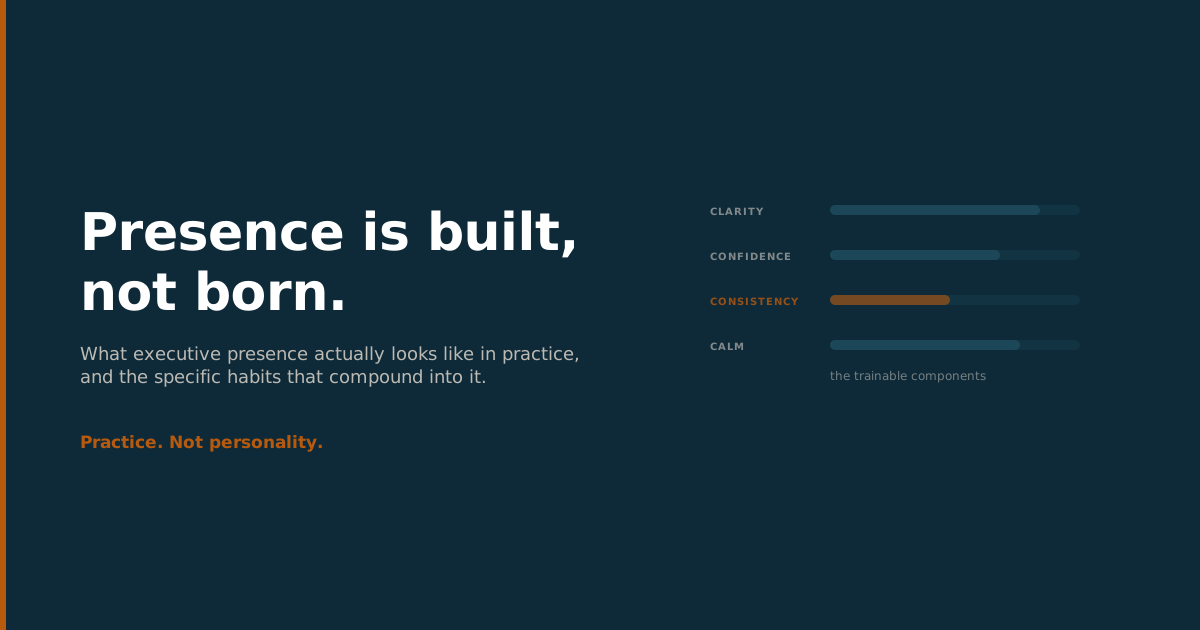
Here's what that looks like in practice, across four specific dimensions you can assess and improve.
Half the battle in any meeting is helping people follow your thinking. Not because your audience isn't smart, but because they're carrying the cognitive load of 14 other decisions they need to make that day.
Professionals who score high on clarity do a few things differently. They structure their communication top-down rather than building to a conclusion. When a VP asks "where are we on the Q3 roadmap," they don't start with the backstory of how the team evaluated trade-offs over three sprints. They lead with the answer: "We're on track for two of three deliverables. The third is at risk, and here's what I recommend." Background comes second, only as much as needed.
They also ruthlessly cut filler. The phrase "I just wanted to give a quick update" before a presentation tells the room that what follows might not be worth their attention. Starting with the point tells them it is.
One useful test: could someone who walked into the room 30 seconds into your remarks still understand your key message? If the answer is no, your structure needs work. The most effective communicators in senior meetings operate as though everyone arrived late, because cognitively, most of them did.
Confidence
Confidence in communication isn't about volume or certainty. It's about the absence of apology.
Pay attention to the verbal patterns of someone who gets described as "not quite senior enough" and you'll hear a specific set of hedges: "I might be wrong, but..." "I think maybe we should consider..." "Sorry, can I jump in here?" "This might be a dumb question..." Each one is a small withdrawal from the credibility bank before they've even made a deposit.
Confident communicators don't bulldoze. They don't pretend to know things they don't. What they do is own their contributions without preemptively undermining them. "Here's what the data shows and my recommendation based on it" lands differently than "I think the data might suggest, and this is just my opinion, but maybe we could try..."
Physical delivery matters too, though less than most executive coaching programs suggest. The basics are sufficient: make eye contact, don't rush, pause before responding to hard questions instead of filling the silence with filler words. You don't need a TED Talk coach. You need to stop signaling uncertainty when you're actually prepared.
A director of marketing at a consumer goods company told me she recorded herself in three consecutive leadership meetings. Watching the playback was painful, she said, but clarifying. She counted eleven instances of "I think" in a single meeting where she was presenting data she'd personally analyzed. She knew the numbers cold. Her language suggested she'd found them on a napkin in the break room.
That gap between what you know and how it reads is exactly what promotion decisions turn on — and hiring decisions too. If you're starting to look outside for the seniority your current company won't name, paste a posting you want into the match analyzer with your resume and see how your experience reads to someone deciding whether you're ready. It's free and takes about a minute.
Conciseness
Senior leaders operate in environments where every minute of meeting time has an outsized cost. A one-hour meeting with eight directors and two VPs doesn't cost one hour. It costs ten hours of senior leadership bandwidth. The people who earn influence in those rooms respect that economy.
Conciseness is not about being brief for brevity's sake. It's about having the discipline to know what your audience needs from you in this specific conversation and delivering exactly that.
The pattern that kills credibility fastest in senior meetings is over-explaining. When someone asks a yes/no question and gets a four-minute narrative, the room doesn't think "wow, thorough." The room thinks "this person can't distinguish signal from noise." That's a devastating perception at the senior level, where the entire job is distinguishing signal from noise across competing priorities.
A practical rule: prepare three times more than you plan to share, then share only what's asked for. Keep the rest ready. Having depth you don't use signals more competence than displaying everything you know.
Connection
The first three dimensions handle the "head" part of communication. Connection handles the heart, and it's the one most technically-oriented professionals underestimate.
Connection is your ability to read a room and adjust. To notice when your CFO's eyes glaze over during your technical explanation and pivot to the financial impact. To sense when your team needs acknowledgment before they can hear feedback. To recognize that the same message delivered to your engineering peers and your executive sponsor requires fundamentally different framing.
People with strong connection skills ask questions that show they've actually listened, not just waited for their turn. They reference what others have said ("building on Maria's point about timeline risk...") rather than treating each contribution as independent. They name the tension in the room when everyone else is dancing around it.
This dimension is where many mid-career professionals have the greatest room for growth, particularly those who've built their careers on deep expertise. Technical fluency earned their seat at the table. Relational fluency determines whether they get to keep pulling up chairs at bigger tables.
The Myth of the Natural
One of the most damaging ideas about executive presence is that it's innate. That some people are born commanding rooms and others aren't. That it's tied to height, or gender, or extroversion, or some ineffable quality you either have or you lack.
This framing is convenient for organizations that want to promote the people they're already comfortable with. It's not supported by the evidence.
Every dimension of executive presence is a trainable skill. Clarity improves with structured practice in top-down communication. Confidence builds when you identify and eliminate undermining verbal habits. Conciseness sharpens when you prepare with your audience's needs rather than your own expertise as the organizing principle. Connection develops when you start paying as much attention to how your message lands as to what your message says.
The engineering manager I mentioned at the top? Eight months after getting that frustrating feedback, she got the director promotion. Not because she became someone different. Because she got specific about what "executive presence" actually meant in her context and worked on the two dimensions (clarity and confidence) where her habits were undermining her credibility.
She still runs the most productive team in her division. She's still an introvert. The difference is that when she speaks in senior meetings now, people hear what she's actually saying instead of getting distracted by how she's saying it.
Your Move
Pick one meeting this week and record yourself (most video platforms make this easy). Then assess yourself honestly across the four dimensions: clarity, confidence, conciseness, connection.
Don't try to fix everything at once. Identify the single dimension where the gap between your intent and your impact is widest. Work on that one for 30 days. Then reassess.
Want a structured starting point? Try the Communication Style Assessment on Modern Compass. It walks you through a self-evaluation across all four dimensions and generates specific exercises based on where your scores indicate the most leverage. Your coach can reference those results in future conversations to help you track whether the changes are sticking.
Executive presence isn't a personality type. It's a practice. And the professionals who figure that out stop waiting for permission to be seen as leaders.
Ready to assess your communication style?Take the Communication Style Assessment and get a personalized breakdown across all four dimensions of executive presence.
Grow as a Leader
From Individual Contributor to Manager: The Decision Has Changed
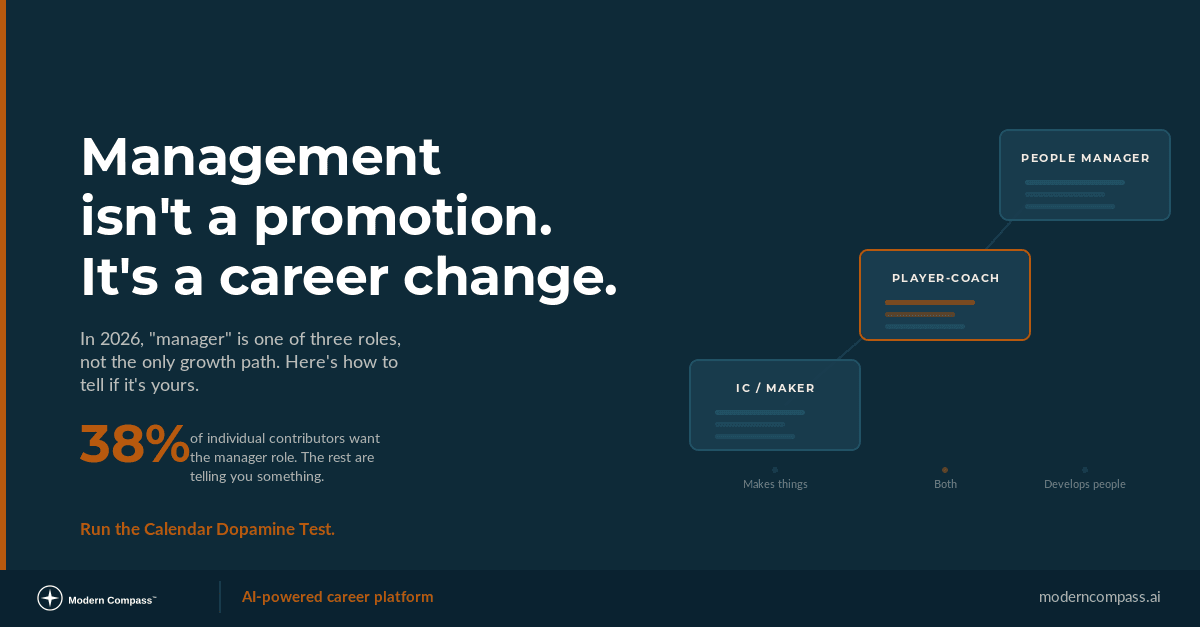
The individual contributor to manager move used to be the only growth path. In 2026, it's one of three. Here's how to tell if it's yours.