Building a Professional Network That Actually Helps Your Career
Future-Proof Your CareerFebruary 6, 20268 min read
building professional networkprofessional networking mid-careernetworking for introvertscareer networking strategycareer-growth
Most networking advice is written for extroverts who enjoy working a room full of strangers. For the rest of us, it reads like a homework assignment from someone who has never felt the energy drain of forced small talk at an industry mixer.
I've spent my career in product and AI leadership at companies like Disney, Salesforce, and Royal Caribbean. The relationships that actually moved my career forward never started at a networking event. They started with people I worked alongside, solved problems with, or learned from during the normal course of doing good work. And some of the most important ones came from female leaders who taught me, as a natural introvert, how to connect with and trust other people in ways that felt real, not performative.
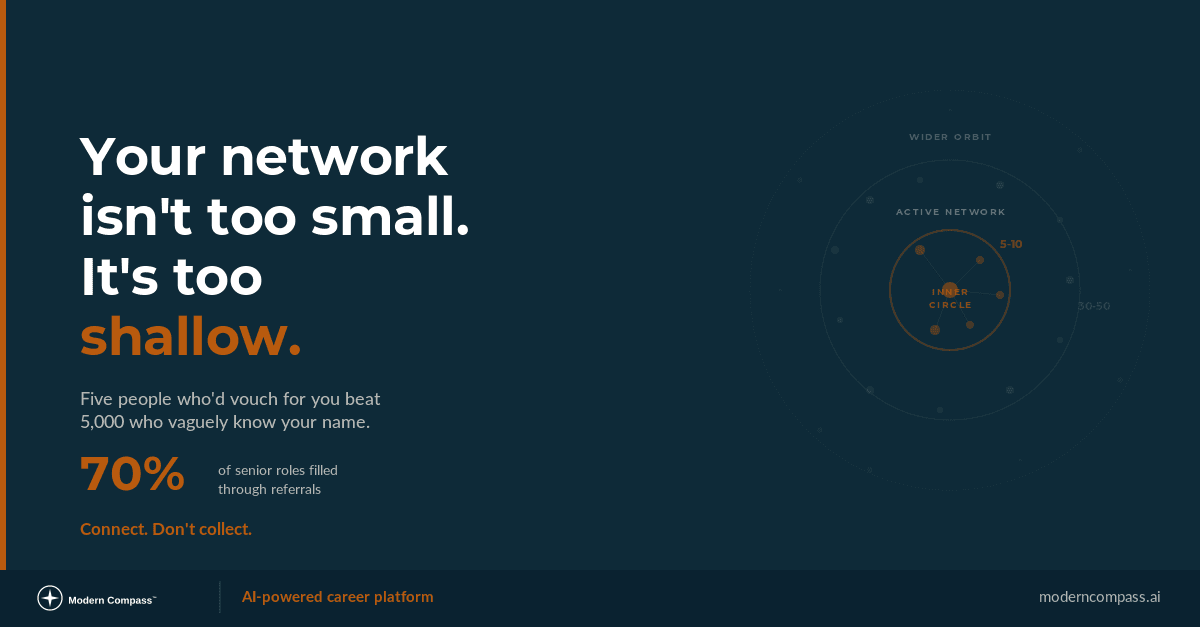
Building a professional network that helps your career isn't about the size of your LinkedIn connections list. It's about the depth of a small number of relationships where both people actually care about each other's success.
Why Most Networking Advice Fails Mid-Career Professionals
If you have 10 or 15 years of experience, you've probably noticed that the standard networking playbook feels increasingly irrelevant. "Attend mixers." "Collect business cards." "Work the room." That advice assumes two things: that you're starting from zero, and that you're comfortable performing extroversion on demand.
Neither is true for most mid-career professionals.
You already have a network. You've worked with hundreds of people across multiple roles and companies. The problem isn't access to people. The problem is that those relationships have gone dormant, or they were never deep enough to be useful when it matters.
Sociologist Mark Granovetter's "strength of weak ties" research showed that acquaintances are often more valuable for career opportunities than close friends, because they connect you to information outside your immediate circle. But here's what that research doesn't tell you: weak ties only work if there's enough trust for someone to actually vouch for you. A LinkedIn connection who vaguely remembers your name isn't a weak tie. That's a stranger.
The Three Tiers of a Network That Works
Not every professional relationship needs the same investment. Thinking about your network in tiers helps you spend your limited energy where it actually compounds.
Your inner circle (5 to 10 people). These are the people you'd call on a Sunday if you got laid off on Friday. Former managers who know your work deeply. Colleagues who've seen you handle a crisis. Mentors who tell you what you need to hear, not what you want to hear. These relationships require real maintenance: quarterly conversations at minimum, genuine interest in their lives, and a willingness to be honest with each other.
Your active network (30 to 50 people). People you've worked with, collaborated on projects with, or share a professional community with. You don't talk regularly, but when you reach out, there's real context to build on. A shared project, a mutual connection, a specific memory. This tier is where most career opportunities actually surface, because these people know your work and move in circles you don't.
Your wider orbit (everyone else). Conference acquaintances, LinkedIn connections, people you've met once. Be realistic about this tier. These connections become valuable only when something specific triggers a conversation. Don't waste energy trying to "maintain" hundreds of shallow relationships. Instead, be the kind of professional others remember when something relevant comes up.
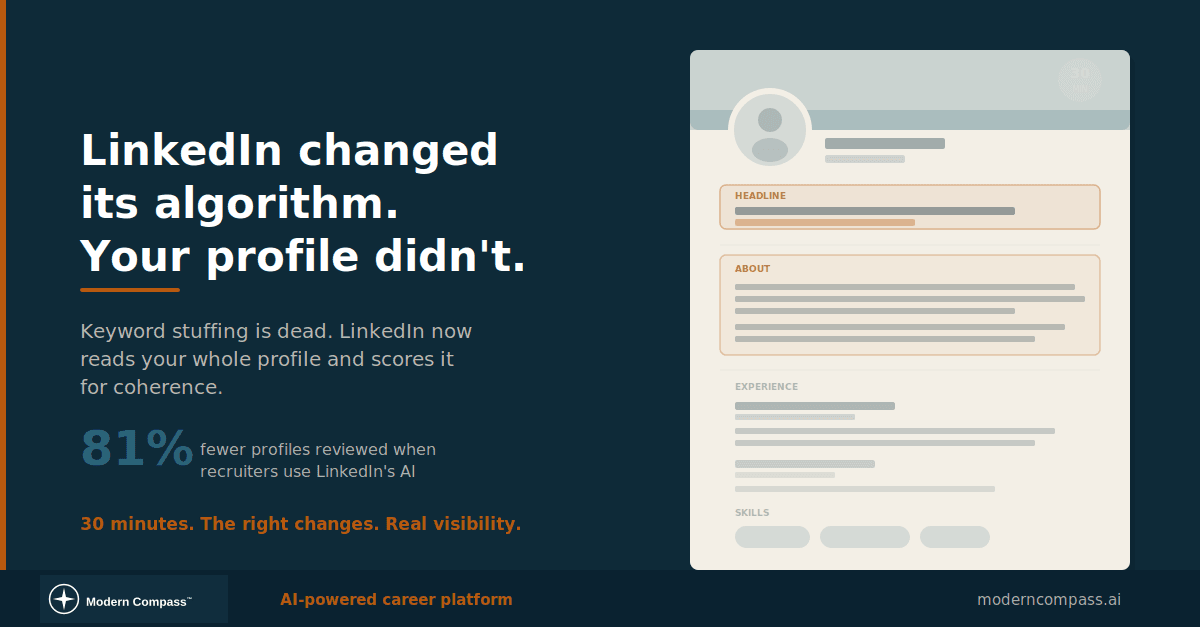
One thing all three tiers have in common: when your name comes up, the first thing most of these people do is look at your LinkedIn profile. If yours hasn't been touched since your last job change, run it through the LinkedIn audit and see what a reconnection actually finds when they search you. It's free and takes a few minutes.
Give First, But Only If You Mean It
"Lead with generosity" has become standard networking advice, and it's good advice. But there's a version of it that backfires badly at the senior level.
You've met the person who shares an article with you and then immediately follows up asking for a favor. Or the one who makes an introduction and then tracks whether you reciprocated within a specific timeframe. That isn't generosity. It's a transaction wearing a generosity costume.
The give-first approach works when it comes from genuine interest in helping someone, not from a mental ledger of favors owed. Share an article because you actually thought of that person when you read it. Make an introduction because you genuinely believe both people would benefit. Celebrate someone's promotion because you're actually happy for them.
People with 15 years of professional experience can spot performative generosity instantly. The professionals who build the strongest networks are the ones who help because they want to, with no expectation of return. Paradoxically, those are the people who get the most back.
How Your Network Actually Gets You Hired
When I'm evaluating candidates for leadership roles, a referral from someone I trust moves that resume to the top of the pile immediately. Not because I'm playing favorites, but because a trusted referral is the strongest signal available. It means someone with professional credibility is willing to stake their reputation on you.
A large, vague network doesn't do this for you. Having 5,000 LinkedIn connections doesn't help if none of them would go to bat for you in a hiring conversation. What matters is whether three to five people in your field would pick up the phone and say, "You should talk to this person. I've seen their work and they're excellent."
This is why depth beats breadth every time at the mid-career level. A hiring manager doesn't care how many people know your name. They care whether the right people can speak to your specific capabilities. And your resume needs to back up what your network says about you.
If you're wondering where you stand in your career positioning, the Career Audit takes about 10 minutes and gives you a clear picture of your strengths and gaps, including how well your professional brand translates to the people evaluating you.
Networking When You're Not the "Working the Room" Type
Most networking articles skip this entirely: some of the best connectors in any industry are introverts. They just network differently.
Large events with hundreds of strangers and a cash bar aren't the only path. They're not even the best path. The people who build the deepest professional relationships often do it in smaller, more intentional settings.
Go deep instead of wide. One meaningful 45-minute coffee conversation with a former colleague builds more network value than spending three hours circulating at a conference reception. If big events drain you, skip the reception and invite one person to breakfast the next morning instead.
Use writing as your networking tool. LinkedIn posts, thoughtful comments on others' work, or even a short email sharing something you learned. Written communication lets introverts contribute their best thinking without the pressure of real-time performance. Some of the strongest professional relationships start with someone saying, "I loved what you wrote about X."
Ask better questions instead of making small talk. Introverts often excel at asking the kind of questions that make other people feel genuinely heard. "What's the hardest problem you're working on right now?" opens a real conversation. "So, what do you do?" opens a dead end.
Volunteer for a specific role. If you do attend events, having a job, like moderating a panel, introducing speakers, or organizing a breakout session, gives you a purpose and built-in conversation starters. You're not wandering the room hoping something clicks.
Reactivating Dormant Connections Without Being Awkward
The most underused networking strategy for mid-career professionals is reaching back out to people you've lost touch with. Research from organizational psychologist Adam Grant shows that dormant ties, people you haven't spoken to in years, often provide more novel information than your current contacts, because they've been accumulating different experiences and connections since you last spoke.
The awkwardness people feel about reaching out after a long gap is almost always imagined. Most professionals are happy to hear from a former colleague. The key is making it easy and specific.
Don't send "Let's catch up sometime!" which puts the burden on them to figure out why. Instead, reference something specific: a project you worked on together, something they posted recently, or a genuine question you think they could answer. Give them a reason to respond that isn't just social obligation.
A simple framework: mention something real from your shared history, acknowledge the gap honestly, and ask something specific. "I saw your team launched that new platform. I've been working on something similar and would love to hear what you learned. Any chance you have 20 minutes this month?" This kind of targeted outreach pairs well with a targeted job search strategy when you're actively exploring new roles.
Your Network Compounds. Start With One Conversation This Week
Building a professional network that actually helps your career isn't a project with a deadline. It's a practice that compounds over years. Every genuine conversation, every thoughtful introduction, every time you help someone without keeping score adds a layer of trust that pays dividends in ways you can't predict.
Don't try to overhaul your entire network this quarter. Pick one person you've lost touch with who you genuinely respect. Send them a message this week. Reference something specific. Ask a real question. See where it goes.
The professionals who have the strongest networks in 10 years aren't the ones who attended the most events or collected the most contacts. They're the ones who started one real conversation at a time and kept showing up.
If your career direction needs clarity before you start investing in new relationships, the Career Quick Check can help you figure out what you're building toward.
And since LinkedIn is where most professional relationships start (or restart) these days, make sure your profile is doing its job. Optimizing your LinkedIn profile takes 30 minutes and dramatically increases who finds you.
Future-Proof Your Career
Setting Career Goals That Actually Compound: Beyond Basic SMART
SMART goals work, but most mid-career professionals use them wrong. Learn how to build goals that compound on each other instead of chasing titles.