You sent 80 applications over five weeks. Two auto-rejections. Silence on the rest. One screening call that never led anywhere. You are exhausted, and your instinct says to apply harder, apply more, cast the net wider.
That instinct was already weak in 2022. In 2026 it is a losing game you cannot play fast enough to win.
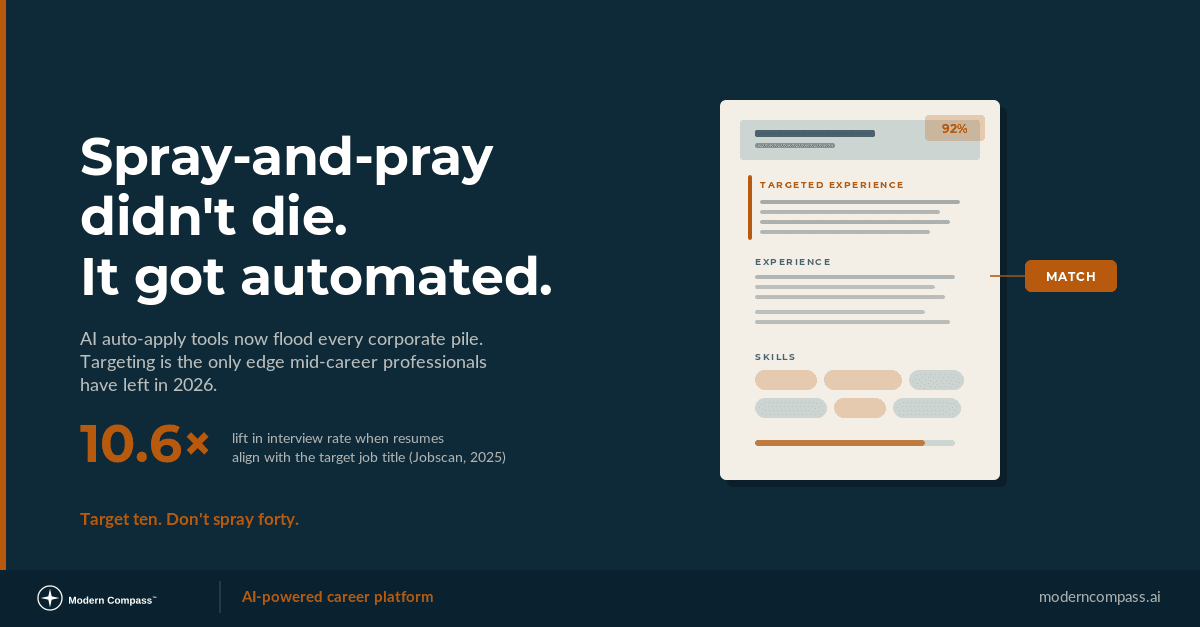
Greenhouse CEO Daniel Chait has described the current hiring market as an "AI arms race": job seekers firing off bot-assisted applications at unprecedented scale, recruiters drowning in volume, and companies increasingly unable to separate real candidates from auto-generated ones. Greenhouse's 2025 Workforce & Hiring Report found that 34 percent of recruiters now spend up to half of their working week filtering spam and junk applications. Spray-and-pray didn't stop working. It got automated. And you cannot out-spray a bot.
The question that earns you a callback in 2026 isn't "how many applications should I send?" It's "which ten, and how?"
Mid-career professionals with 10, 15, 20 years of real results deserve a better strategy than hoping the right recruiter happens to pull their resume from a pile of 400. This is how that strategy actually works, backed by the data most career advice still ignores.
The Volume War You Cannot Win
The hiring funnel for mid-career roles has collapsed in ways most job seekers do not see clearly.
A single corporate job posting now attracts around 250 applications on average, with senior roles often drawing 500 or more. Only about 3 percent of applicants make it to an interview, down from roughly 15 percent in 2016. The bottleneck is getting worse, not better. And a meaningful slice of the postings you are applying to were never going to be filled in the first place.
Then land the interview: a tailored resume + matching cover letter for $5.99$12(launch pricing).
Greenhouse's data shows that roughly one in five active job listings is a "ghost job." A March 2025 LiveCareer survey of 918 HR professionals found that 45 percent admit they regularly post jobs with no intent to hire for them in the near term, with another 48 percent doing so occasionally. Some postings exist to build a talent pipeline. Some exist to placate internal stakeholders. Some exist because nobody took them down after the req was pulled.
So the math of the generic application goes like this. Your resume lands in a pile of 250 that now includes an estimated one-third submitted by AI auto-apply tools built specifically to look human. It has roughly a 1 in 5 chance of being for a role that was never real. And the recruiter reviewing it is burned out from filtering auto-generated applications that have been getting harder to spot. 91 percent of recruiters have now encountered candidate deception, from prompt-injection tricks hidden in resumes to fully AI-generated work samples. The trust floor has dropped out.
This is not a market where effort guarantees traction. It is a market where effort allocation does.
The ATS Rejection Myth Is Misdirecting Your Effort
If you have spent any time reading job search advice, you have seen the stat: 75 percent of resumes are rejected by an applicant tracking system before a human ever sees them. You probably built your resume around dodging this rejection.
The stat is a myth. It traces to a 2013 startup called Preptel that shut down years ago, and it has never been replicated in credible research. A 2025 HR.com survey of recruiters found that 92 percent confirmed their applicant tracking systems do not automatically reject resumes. ATS platforms sort, filter, and rank. They rarely eliminate anyone without a human clicking a button.
The real bottleneck is not the machine. It is the human on the other side of it.
Harvard Business School's landmark "Hidden Workers: Untapped Talent" study makes the deeper point. Automated systems frequently do misroute qualified candidates, but less because the algorithm is aggressive and more because the job descriptions feeding them are overstuffed with wish-list requirements written by committee. The system then faithfully applies bad input at scale. Add in an overloaded human reviewer scanning the top third of page one for six seconds, and you get the actual filter: tired eyes looking for immediate, obvious fit signals.
Writing a resume to beat an algorithm is yesterday's problem. Writing one to earn a tired recruiter's next six seconds is today's. Those two strategies look different on the page.
What Targeted Actually Looks Like for Senior Roles
Targeted does not mean "I changed the summary paragraph." For a mid-career professional, it means structurally different applications for structurally different opportunities. Four moves separate targeted from spray-and-pray.
You research before you apply
Fifteen minutes of real investigation, not five. Read the most recent earnings call or investor letter. Scan the hiring manager's LinkedIn activity for what they have been talking about publicly over the last six months. Look at the team's shipped work if it is visible. You are trying to answer one question: what business problem is this role actually solving? The job description is downstream of that problem. Your application needs to be upstream of it.
You decode the job description instead of reading it at face value
Most postings are written by committee, padded with wish-list requirements, and shaped by internal politics you cannot see. A line like "experience leading cross-functional digital transformation initiatives" might mean the company is mid-migration and in pain, or it might mean the CEO used the phrase in an all-hands and HR added it to every posting that quarter. Your task is to identify the non-negotiable capabilities, separate them from the padding, and figure out what problem the hire actually solves.
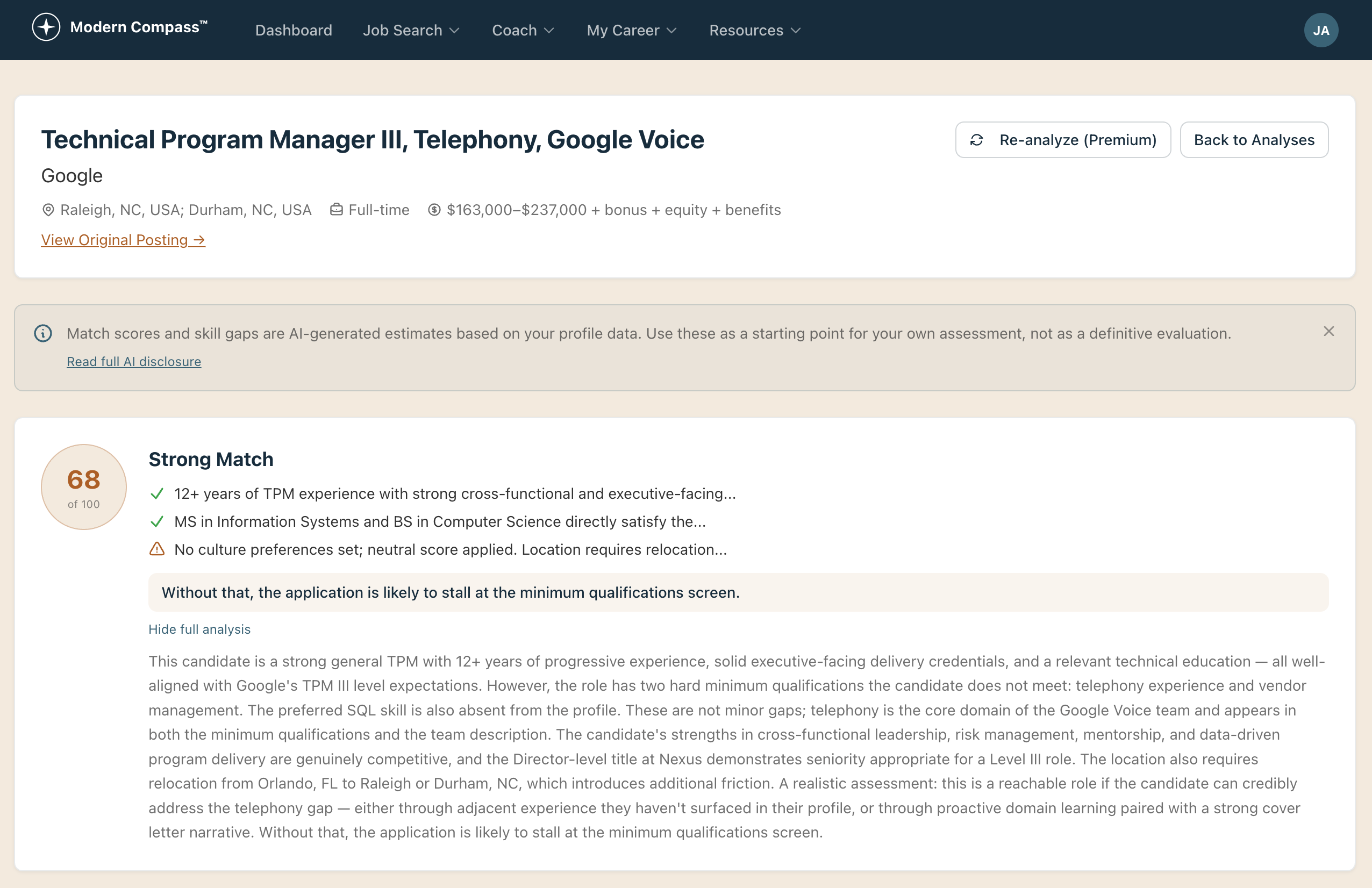
This is the work the Job Analysis tool on Modern Compass does automatically. Paste in a job description and it maps the real requirements versus the padded ones, flags the signals a hiring manager is likely scanning for, and shows where your background aligns and where it does not. If you want to see how one of your target roles actually reads underneath the corporate wallpaper, the Job Analysis tool runs in under a minute and costs nothing.
You customize with intention, not cosmetics
Tailored does not mean "I copy-pasted a keyword into my summary." The research on this is clearer than generic advice suggests. Jobscan's February 2025 study of 442 job seekers found that aligning your resume title and top-of-page content with the target job title increased interview rates by 10.6x. A separate analysis of 15,000 applications cited by Resumly put callback rates at 11.7 percent for resumes optimized for both readability and keyword alignment, compared with 4.2 percent for generic versions.
Real customization is structural. A resume written for a Series B startup scaling its operations team should read fundamentally differently than a resume for a Fortune 500 modernization initiative. Different hero metrics surfaced at the top. Different accomplishment bullets elevated. Different language that matches what the hiring manager already believes about the role. If you have never stress-tested how your resume reads against a specific posting, the free resume audit is a useful starting point.
You track what is working
A targeted search is a project with data, not a prayer with hope. After every 10 applications, review your callback rate by industry, by role seniority, by referral versus cold. Note where conversations stall and where they move. Patterns show up quickly when the sample is intentional. They never show up in a spray, because the signal is drowned in noise.
Why 10 Targeted Applications Beat 40 Generic Ones
The pushback is obvious. "I can send 40 generic applications in the time it takes to send 10 targeted ones. More shots, more chances."
The research says the opposite. Jobscan's 2025 survey found that 10.6x lift in interview rate for title-aligned applications. The same dataset has repeatedly put the callback improvement from tailoring at roughly 40 to 60 percent per application, with some analyses pegging it higher. One industry study reported that job seekers who tailored every application averaged about 3.1 applications per interview, compared with 47 applications per interview for those who did not.
Work the math. Forty generic applications at a 2 percent interview rate gives you less than one interview. Ten targeted applications at a 10 to 20 percent rate gives you one to two interviews, from a quarter of the effort, with material you can actually use in the interview because you already did the research.
Those interviews are also better interviews. You walk in with context on the business problem, a point of view on how your experience applies, and a head start on the "why this role, why this company" question that derails half of senior candidates in round one.
Fewer applications. More conversations. Shorter overall search. That is the entire trade.
When Targeting Feels Too Slow
This is the part of the advice most job seekers resist, and the resistance is emotional, not intellectual.
Spray-and-pray gives you the illusion of momentum. You can count submissions. You can feel productive. Targeted search, in its first two weeks, looks slow from the outside. You submitted eight applications. Your neighbor submitted eighty. It is uncomfortable.
The discomfort is temporary. The U.S. Bureau of Labor Statistics reports that the median duration of unemployment has trended upward over the last two years, and industry data shows that roughly 40 percent of senior-role searches take longer than 90 days. You are not in a sprint. You are in a multi-month project. Projects are measured by progress toward outcomes, not by units of activity.
If you do not believe the math yet, test it on yourself. Spend two weeks spraying 30 generic applications. Spend the next two weeks sending 10 targeted ones with real research behind them. Track the callback rates. The data will make the argument better than any blog post.
For professionals who are not sure whether they are in the right role category to begin with, the symptom of endless "meh" callbacks is sometimes misaligned targeting, not misaligned resumes. The free Career Audit maps your direction across five dimensions in about 10 minutes, which is enough to surface whether you are applying narrowly to the right tier of roles or broadly to the wrong one.
Your Move
Pick one role this week. Not ten. One.
Spend 45 minutes on it. Read the company's most recent investor letter or product announcement. Read the hiring manager's LinkedIn posts from the last six months. Re-read the job description three times, underlining the words that appear more than once. Write one sentence on what business problem this hire solves, and one sentence on how your last 15 years of experience connect to that problem.
Then build the application around those two sentences.
One application done that way teaches you more about your own search than fifty done fast. Your career has always deserved more than a lottery ticket strategy. In 2026, with the bots playing the lottery on your behalf, it deserves that strategy more than ever.
Land Your Next Role
Advanced Salary Negotiation: How to Negotiate Equity, Benefits, and Total Compensation
Go beyond base salary. Research-backed strategies for negotiating equity, RSUs, benefits, and total compensation at the mid-career and senior level.