You've been writing resumes for over a decade. You know the fundamentals. And yet, something isn't clicking. Applications go out, callbacks don't come back.
The resume basics you learned in your twenties are actively working against you now. The rules changed. Your career grew. But your resume strategy probably didn't grow with it.
Most resume advice online is written for people entering the workforce. It tells you to use action verbs and quantify your results, as if you've never written a bullet point before. What it doesn't address is the specific challenge you face: distilling 10, 15, or 20 years of complex, overlapping experience into a document that gets a hiring manager to pick up the phone.
That's a fundamentally different problem than "how do I write my first resume." And it requires a fundamentally different approach. (If you're navigating this alongside a career change, the challenges compound further, and writing a resume for a career pivot is its own discipline.)
Your Resume Gets 6 Seconds, But Not in the Way You Think
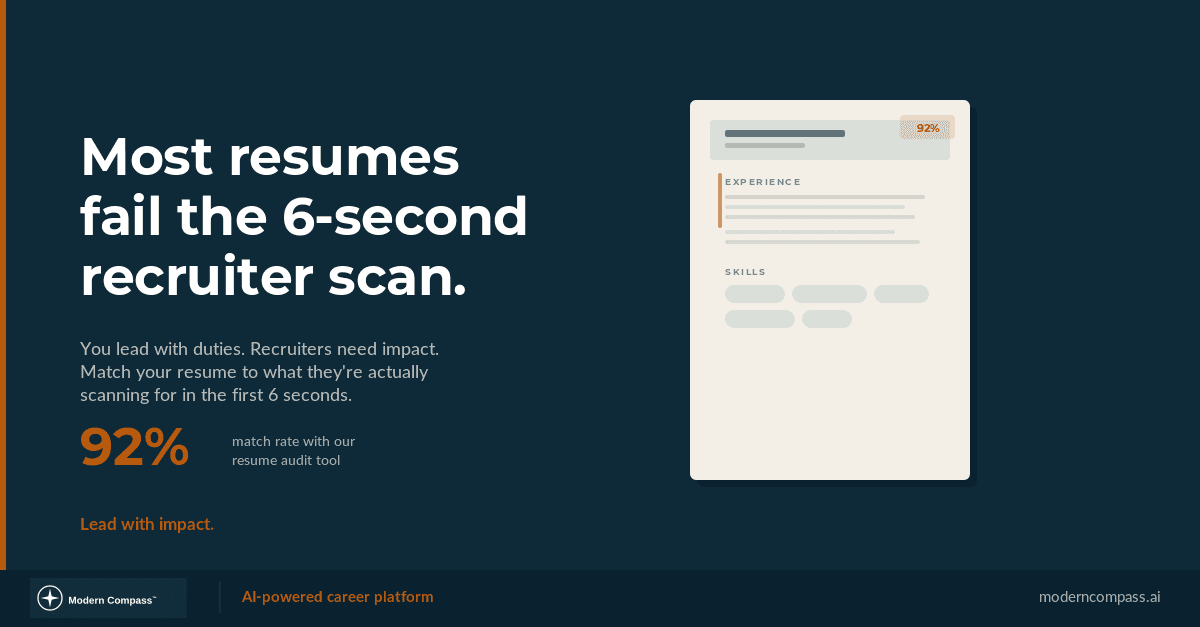
For experienced professionals with 10+ years in their field, the 6-second scan, a figure that Ladders' eye-tracking research helped popularize, works differently than most advice suggests. The hiring manager isn't checking whether you have relevant experience. At your level, they assume you do. Those 6 seconds are spent answering a different question: "Is this person operating at the level I need?"
That means the visual hierarchy of your resume matters more than the individual words. A hiring manager scanning a senior-level resume is looking for company names they recognize, titles that signal scope, and numbers that suggest scale. They're not reading your bullet points during that first pass.
This is why formatting isn't cosmetic at your level. It's strategic. The choices you make about what goes where on the page determine whether a hiring manager even gets to your accomplishments.
Then land the interview: a tailored resume + matching cover letter for $5.99$12(launch pricing).
Think about what you see when you glance at a resume for someone with 15 years of experience. If the top third of page one is a wall of text with no company names visible, no numbers, and a title that reads "Specialist" rather than "Director," you've already formed an impression. That impression happens before you read a single word. Your resume needs to win that visual judgment call.
Two Pages Is Not a Suggestion. It's Expected.
If you have 15 years of experience and you're cramming everything onto one page, you're signaling one of two things to a hiring manager: either your career has been thin, or you can't prioritize. Neither helps you.
Two pages is standard for anyone with a decade or more of experience. The question isn't whether to use two pages. The question is what to cut from page three.
Here's the priority stack that works:
Page one should cover your current or most recent role in detail (this should take up roughly 60-70% of the page), your professional summary, and the beginning of your second-most-recent role. Page one is your argument for why you're right for this specific job.
Page two covers earlier roles with decreasing detail, your skills section, education, and certifications. Roles from more than 10 years ago get one line each, or get cut entirely.
The mistake most experienced professionals make is giving equal weight to every role. Your job from 2009 doesn't need three bullet points. It might not need to be there at all. A hiring manager evaluating you for a VP role cares about what you did in the last five years, not the project you managed as an individual contributor in 2012.
Stop Writing Bullet Points Like Job Descriptions
You've probably heard the advice to focus on achievements, not responsibilities. That's correct, but incomplete. The real issue for experienced professionals is that your achievements are often organizational, cross-functional, and hard to attribute to a single person. "Led a team" doesn't capture what you actually do.
At the senior level, the bullets that land interviews follow a different pattern. They answer three questions: What was the business problem? What was your specific role in solving it? And what changed as a result?
Compare these:
Generic: "Managed cross-functional team to deliver product launch on time and under budget"
Specific: "Built and led a 12-person cross-functional team across engineering, design, and marketing to launch a B2B platform that generated $4.2M in first-year revenue, 40% above forecast"
The second version works because it includes scope (12 people, three departments), outcome ($4.2M revenue), and context (B2B platform, first-year, above forecast). A hiring manager can picture the complexity you managed.
But not every bullet needs a dollar sign. I've seen this trip up experienced professionals more than almost anything else. Some of your most impressive accomplishments involve organizational change, team development, or strategic decisions that don't have neat metrics. In those cases, be specific about the change you caused.
"Redesigned the engineering hiring process, reducing time-to-fill from 67 days to 31 days while improving 90-day retention by 22%" tells a clear story even though there's no revenue figure.
The Professional Summary Is Your Most Underused Real Estate
Early-career advice often dismisses the professional summary. At 5 years of experience, that's fair. You don't have enough to summarize yet. But at 15 years? Skipping the summary is a missed opportunity. It's the one section where you get to frame the narrative before a hiring manager forms their own interpretation from your job titles.
Your summary isn't a personality statement or an objective. It's a positioning tool. In 2-3 sentences, it should answer: "What do I do, at what level, and what makes my approach distinctive?"
A strong summary for a mid-career professional looks like this:
Product leader with 14 years building B2B SaaS platforms across fintech and healthcare. Track record of scaling product teams from 3 to 25 while maintaining sub-6-month time-to-market. Known for turning ambiguous executive mandates into shipped products.
Notice what that does: it establishes domain (B2B SaaS, fintech, healthcare), scope (scaled 3 to 25), a specific strength (speed), and personality (ambiguous mandates to shipped products). A recruiter reading this knows immediately whether you're a fit.
What doesn't work: "Results-driven professional with a passion for innovation seeking a challenging role where I can leverage my extensive experience to drive business growth." I've read some version of this sentence on thousands of resumes. It says nothing. Every word is doing the job of sounding professional while communicating zero information.
ATS Compatibility Matters, But Not the Way the Internet Tells You
There's a cottage industry of resume advice that treats Applicant Tracking Systems like a puzzle to be cracked. "Use the exact keywords from the job description!" "Avoid tables and columns!" "Put everything in plain text!"
Some of this is valid. Some of it is outdated or overblown.
What actually matters for ATS in 2026: use standard section headings (Experience, Education, Skills), submit as a PDF unless the application specifically asks for .docx, and don't put critical information inside headers, footers, or text boxes. Most modern ATS platforms can parse two-column layouts and basic formatting just fine. The systems that couldn't do this were common in 2015. They're not the norm anymore.
The keyword question is more nuanced than "copy and paste from the job description." If a role asks for "cross-functional collaboration" and your resume says "interdepartmental coordination," a modern ATS will likely match those. Where keywords matter most is with specific technical terms, certifications, and tools. If the job requires "Tableau" and you call it "data visualization," the system might not connect those dots.
The practical approach: read the job description carefully, make sure your resume uses the same terminology for technical skills and tools, and don't worry about matching every soft skill phrase word-for-word. If you're spending hours gaming an ATS with keyword density tricks, you're solving the wrong problem. The real bottleneck for experienced professionals is rarely the ATS. It's the human on the other side who glances at your resume and doesn't see what they need in the first few seconds.
Tailoring Doesn't Mean Rewriting. It Means Reordering.
"Tailor your resume to every job" is perhaps the most repeated and least helpful piece of resume advice. It sounds right. It's also impractical when you're applying to 15 roles and each one would require a meaningful rewrite.
The approach that actually works: maintain a master resume with every role, bullet, and accomplishment you might ever use. It can be 4-5 pages. Nobody sees this document but you. Then, for each application, you make three targeted adjustments.
Adjust the summary to emphasize the skills and experience most relevant to this specific role. This takes 5 minutes.
Reorder your bullets so the most relevant accomplishments for this role appear first in each position. Most people list bullets chronologically or by importance. Reorder them by relevance to the job you're applying for.
Trim or expand early roles based on their relevance. If you worked in healthcare 12 years ago and you're applying to a healthcare company, that early role gets more space. Otherwise, it gets a single line.
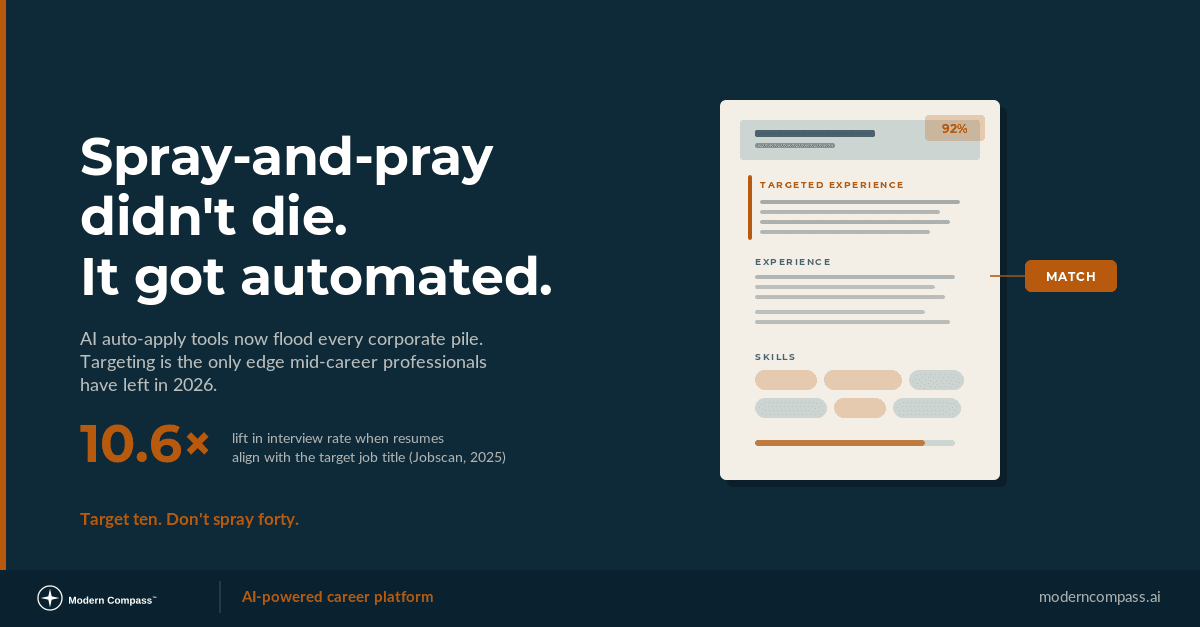
This approach takes 15-20 minutes per application, not 2 hours. And it makes a real difference because the hiring manager's 6-second scan hits the most relevant content first. (This is part of a broader shift from spray-and-pray job searching to a targeted approach.)
If you want to see how well your resume aligns with a specific role, the Job Match Analyzer can show you exactly where the gaps are. It takes about 60 seconds and costs nothing.
What to Do This Week
Pick one role you've applied to recently where you didn't get a response. Pull up the job description and put it next to your resume. Ask yourself: in the first 6 seconds of scanning my resume, would a hiring manager see evidence that I operate at the level this role requires?
If the answer is uncertain, start with your professional summary. Rewrite it to position you for that specific type of role. Then reorder your bullets so the most relevant work leads each section. That single exercise will teach you more about your resume than any list of tips ever could.
And if you want a second opinion, run your resume through the Resume Audit. It flags the specific issues that experienced professionals tend to miss, from quantification gaps to buried accomplishments. Think of it as a gut-check before you send your next application.
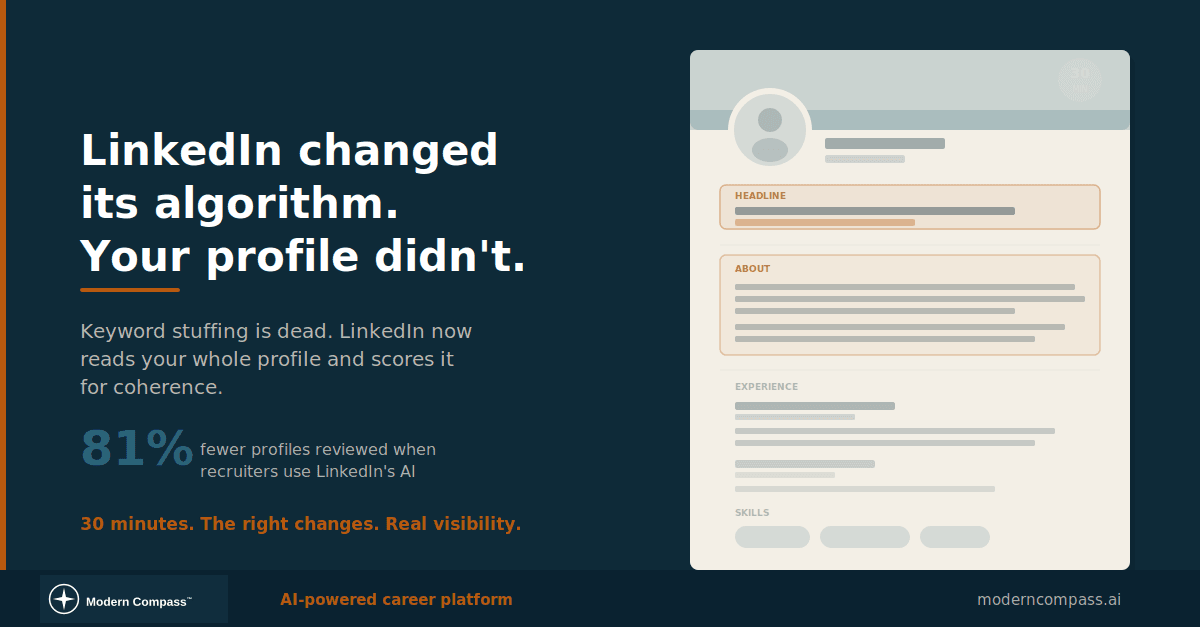
One last thing: your resume and your LinkedIn profile tell the same story — or they should. If they contradict each other, hiring managers notice. Once your resume is in shape, optimize your LinkedIn profile to match. It takes 30 minutes and affects every recruiter search you appear in.
Land Your Next Role
Optimize Your LinkedIn Profile in 30 Minutes
A hiring manager's guide to LinkedIn profile optimization for mid-career professionals. Fix the mistakes that make recruiters scroll past you.