You've managed teams, survived reorgs, shipped products under impossible timelines, and navigated more corporate politics than you'd care to admit. Then someone across the table asks you to "tell me about a time you showed leadership," and suddenly you're supposed to perform like a college senior at a campus career fair.
Something is off about that picture.
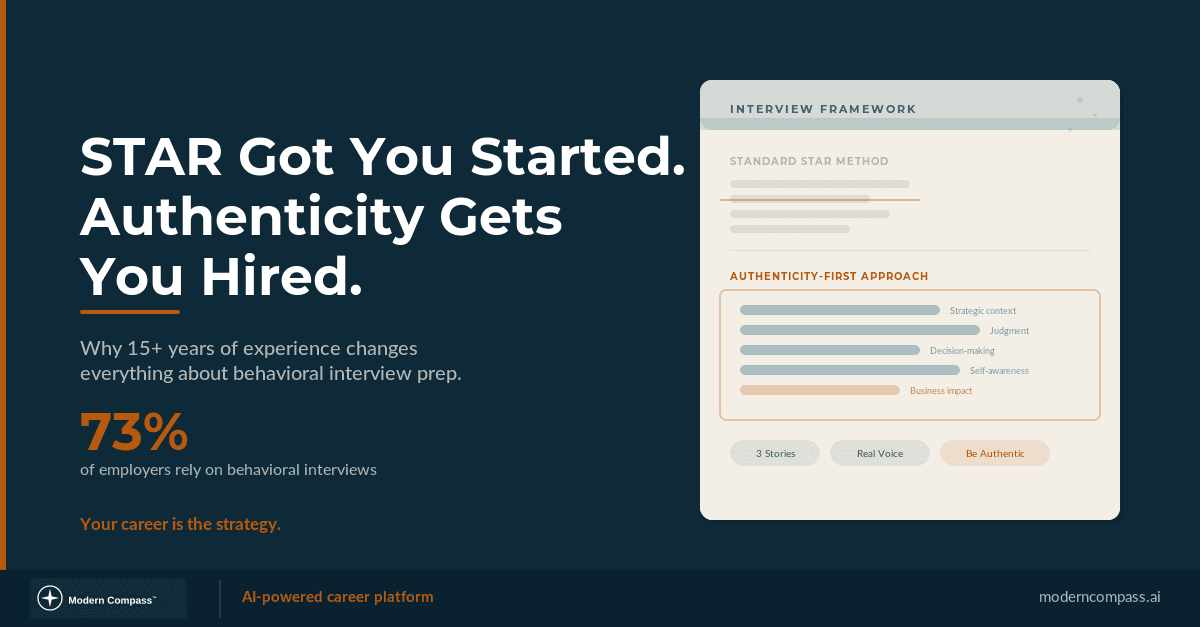
Behavioral interviews are the most common interview format in corporate hiring today, with roughly 73% of employers relying on them as a core screening method. The standard advice is everywhere: use the STAR method, prepare your stories, quantify your results. That advice isn't wrong. It's just incomplete, especially if you've been working for a decade or more.
But nobody talks about this: the skills that made you successful in your career, reading the room, adapting your communication, knowing when to go deep vs. when to stay high-level, are the same skills that matter in a behavioral interview. Most interview prep teaches you to suppress those instincts in favor of a rigid formula. That's a mistake.
I've been on both sides of the behavioral interview table, conducting them as a hiring manager at Disney, Salesforce, and Royal Caribbean, and sitting through them as a candidate for senior product and AI leadership roles. What I learned on the hiring side changed how I think about the candidate side entirely.
What Behavioral Interviews Actually Measure (It's Not What You Think)
The textbook answer is that behavioral interviews predict future performance based on past behavior. The research tells a more nuanced story. Studies on structured behavioral interviews show a , and predictive accuracy for future job performance hovers around 55%. That's real signal, but it's not the definitive assessment most hiring guides make it out to be.
What behavioral interviews actually reveal, at least when I was conducting them, is something harder to quantify: motivation, how someone handles complexity, and whether they can communicate a coherent narrative about their work. The candidate who gave a technically perfect STAR answer about a project they led but couldn't articulate why that project mattered to the business told me more than they intended. Not about their competence. About their fit for the role I was hiring.
I saw candidates with polished, structured answers who were clearly talented but focused on the wrong discipline entirely. They would have been great in a different role. And I saw candidates who stumbled through an imperfect answer but still got their story across in a way that resonated, because you could feel the authenticity of their experience. The second group got hired more often.
The STAR Method Is a Starting Point, Not a Destination
STAR (Situation, Task, Action, Result) is useful scaffolding. For someone early in their career who hasn't told many professional stories, it provides a structure that prevents rambling. Every career advice site teaches it. Every interview prep guide centers on it.
The problem starts when a 15-year veteran uses STAR the same way a new graduate does. They sound over-rehearsed. Worse, they often compress the most interesting parts of their experience, the messy decision-making, the trade-offs, the organizational dynamics, into a formulaic structure that strips out exactly the context a senior-level interviewer wants to hear.
At the senior level, the "Action" in STAR shouldn't just be what you did. It should include why you chose that approach over the alternatives, what you were weighing, and what business context shaped your thinking. A director-level candidate who says "I prioritized the enterprise integration over the consumer feature launch because our renewal pipeline was at risk" is demonstrating something that no amount of STAR formatting can fake: judgment.
What STAR Teaches
What Senior Candidates Need to Add
Describe the situation briefly
Explain the organizational stakes and competing priorities
State your task
Clarify why this was your problem to solve (scope of ownership)
Detail your actions
Show your decision-making process, not just the actions
Share the result
Connect the outcome to business impact, not just project metrics
The framework still works. You just need to treat it as a skeleton and add the muscle of strategic context around it.
Knowing which stories to lead with starts with knowing what the role actually values. If you have an interview on the calendar, paste the posting and your resume into the match analyzer — the gaps it flags are usually the exact competencies the behavioral questions will probe. Free, and it takes about a minute.
The Over-Complication Trap That Only Senior Professionals Fall Into
Junior candidates tend to under-prepare. They wing it, give vague answers, and forget to include results. Senior candidates have a different problem: they over-complicate.
I've watched experienced leaders turn a straightforward behavioral question into a 10-minute lecture on their leadership philosophy. They're trying to sound strategic. They want to demonstrate that they think at a higher level. The impulse makes sense. The execution backfires.
When I asked candidates about how they manage prioritization and handle risk, the strongest answers weren't the most elaborate ones. They were specific. One VP candidate described a single quarter where she had to choose between three product initiatives, all with executive sponsors, and walk me through how she made the call. Took about 90 seconds. I learned more from that answer than from the director who spent four minutes explaining his framework for stakeholder alignment.
The fix is counterintuitive for experienced professionals: go smaller, not bigger. Pick one specific moment. Give enough context to make it real (two or three sentences, max). Spend most of your time on what you actually did and why. Finish with the outcome in one sentence.
Authenticity Is the Only Unfair Advantage You Have
Every candidate at your level has been coached on STAR. Every candidate has prepared stories. Every candidate knows to quantify results. When everyone is running the same playbook, the differentiator isn't the playbook. It's you.
Behavioral interviews work best when the interviewee is authentic and shares detailed personal stories of their accomplishments. Not stories that sound good. Stories that are true, told in your actual voice, with the parts that were hard or uncertain left in.
This doesn't mean being unprepared. You should know your three best career stories cold, stories where you drove a meaningful outcome and can speak to the details without notes. But "knowing your stories" and "performing your stories" are different things. The goal is to sound like you're telling a colleague about something that happened, not reciting a case study.
Three signals that separate authentic answers from performed ones:
Authentic answers include a moment of uncertainty. "I wasn't sure this would work, but here's why I committed to it anyway." Performed answers present every decision as inevitable.
Authentic answers acknowledge other people's contributions naturally. "My engineering lead pushed back hard on the timeline, and she was right, so we restructured the approach." Performed answers make everything sound like a solo achievement.
Authentic answers sometimes include what you'd do differently. Interviewers at the senior level don't expect perfection. They expect self-awareness.
You're Interviewing Them Too
The standard behavioral interview advice ignores something important: at the 15-year mark, you aren't just answering questions. You're evaluating whether this is a company and team where you want to spend the next chapter of your career.
The questions an interviewer asks tell you a lot about how that organization thinks. If every behavioral question is about conflict resolution and working with difficult stakeholders, that's data. If they never ask about prioritization or strategic decision-making, that's data too.
Pay attention to the follow-up questions. A skilled interviewer who asks "what would you do differently?" after your STAR answer is probing for self-awareness and growth orientation. An interviewer who just nods and moves to the next question might be checking boxes on a rubric. Both tell you something about the environment you'd be joining.
You can also learn from what they don't ask. If nobody asks about how you manage risk, how you handle ambiguity, or how you apply business context to technical decisions, you're getting a preview of what that organization values. Or doesn't.
Your Prep Should Look Different at This Level
Forget the advice that tells you to prepare 8-10 stories for every possible competency. That's valuable for someone with limited experience who needs to manufacture coverage. You have 15 years of material. Your problem isn't having enough stories. It's choosing the right ones and telling them well.
Here's what to do the night before:
Pick three stories. Choose ones where you drove a real outcome, faced a genuine challenge, and can speak to the business context. (If you're not sure which accomplishments to highlight, identifying your career strengths is a good place to start.) Make sure at least one involves a failure or a pivot, something that went wrong and what you did about it.
For each story, know your opening line. Not a script. Just the first sentence, so you don't fumble the start. "Last year at [Company], our biggest enterprise client threatened to leave over a product gap" is a better opening than "So, um, let me think about a time when I had to deal with a stakeholder issue."
Practice telling them conversationally. Tell the story to your partner at dinner. If it sounds like an interview answer, you're over-polishing it. If it sounds like something that actually happened to you, it's ready.
Prepare two questions that the behavioral interview should answer for you. These become your anchor for the conversation: not just answering their questions, but using the interaction to gather your own signal about the team and culture. (This fits into a broader strategy of treating your job search as targeted, not reactive.)
What to Do When You Don't Have the Perfect Story
Sometimes the interviewer asks about a situation you genuinely haven't faced. Most advice says to pivot to a related story. That works, but there's a better first move: say so.
"I haven't managed a full P&L, but I've owned budget decisions for a $12M product line. Let me tell you about that." Honesty about scope, followed by a strong adjacent example, builds more trust than a stretch story that an experienced interviewer will see through.
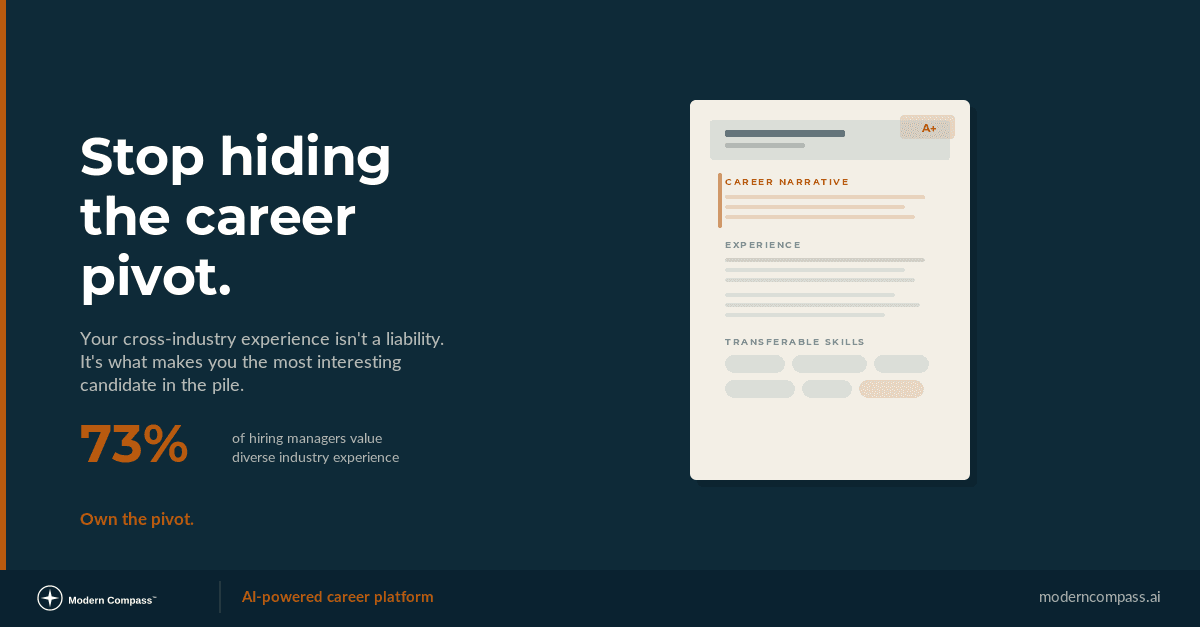
The worst thing a senior candidate can do is fabricate relevance. This is especially true if you're navigating a career change, where honesty about transferable skills matters more than forced parallels. At your level, interviewers expect gaps. Nobody has done everything. What they're listening for is self-awareness about what you have and haven't done, and the ability to draw transferable lessons from real experience.
Start With Three Stories This Week
Don't prep for behavioral interviews by memorizing frameworks. Prep by identifying three moments in your career where you did something you're proud of, something that was hard, and something that changed how you work.
Write each one down in three sentences: what happened, what you did, how it turned out. If you need more than three sentences, you're over-explaining. If you can't get to three sentences, the story might not be strong enough.
Then tell them out loud to someone who doesn't work with you. If they ask follow-up questions, the story has hooks. If their eyes glaze over, try a different one.
If you want a structured starting point for identifying where your career strengths actually lie, the Career Audit takes about 10 minutes and maps your experience against common career trajectories for professionals at your level. It won't prep your stories for you, but it'll help you see which chapters of your career contain the strongest material.
The best behavioral interview answer you'll ever give won't come from a framework. It'll come from knowing your own career well enough to speak about it like it matters to you. Because when it does, it shows.