I remember spending weeks a few years ago mastering a complex workflow in a specific software program. I felt like a wizard. Then, six months later, a single update automated the entire process. I felt obsolete for about ten minutes, until I realized something important: my value wasn't in pushing the buttons. It was in knowing why we were pushing them.
That experience scaled up is the entire 2026 job market. But most advice about how to stay relevant in your career gets the problem wrong. It tells you to learn more, as if relevance were a private stockpile of skills you top up like a retirement account. After twenty years of watching careers rise and stall, I'd put it differently. Relevance is not what you know. It's what the people who make decisions about you know that you know.
That distinction changes what you should actually do. Here are five shifts, in the order I'd make them.
Stop expecting your employer to keep you current
This one is uncomfortable and the data is blunt. Even as demand for AI capability surges, the share of organizations offering formal upskilling programs fell to 26% this year, down from 35%. Read those two trends together: companies want skills they've stopped paying to build. The gap between what your employer demands and what your employer develops is now yours to close.
The mid-career trap is assuming the company that promoted you twice will also re-skill you. It promoted you for what you already did. Harvard Business Review's research this spring on lengthening careers found that professionals in their "pivotal 40s" face peak workload exactly when they most need time to retool, and that organizations largely haven't redesigned mid-career work to allow it.
So claim the time unilaterally. A weekly hour, calendar-blocked and defended like a client meeting. Not for vague "learning," but pointed at the next shift below.
With estimates putting half of current skills on a path to obsolescence within a few years, the durable asset isn't any individual skill. It's how fast you acquire the next one. Learning velocity compounds. A stockpile depreciates.
The practical version: always be in the middle of learning exactly one thing, and attach it to a live project so it produces evidence instead of certificates. Learning prompt engineering? Use it on the feature you're shipping this quarter. Learning data storytelling? Build the deck for your next business review with it. Skills learned in the abstract evaporate. Skills learned against a deadline stick, and they leave a trail someone else can see.
That trail matters more than ever, because employers are verifying rather than trusting. Skills-based assessments are now standard in hiring, and verified AI and technical skills carry meaningful wage premiums. US job postings requiring AI skills grew 144% year over year as of April. The market is loudly telling you which lane has momentum.
Make your relevance legible
Here's my contrarian take, and the one I'd defend hardest: most mid-career professionals who feel irrelevant aren't behind on skills. They're behind on legibility. Their capability is real but invisible, locked inside work products nobody outside their team ever sees.
You can be the most adaptable person in the building, and if your last visible artifact is from 2023, you are irrelevant in every conversation where you're not in the room. Those conversations are where promotions, layoff lists, and project staffing get decided.
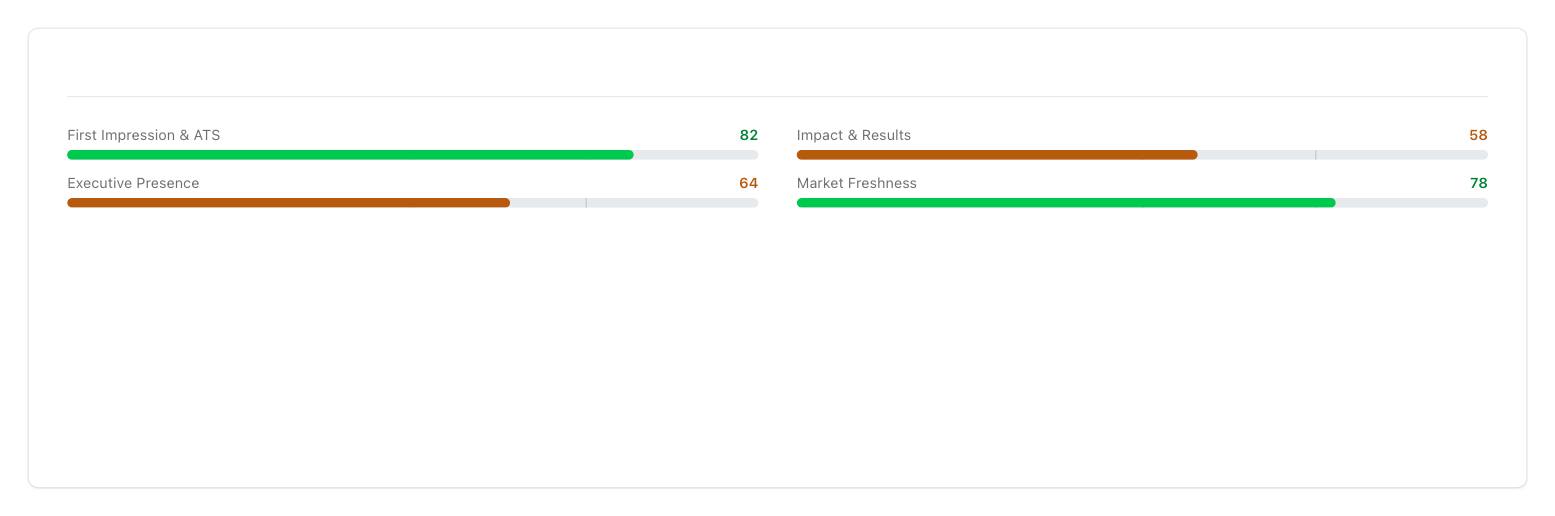
Legibility doesn't require becoming a LinkedIn influencer. It looks like: a short written summary when you solve something hard, sent where decision-makers will see it. A skills section on your profile that uses current language for what you do (the resume audit will show you in about a minute whether yours reads as 2026 or 2019). One internal demo a quarter. Quiet competence was a fine strategy in a stable market. It's a liability in a churning one.
Section scores for a sample operations director resume: solid ATS basics, weaker impact evidence and executive framing. Generic language costs points in every category.
Be more human, but specifically
Every future-proofing listicle says "double down on human skills." It's true and useless at that altitude. The human skills that actually command a premium are the ones AI exposes by contrast, and they're narrower than "empathy."
Judgment under ambiguity: making a defensible call when the data genuinely doesn't decide it. Trust repair: the conversation after the missed deadline, which no tool will ever conduct. Taste: knowing which of the AI's five drafts is the one worth shipping, and why. Roles built around these aren't getting automated. They're getting more valuable, because the volume of machine output that needs human judgment is exploding.
Notice what these have in common: they're all things you've been building for fifteen years without calling them skills. The work is naming them, claiming them, and putting them where they're visible. Which is the previous shift again. It usually is.
Treat AI as a daily tool, not a topic
You don't need to become technical. You need fifteen minutes a day of actual use. Draft the status update with it, pressure-test your plan against it, make it argue the other side of your decision. Comfort comes from contact, and right now comfort is being read as a hiring signal: nearly three quarters of hiring managers say they weigh a candidate's ease with AI tools.
The professionals struggling most with AI aren't the skeptics. They're the ones who formed an opinion without forming a habit.
If you want an honest read on where you currently stand, the AI fluency assessment takes five minutes and doesn't grade on a curve.
The question to sit with
Change isn't a season anymore. It's the climate. But the response that works isn't frantic accumulation, and it certainly isn't working more hours. It's a calmer discipline: one skill in progress, attached to real work, made visible, repeated.
So, one question for this week: if your name came up in a staffing conversation tomorrow, in a room you're not in, what would the most recent evidence of your relevance be? If you don't like the answer, you know exactly which of the five shifts to start with. And if the question itself feels hard to answer, the career audit is a structured way to find out what's actually missing.