I want to pick a fight with the most popular piece of career advice in the English language.
"Follow your passion." You've heard it at commencement speeches, read it in bestsellers, seen it on motivational posters hung in offices where nobody looks particularly passionate about anything. Steve Jobs said it. Oprah said it. Your well-meaning aunt has probably said it at Thanksgiving while you were trying to eat mashed potatoes in peace.
And if you're a mid-career professional feeling directionless, this advice is actively making things worse.
Not because passion is bad. Passion is great when it shows up. The problem is treating it as a prerequisite for career decisions rather than a byproduct of doing meaningful work. When you tell someone who's already questioning their path that they need to find their passion first, you've just added another thing they're failing at.
The Passion Trap
Research from Stanford psychologists Paul O'Keefe, Carol Dweck, and Gregory Walton suggests that believing passions are "found" rather than developed actually makes people less likely to persist when a new interest gets difficult. If this were my true passion, it wouldn't feel this hard. So they abandon it and keep searching for the thing that will feel effortless. Which doesn't exist.
Mid-career professionals fall into a specific version of this trap. You've been working for 10, 15, maybe 20 years. If you had a singular passion, the logic goes, you'd have found it by now. The fact that you haven't must mean something is wrong with you. Maybe you're not creative enough. Not brave enough. Not "self-aware" enough.
None of that is true.
What's actually true is that most capable adults have multiple interests, and those interests change over time in response to experience, life stage, and context. You're not broken for not having a burning, singular calling. You're normal. The people who do have that tend to be outliers, and building career advice around outliers is like building nutrition guidelines around Olympic swimmers.
Here's what I'd replace "follow your passion" with: find a direction you're willing to walk in, and start walking.
That sounds less inspiring, I know. It won't end up on any motivational posters. But it works for the way career decisions actually unfold for people who have mortgages, kids in daycare, and aging parents to think about.
A direction is not a destination. You don't need to know that you want to be the VP of Product at a climate tech company by 2028. You need to know that you want to move toward work that involves building new things rather than maintaining old systems. Or that you want more autonomy and less managing. Or that the industry you're in bores you and you're curious about a different one.
Directions are testable in ways that passions aren't. You can take a small step in a direction and see how it feels. You can't take a small step toward a passion you haven't identified yet.
Here's one of the smallest tests available: find a real posting in the direction you're curious about, paste it and your resume into the match analyzer, and see how the fit actually reads. You're not applying — you're gathering data on a direction, and it takes about a minute.
How to Find Your Direction (Without a Retreat in Sedona)
Skip the personality assessments. I know that's heresy in the career coaching world, but a Myers-Briggs result isn't going to tell a 38-year-old operations manager what to do with the next chapter of their career. You already have something far more useful than any assessment: a decade-plus of lived professional experience. The data is in your history. You just haven't analyzed it yet.
Look at your energy, not your skills.
Skills tell you what you can do. Energy tells you what you should. Most mid-career professionals have accumulated skills in areas that drain them, because the market rewarded those skills and the paychecks followed. Your resume is a record of what other people valued about you. Your energy patterns are a record of what you value about yourself.
Try this: look at your calendar from the past two weeks. Highlight every meeting or task that you approached with genuine interest (not obligation, not duty, genuine interest). Now highlight everything you dreaded or postponed. You don't need a personality quiz to see the pattern. The pattern is already living in your Google Calendar.
Pay attention to the problems you volunteer to solve.
When something goes wrong at work and it's not your job to fix it, but you get pulled in anyway because you're curious about the problem? That's a signal. People gravitate toward problems that match their cognitive wiring. An operations-minded person wanders into process breakdowns. A people-oriented person gets drawn to team conflicts. A strategy thinker can't resist picking apart competitive positioning, even when it's someone else's department.
The problems you voluntarily engage with reveal more about your direction than any values card sort exercise.
Notice what you teach.
What do junior colleagues come to you for? Not what your job description says you should mentor on. What do people actually seek you out to learn from? If you're the unofficial go-to for navigating internal politics, that tells you something different than being the go-to for data analysis, which tells you something different than being the person everyone wants to brainstorm with.
Your informal teaching reputation is a mirror. It reflects back the things you're both good at and engaged enough to explain well. Those two qualities together are rare and worth following.
The Courage Gap Is Smaller Than You Think
Most people stuck at the career direction stage believe the gap between where they are and where they want to be is enormous. It almost never is. In my experience, the average mid-career professional is two or three deliberate moves away from work that fits them significantly better. Not a completely different career. Not going back to school. A different role within their industry, or the same type of role in a different industry, or a structural change (going from corporate to consulting, from a big company to a 200-person one, from an individual contributor track to management or vice versa).
The hard part isn't the gap. The hard part is giving yourself permission to want something different when the thing you have looks good on paper.
I talk with a lot of professionals who describe their dissatisfaction almost apologetically, as if wanting more from their career when they're already doing well is greedy or ungrateful. There's a specific guilt that comes with being objectively successful and subjectively unfulfilled. It feels like a luxury problem, and luxury problems don't deserve real attention.
They do, though.
Spending 40 to 50 hours a week on work that doesn't engage you isn't a small issue. It seeps into everything: your energy at home, your patience with your kids, your sleep, your health. The people who dismiss career dissatisfaction as a "first world problem" are usually the same people medicating their own dissatisfaction with overwork or expensive hobbies or a third glass of wine on weeknights.
One Thing to Try Before Friday
Open a note on your phone. Over the next five workdays, write down every moment where you feel a spark of genuine engagement. Not satisfaction from completing a task. Not relief. A moment where your brain actually lights up and you think, huh, this is interesting.
It might happen during a specific type of conversation. While reading an article about a particular industry. During a problem-solving session that pulls on certain skills. While mentoring someone. While arguing for something you believe in.
After five days, read your notes. You'll likely see two or three threads. Those threads aren't your passion. They're better. They're your direction.
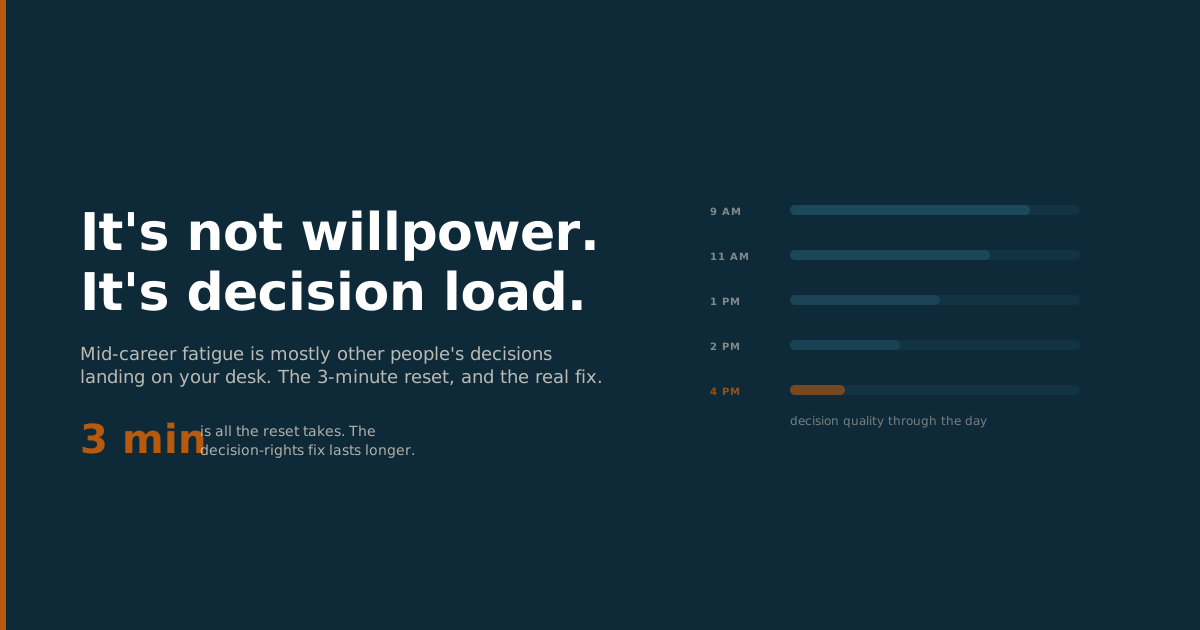
Once you have a direction, strategic career planning can help you turn it into a roadmap. And if you're finding it hard to even start because every option feels equally possible, you might be dealing with decision fatigue — which has a surprisingly simple fix.
Grow as a Leader
Why Your Best Directors Aren't Getting Promoted to VP
Discover the 6 overlooked factors that determine Director-to-VP promotions. Learn why strong performance alone won't get you promoted and what executives actually evaluate.