Strategic Career Planning: Why Your 5-Year Plan Is Already Outdated
Future-Proof Your CareerFebruary 6, 20269 min read
strategic career planningcareer roadmaplong-term career plancareer planning for mid-career professionalscareer-growth
You've been told to build a 5-year career plan since your first management training. Write down where you want to be. Reverse-engineer the steps. Check the boxes annually. It sounds disciplined. Strategic, even.
Ten or fifteen years in, you start to notice something. The professionals who actually navigate career inflection points well aren't following a rigid 5-year roadmap. They're working with a directional north star and shorter, more adaptive planning cycles. And they're using better data than gut instinct to decide what to work on next.
Strategic career planning at the mid-career level isn't about predicting where you'll be in 2031. It's about building the self-awareness, skill clarity, and decision-making framework to respond well when the next reorg, opportunity, or industry shift shows up at your door.
The 5-Year Plan Problem Nobody Talks About
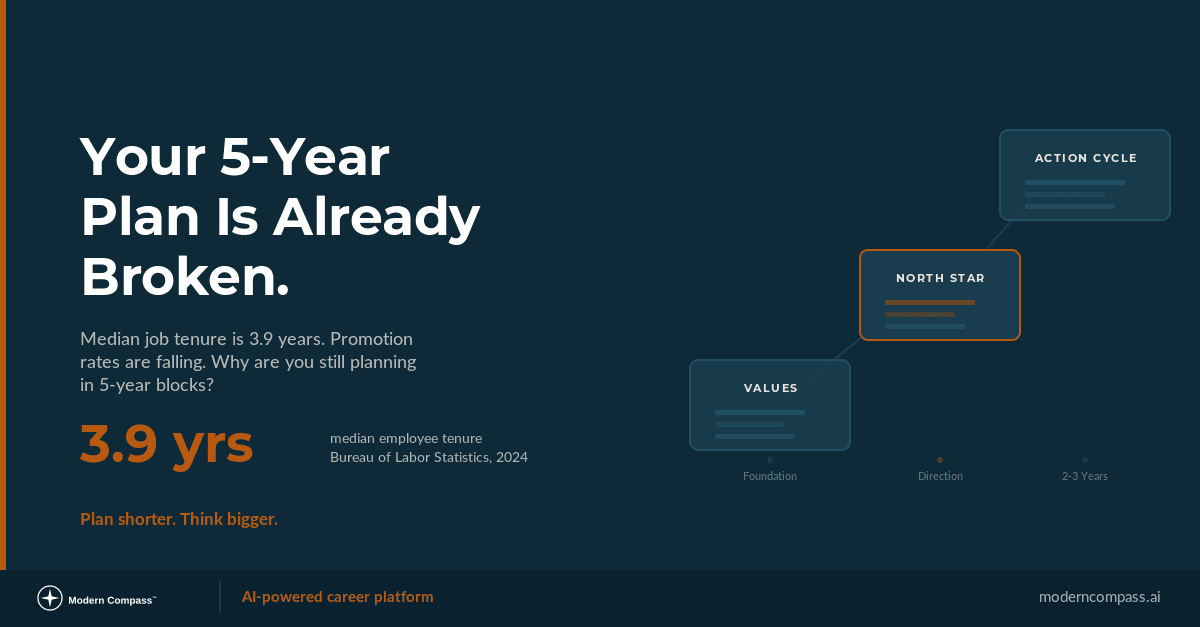
The Bureau of Labor Statistics reports that median employee tenure dropped to 3.9 years in January 2024, the lowest since 2002. Promotion rates fell to roughly 3.8% across industries that same year. The career environment your plan assumes will exist in five years probably won't.
I learned this firsthand. Early in my career, I was reorged into a digital marketing role that was nowhere near my product leadership trajectory. It wasn't a great fit. But I knew the move required me to prove myself in a new context before I could reassess my direction. That detour eventually led me back to my ideal path, and I came out of it with a more diverse background that made me a stronger leader. The plan broke. The strategic thinking behind it didn't.
Five years is long enough for your industry to restructure, your company to pivot, and your own priorities to shift in ways you can't predict. The professionals who treat their 5-year plan like a contract end up either rigidly pursuing goals that no longer serve them or abandoning planning entirely because it feels pointless.
Neither outcome is strategic.
How Far Ahead Should You Actually Plan Your Career?
For mid-career professionals, the most effective planning horizon is two to three years for concrete action plans, anchored by a longer-term directional vision that you revisit regularly. Rigid 5-year plans break down too often to be useful. Shorter cycles give you enough runway to develop meaningful skills while staying responsive to change.
The most effective approach I've seen, both in my own career and in working with mid-career professionals through coaching, is a layered model. You need two things working together:
A directional north star. This isn't a specific job title or salary number. It's a clear sense of what kind of work energizes you, what impact you want to have, and what kind of life you want your career to support. Your north star might be "lead product strategy at a company where AI is transforming an established industry" or "build and mentor a high-performing team while keeping my evenings free for my family." It's directional, not prescriptive.
Two- to three-year action cycles. Within that north star, you plan in shorter, more concrete windows. What skills do I need to develop in the next two years? What roles should I target? What relationships do I need to build? These cycles are specific enough to act on and short enough to adapt when circumstances change.
This isn't lowering your ambitions. It's being honest about the pace of change. A 2025 study in Frontiers in Psychology found that career sustainability is "complex, non-linear, and dynamic," and that individuals' goals change over time in ways that complicate rigid long-term planning. Shorter cycles with a stable directional anchor give you both ambition and adaptability.
Start With What You Actually Value (Not What You Think You Should)
Most strategic career planning advice starts in the wrong place. It starts with goals. What role do you want? What salary? What title?
Those are outputs. They're not foundations.
The foundation is knowing what you actually value. Not what your LinkedIn network values, not what your industry rewards, not what your parents expected. Research from the University of Pennsylvania's career services group confirms that when personal values align with career goals, professionals experience meaningfully higher satisfaction, lower burnout, and better long-term outcomes.
But most mid-career professionals haven't done this work rigorously. You might say you value "growth" and "impact," but what happens when a high-growth role requires 60-hour weeks and your family needs you home by 6? If you haven't ranked your values against each other, you'll make that decision reactively, under pressure, and probably regret it.
The Values Prioritization exercise forces this ranking. It takes about 15 minutes and makes you choose between competing priorities through guided comparisons. The output isn't a feel-good list of things you care about. It's a ranked hierarchy that exposes hidden conflicts. The ones that only surface when you're staring at two job offers and can't explain why neither feels right.
That hierarchy becomes the filter for every career decision that follows. Autonomy ranks above compensation? The VP offer with a micromanaging CEO becomes an obvious no, even when the salary is 40% higher. Meaning ranks above prestige? The lateral move to a mission-driven company stops looking like a step backward.
Use Job Analysis to Find the Gaps You Can't See
Once you know what you value and where you're headed directionally, the next question is practical: what do you actually need to develop to get there?
Most people answer this question from memory. They think about the skills listed on job postings they've seen, or feedback they've received in reviews. That works for obvious gaps. It completely misses the non-obvious ones.
When I ran the Job Match Analyzer on roles I was targeting, I discovered that revenue operations was a significant component of several positions I had my eye on. That wasn't on my radar at all. I would have continued investing my development time in areas I already understood while completely missing a skill domain that was becoming critical for the roles I wanted.
This is the difference between planning from assumption and planning from data. The Job Analyzer breaks down any job description into its component requirements, matches them against your profile, and surfaces the specific gaps you need to close. It catches the blind spots that self-assessment can't.
I recommend running the analyzer on at least two or three roles that align with your north star direction, even if you're not actively job searching. The patterns across multiple analyses tell you something a single analysis can't: which skill gaps keep showing up across your target roles. Those recurring gaps are your most valuable development priorities. They're the investments that open multiple doors, not just one.
The development goals that come out of this analysis look different from the ones you'd set on your own. More specific. Often surprising. Grounded in what the market actually requires rather than what you assume it does.
Why a Coach Changes the Math on Career Planning
Tools give you data. They can tell you what you value, where you have skill gaps, and how your career health scores across different dimensions. That's essential raw material.
But strategic career planning isn't a data problem. It's an interpretation problem.
A career coach does what the tools can't: they help you make sense of the data in the context of your specific situation. They push back on the stories you tell yourself about what's possible. They notice patterns you're too close to see.
I've watched mid-career professionals run the Career Audit and get their results, then sit with those results for weeks without acting. The scores were clear. The dimension breakdown showed exactly where the pressure was. But translating that into a concrete next move? That requires a different kind of thinking. The kind that happens in conversation with someone who has no stake in your decision except your success.
This is especially true at the mid-career level, where decisions carry real weight. You're not choosing between entry-level jobs. You're evaluating whether to stay and push for VP, leave for a lateral move that opens a new industry, or take a step back in title for a role that better fits your values. The stakes are different when you have a mortgage, a family, and a reputation you've spent a decade building.
A coach helps you stress-test those options against your north star, your values hierarchy, and the skill gap data, all at once. They also hold you accountable to the plan you build. Without that external accountability, even the most well-designed career strategy tends to lose urgency somewhere around week three. I've been guilty of this myself.
If you want a quick pulse check before a coaching conversation, the Career Quick Check takes two minutes and identifies which of five career dimensions is creating the most pressure right now.
Building Your Adaptive Career Plan: A Practical Framework
Stop writing a 5-year plan. Instead, build a living strategic plan with these three layers:
Layer 1: Your values foundation. Complete the Values Prioritization exercise. Revisit it annually or whenever you face a major decision. Your values evolve as your life does, and your plan needs to reflect that.
Layer 2: Your north star direction. Write one to two sentences describing the kind of professional life you're building toward. Not a specific title. A direction. Review it every six months and ask yourself honestly: does this still resonate, or has a new possibility emerged that shifts it?
Layer 3: Your current action cycle (2-3 years). Run the Job Analyzer on two or three roles that align with your north star. From the gap analysis, identify three to five specific development goals. Not "improve leadership skills." Try "build revenue operations fluency through a cross-functional project by Q3" or "develop board communication skills by presenting quarterly to the advisory committee."
Check your action cycle quarterly. Are your development goals still the right ones? Has a reorg, a new role, or a market shift changed the calculus? Adjust the actions without abandoning the direction.
The professionals who navigate mid-career inflection points best are the ones who hold their direction loosely enough to adapt but firmly enough to avoid drifting. They plan strategically not because they can predict the future, but because the act of planning builds the muscle for making better decisions when the future surprises them.
If you want to see where you actually stand, the Career Audit takes about 15 minutes and scores you across five career dimensions. Bring those results to a coaching conversation and you'll have the raw material to build your first action cycle this week.
Grow as a Leader
Decision Fatigue Is Real: Here's How to Hit the Reset Button
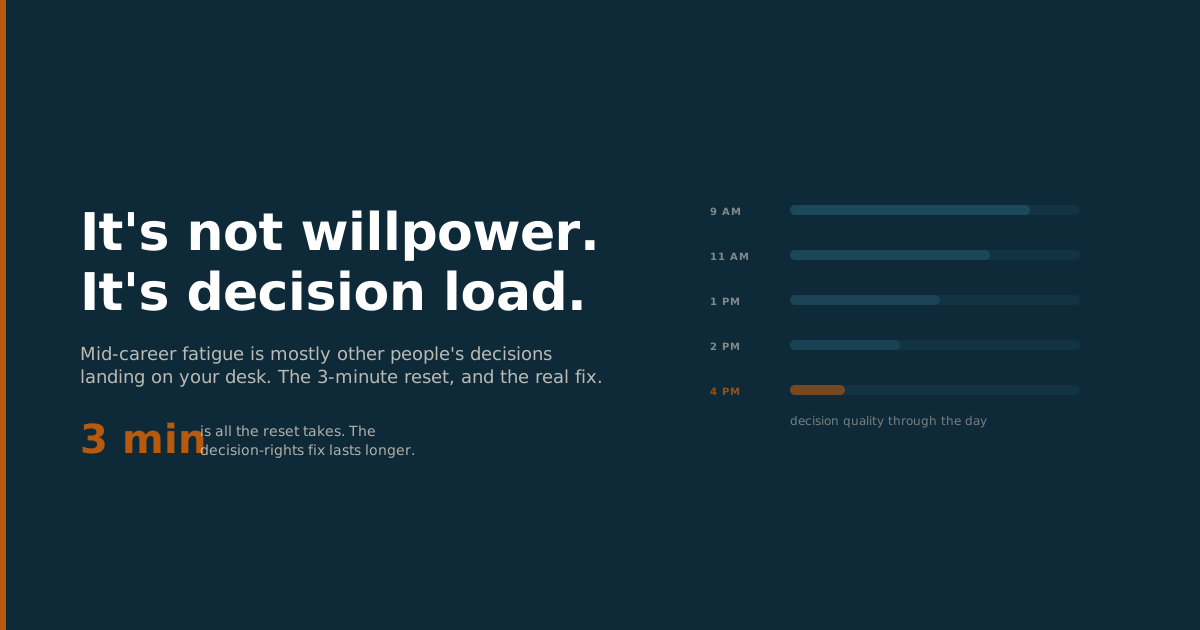
Decision fatigue isn't a willpower problem at the mid-career level. It's a decision-rights problem. The 3-minute reset, plus the fix nobody talks about.