Setting Career Goals That Actually Compound: Beyond Basic SMART
Future-Proof Your CareerFebruary 6, 20268 min read
setting career goals SMARTSMART career goals examplescareer goal setting frameworkmid-career goal settingcareer-growthgoal-setting
You already know what SMART goals are. You've been setting them in performance reviews for a decade. And if you're being honest, most of them evaporated by March. The problem isn't the framework. The problem is how mid-career professionals typically apply it: isolated goals that check a box but don't build toward anything larger.
I've spent my career in product and AI leadership at Disney, Salesforce, and Royal Caribbean. Along the way, I've set goals that transformed my trajectory and goals that looked impressive on paper but moved nothing forward. The difference came down to one shift: I stopped treating SMART goals as standalone targets and started using them as compounding milestones toward a bigger vision.
Why Most SMART Goals Fail After Year Eight
For professionals with 10+ years of experience, SMART goals fail not because the framework is broken but because the core problem has shifted. Early-career professionals need structure around vague ambitions. Mid-career professionals need direction, not structure. Applying SMART criteria to the wrong goal just makes you efficiently walk the wrong path.
Early in your career, almost any well-formed goal moves you forward because the surface area of useful experience is enormous. Learn SQL. Get certified. Lead a small team. All valuable regardless of the specific trajectory. But mid-career goals carry higher stakes. A two-year investment in the wrong direction costs more than just time. It costs positioning, momentum, and sometimes opportunities that don't circle back.
The most common version of this I see: "Reach VP level by 2028." It's technically SMART. Specific title, measurable (you either have it or you don't), presumably achievable, relevant-ish, and time-bound. Five out of five. Terrible goal.
Chasing a title rather than responsibility or skill development leads to what I call a "political career." You start optimizing for visibility over value, for face time over business impact. I've watched talented people spend three years positioning for a VP title instead of three years becoming the person a VP role naturally falls to. Those are very different paths, and only one of them builds something durable.
The BHAG-to-Milestone Method: Setting Career Goals That Stack
Here's what works better at this stage. Start from the top and work backward.
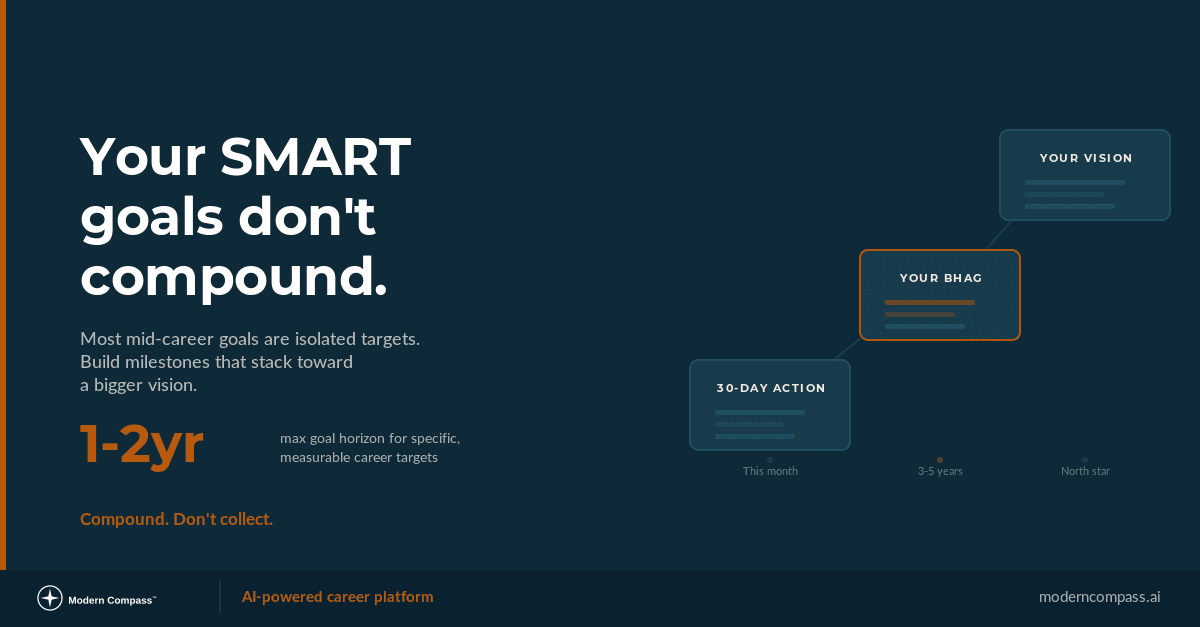
Begin with your personal vision statement. Not a corporate one. Yours. Where do you want to be in terms of the work you're doing, the problems you're solving, the life you're living? Then translate that into what Jim Collins calls a Big Hairy Audacious Goal, your BHAG. That's the 3-5 year horizon, and it should feel slightly uncomfortable.
Now break the BHAG into SMART milestones. This is where the framework actually earns its keep. Not as the goal itself, but as the bridge between your ambitious vision and what you do next Tuesday.
Horizon
Purpose
Example
Vision Statement
Your north star, personal not corporate
"I lead teams building AI products that make professional services accessible to everyone"
BHAG (3-5 years)
The uncomfortable stretch
"Launch a platform that serves 100,000 mid-career professionals"
Annual Milestone
Measurable yearly progress
"Ship the core product and reach 1,000 users by December"
90-Day Sprint
Quarterly deliverable
"Complete user research with 50 professionals and finalize the product roadmap"
30-Day Action
What's happening right now
"Conduct 15 user interviews and synthesize findings into three personas"
Each level feeds the one above it. Every 30-day action connects to a 90-day sprint that connects to an annual milestone that connects to the BHAG. Nothing is orphaned. Nothing is arbitrary.
Apply the SMART criteria at the 30-day, 90-day, and annual levels. At the BHAG and vision levels, precision actually hurts. You need room to adapt as the world shifts.
One way to pressure-test an annual milestone against the actual market: find a posting for the kind of role your BHAG points toward, run it and your resume through the match analyzer, and see which capabilities the gap names. That gap is 90-day sprint material, not a verdict.
Stop Anchoring Goals to Titles, Technologies, or Companies
This is the trap I see most often. Someone builds their entire goal structure around a specific title at a specific company using a specific technology stack. Then the company reorganizes. The technology shifts. The role gets redefined. And the entire goal framework collapses because it was built on labels, not capabilities.
Instead of "Become a Senior Director of Engineering at [Company] by 2028," try "Build the ability to lead a 50-person engineering organization through a major platform migration." The second version survives a job change, a reorg, even an industry shift. The first version crumbles the moment any single variable changes.
Early in my career, I set a goal that I wanted to work with a "longer runway." Bigger, more complex projects. I targeted a $5 million project scope as my next threshold. Notice what I didn't target: a company name, a title, or a specific technology. I named a capability threshold. That goal traveled with me across roles and organizations, and each step built on the last because the measuring stick was skill, not status.
I've been guilty of the opposite, too. Setting goals that sounded strategic but were really just title-chasing dressed up in better language. It took a few misses before I learned the difference.
One practical shift: I've moved to much shorter goal increments over the years. I don't know how many genuine 5-year career goals hold up anymore given the pace of change in technology and business. One to two years is my maximum horizon for specific, measurable targets now. The BHAG lives further out, but the actionable milestones need to stay close enough that you can actually course-correct when the ground moves.
Using AI to Stress-Test Your Goals (Not Just Format Them)
Most articles about SMART goals and AI stop at "use ChatGPT to write your goals in SMART format." That's the easy part and the least valuable part.
The real opportunity is using AI to evaluate whether your goals point in the right direction. Is the role you're targeting growing or contracting? Does your resume actually reflect progress toward the capability you're building? Are the skills you're prioritizing the ones that show up in job descriptions for the work you want?
At Modern Compass, Compass Coach is built for this kind of strategic pressure-testing. It surfaces patterns in your career trajectory that are hard to see from the inside, the kind of patterns that only become obvious when you look at hundreds of career paths side by side. That's different from a chatbot that reformats your bullet points.
Pair that with the Values Prioritization assessment, and something interesting happens. Values alignment isn't a soft skill exercise. It's the difference between setting a goal you'll pursue with real energy for 18 months versus one that drains you by month four. Our career coaches often start with values before touching goals, and the resulting frameworks hold up under pressure because they're built on self-knowledge rather than assumption.
When You Should Abandon a SMART Goal
Nobody talks about this enough. Sometimes the right move is to kill a goal entirely.
The economy shifts. A new technology makes your target role look different than it did a year ago. Your personal priorities change: you had a child, moved cities, or realized you care about something different than you did when you wrote that goal in January. A goal that made perfect sense nine months ago can become an anchor.
This is not failure. This is what strategic adaptation looks like in practice.
The rigid version of SMART goal-setting treats abandonment as weakness. "You committed. Follow through." That logic works for project deliverables with fixed scope. It does not work for career trajectories that span decades and intersect with a changing economy, evolving technology, and the messy reality of being a human with shifting priorities.
Build review checkpoints into your goal structure. Every 90 days, ask three questions: Is this still aligned with my vision? Has anything material changed in the market or my life? If I were setting this goal fresh today, would I set the same one?
If the answer to that last question is no, update the goal. Don't power through on momentum alone. The sunk cost fallacy kills more mid-career trajectories than failed goals ever will.
What to Do This Week (30 Minutes, No Fluff)
Don't set a SMART goal yet. You're not ready until you've done two things.
Step one (20 minutes): Write a personal vision statement. Not a corporate mission statement, not a LinkedIn headline. A paragraph describing the work you want to be doing, the problems you want to solve, and how that work fits into the life you're building. It doesn't need to be polished. It needs to be honest.
Step two (10 minutes): Draft your BHAG. One sentence. The big, slightly uncomfortable target that your vision points toward over the next 3-5 years. It won't be SMART, and it shouldn't be.
Then, when you're ready, break that BHAG into a 365-day milestone, a 90-day sprint, and a 30-day action. Apply SMART to those three layers. You'll have a goal structure that compounds instead of a list of disconnected targets that evaporate by spring.
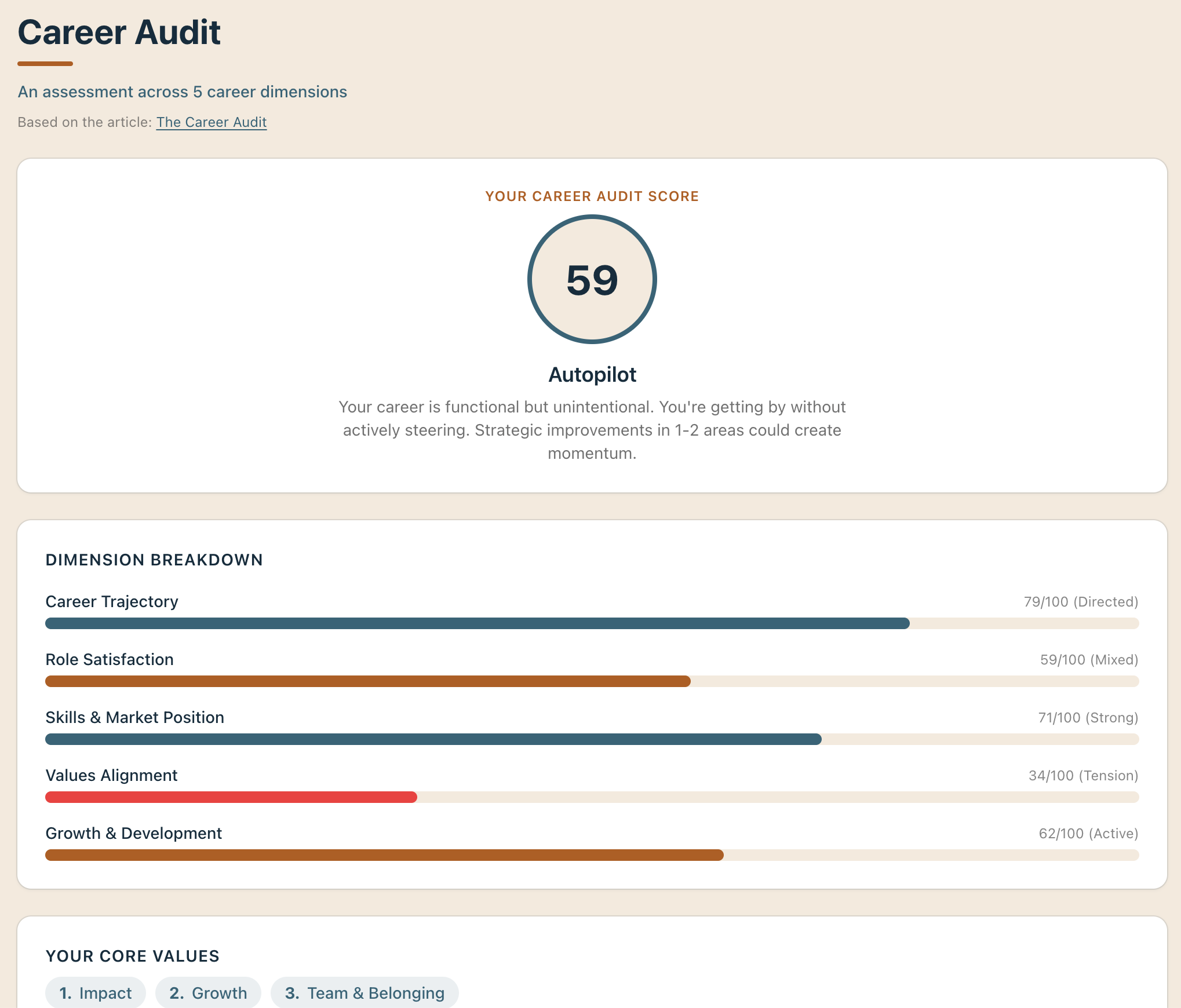
If you want to pressure-test your direction before building out the milestones, the Career Audit takes about 10 minutes and gives you a clear read on where your trajectory is actually pointing. Pair it with your vision statement and you'll have a foundation that makes every subsequent SMART goal sharper.
Grow as a Leader
Managing Up Effectively: How to Build Strategic Relationships with Leadership
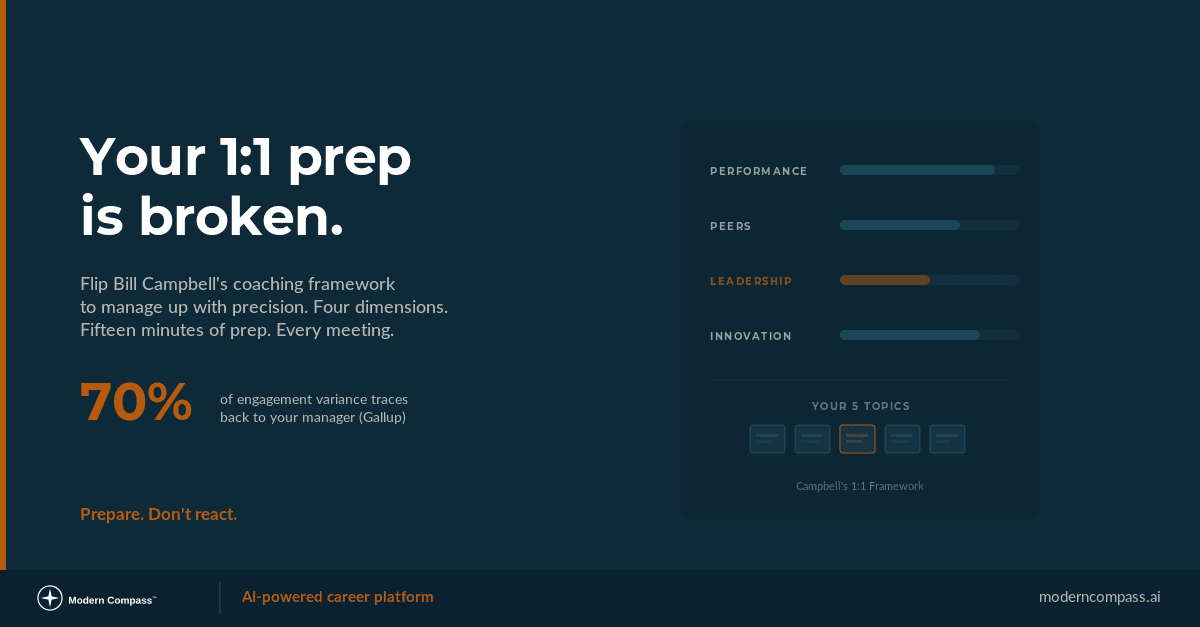
Stop guessing what your boss needs. Use Bill Campbell's 1:1 framework and AI-powered prep to manage up with precision and build trust that compounds.