Advanced Salary Negotiation: How to Negotiate Equity, Benefits, and Total Compensation
Land Your Next RoleFebruary 6, 20269 min read
advanced salary negotiationtotal compensation negotiationnegotiate equity RSUnegotiate beyond base salaryjob-search
You already know you should negotiate. You've read the articles about anchoring, BATNA, and "never accept the first offer." And yet, when the offer letter arrives after three rounds of interviews and a take-home assignment, most of the advice you've absorbed doesn't help with the actual decision sitting in front of you: a package with six different components, a vesting schedule you need a spreadsheet to model, and a 48-hour window to respond.
This is where advanced salary negotiation actually starts. If you're still working on the basics, start with the fundamental negotiation rules first. But if you've got those down and you're facing a complex offer with equity, multiple bonus structures, and benefits you've never thought to negotiate, keep reading. The 30-60% of your compensation that lives outside base salary is where the real leverage sits at the mid-career level.
Why Most Mid-Career Professionals Leave Money on the Table
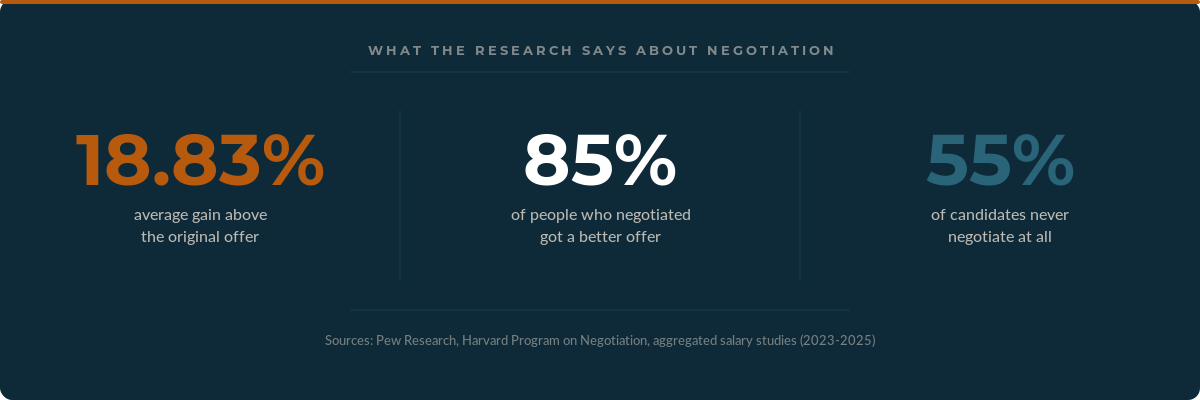
55% of job candidates don't negotiate at all. Among those who do, the average gain is 18.83% above the original offer. On a $180,000 base, that's roughly $34,000 in year-one value. And the gap compounds every year through raises calculated as percentages of your new, higher base.
But the real problem isn't people who skip negotiation entirely. It's experienced professionals who negotiate only base salary and treat everything else as fixed. I've been on the hiring side at organizations like Disney and Salesforce, and I can tell you: base salary was often the hardest component to move. The recruiter and I had a range, and the top of that range had a ceiling. RSUs, on the other hand, were typically an easier conversation. Signing bonuses, flexibility arrangements, professional development budgets: these lived in different budget buckets with different approval chains.
The candidates who understood this walked away with materially better packages. The ones who spent all their negotiation capital pushing base salary up by $5K missed the $20K in RSU value that was genuinely available.
The Components Most People Negotiate Poorly (or Not at All)
Then land the interview: a tailored resume + matching cover letter for $5.99$12(launch pricing).
Not every compensation component is equally flexible. Understanding which ones move easily and which ones don't saves you from wasting leverage on the wrong ask.
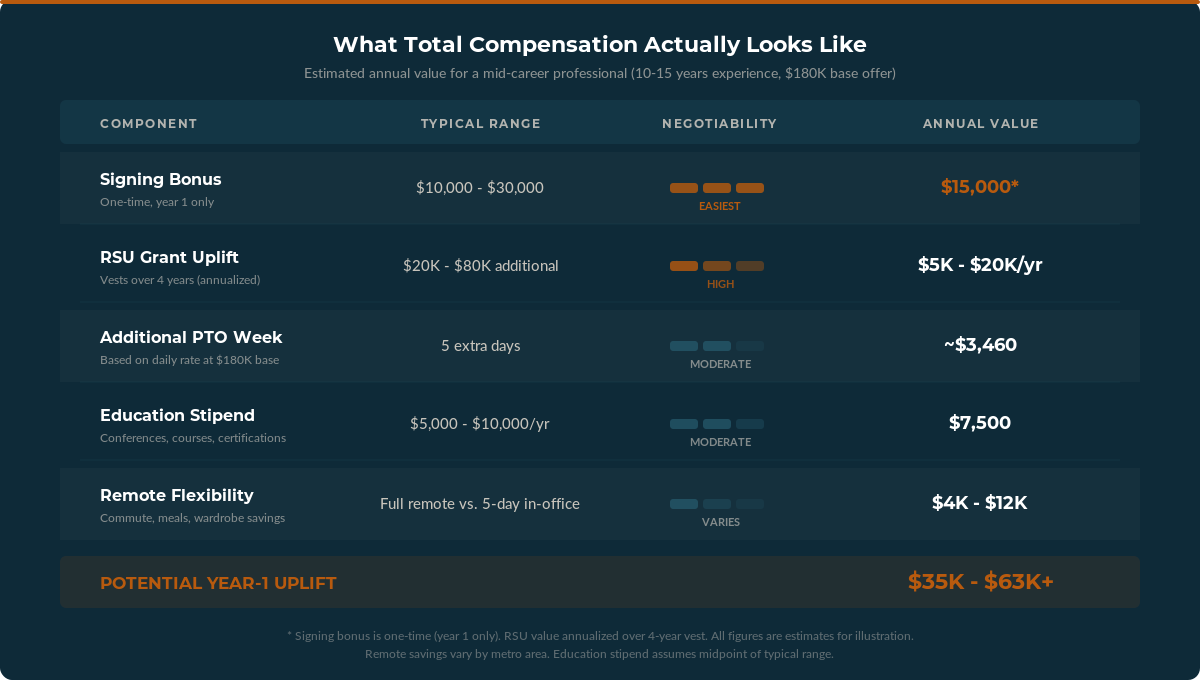
Signing bonuses are almost always the easiest to negotiate. They're a one-time cost that doesn't compound. A $15,000 signing bonus costs the company exactly $15,000. A $15,000 salary increase costs them $15,000 every single year, plus the percentage-based raises built on top of it. When a hiring manager tells you base salary is at the top of the band, this is the first pivot.
Equity grants (RSUs and options) are where the most overlooked value sits for mid-career hires. Companies offering equity compensation report 23% higher retention rates compared to cash-only packages, which means they view equity as a strategic retention tool, not a fixed cost. They're prepared to move on it. The vesting schedule, the grant size, and especially the exercise window on stock options are all negotiable. Standard 90-day post-departure exercise windows are punitive. Negotiating a 12-24 month window costs the company almost nothing but dramatically changes your financial flexibility if you leave.
Benefits and flexibility are the category everyone acknowledges but few actually negotiate. An extra week of PTO. A $10,000 education stipend. Full remote instead of hybrid three days a week. The dollar value of these adds up fast, and they often require a different approver than compensation, meaning you're not competing against the same budget.
How Hiring Managers Actually Think About Your Offer
Most negotiation advice is written from the candidate's perspective, which makes it feel like you're pushing against a brick wall. Knowing what's happening on the other side of the table changes the dynamic entirely.
When I was building offer packages, the process worked in partnership with the recruiter. We had a range for base salary, and moving within that range was straightforward. Pushing above it required VP-level approval and a written justification, which meant it happened rarely and slowly. But equity grants had more discretion at the hiring manager level. If I wanted to bring in a strong candidate and base was already at the ceiling, I could advocate for additional RSUs without escalating through the same approval chain.
This matters because it tells you where to push. The hiring manager isn't your adversary. They've already decided they want you. They're navigating internal constraints just like you navigate organizational politics at your current job. When you frame your ask around components where they have flexibility, you're making it easier for them to say yes.
One pattern I saw repeatedly: candidates who came back with a single, rigid demand ("I need $X base or I can't accept") created an all-or-nothing dynamic. The ones who said "I understand base may be constrained. Could we look at a stronger RSU package and a signing bonus to bridge the gap?" gave me room to work with. That framing converted a negotiation into a collaboration.
The 48-Hour Framework for Evaluating a Complex Offer
When you get an offer with multiple components, resist the urge to respond immediately. Request at least 48 hours. Not because you're playing hard to get, but because you need time to do the math properly.
Convert everything to annual dollar value. RSUs vesting over four years? Divide by four for annual value, then apply a discount if the company is pre-IPO or the stock is volatile. Signing bonus? Year-one only. Don't let it inflate your perception of the ongoing package. Health insurance premium difference between tiers? That's real money every month.
Then model the three-year picture. A lower base with a strong equity grant might look worse in year one but pull ahead by year three as shares vest. A high base with minimal equity gives you cash flow now but less upside. Your personal financial situation should drive this, not a generic compensation calculator.
Now comes the part most people skip: rank your actual priorities before you counter. "More money" isn't specific enough. Do you need cash flow for a mortgage? Base salary and signing bonus matter most. Betting on company growth? Equity is the play. Have young kids and want to stop commuting? Remote flexibility might be worth more than a $10K raise.
Finally, build a package counter, not a line-item counter. Instead of "I want $10K more base," try something like: "I'm excited about this role. Based on my research and the equity I'd be leaving at my current company, could we explore increasing the RSU grant by X shares and adding a signing bonus of $Y? I'm flexible on how we get there." That framing gives the hiring team options. It signals you understand how compensation actually works.
What the Research Says About Who Wins at Negotiation
Most people assume negotiation is a coin flip: either the company says yes or they pull the offer. The data says otherwise. 85% of Americans who negotiated received at least some improvement on the initial offer. The remaining 15% got the original offer unchanged. Virtually nobody had their offer rescinded. That fear you carry into every negotiation? It's not supported by the numbers.
Research from Harvard's Program on Negotiation points to something less obvious: the biggest predictor of negotiation success isn't aggressiveness or even your anchor number. It's preparation and framing. Candidates who presented market data and a clear rationale for their ask consistently outperformed those who simply said "I was hoping for more." The difference wasn't personality. It was homework.
For mid-career professionals, this is good news. You have 10-20 years of specific accomplishments, industry knowledge, and professional networks that a junior hire can't match. The negotiation isn't about persuading them you deserve an arbitrary higher number. It's about connecting what you've done to the specific problems this role needs solved, and then translating that connection into a precise compensation ask.
The Equity Conversation Most People Skip Entirely
If you're joining a company that offers RSUs or stock options and you don't negotiate the equity component, you're likely leaving the single largest negotiation opportunity untouched. Here's why.
Equity grants at hire are the one moment when the company is most motivated to be generous. Once you're an employee, annual equity refreshes follow a formula. But the initial grant is discretionary, and hiring managers know that competing for experienced talent means competing on equity. Vesting schedules, grant sizes, and acceleration clauses for acquisition events are all standard negotiation points at the senior level.
The questions most candidates forget to ask: What's the total share count outstanding? (Your percentage ownership matters more than the number of shares.) What triggers accelerated vesting? (Single-trigger vs. double-trigger acceleration can mean a six-figure difference in an acquisition.) And what's the post-departure exercise window? That 90-day default on stock options has cost experienced professionals hundreds of thousands of dollars when they leave a company and can't afford to exercise in time.
If you're evaluating a role and want to understand how your current experience maps to what a specific job actually requires, the Job Analyzer can help you identify where you have leverage before the negotiation even starts.
What to Do This Week
Pick one offer you've accepted in the past five years and reconstruct the total compensation. Not just what you negotiated, but what you could have negotiated. Calculate the annual value of the equity you didn't push on, the signing bonus you didn't ask for, the PTO days you assumed were fixed. For most mid-career professionals, the gap between what they accepted and what was available is $15,000-$40,000 in year-one value alone. That exercise isn't meant to make you feel bad about past decisions. It's meant to make you precise about future ones.
If you're actively evaluating an opportunity now, don't start with base salary. Start with the full picture. Map every component, rank your priorities, and build a package counter that gives the hiring team flexibility to say yes. And if the negotiation feels uncomfortable, remember that executive presence isn't charisma. It's the clarity and composure to articulate your value without flinching. The person sitting across from you probably wants to make it work. Give them the room to do it.
Future-Proof Your Career
Building a Professional Network That Actually Helps Your Career
Most networking advice assumes you love working a room. Here's how mid-career professionals build real networks through trusted relationships, not small talk.