You got the offer. The number is... fine. Not insulting, not exciting. And now you're doing the mental math: is it worth pushing back, or should you just be grateful they picked you?
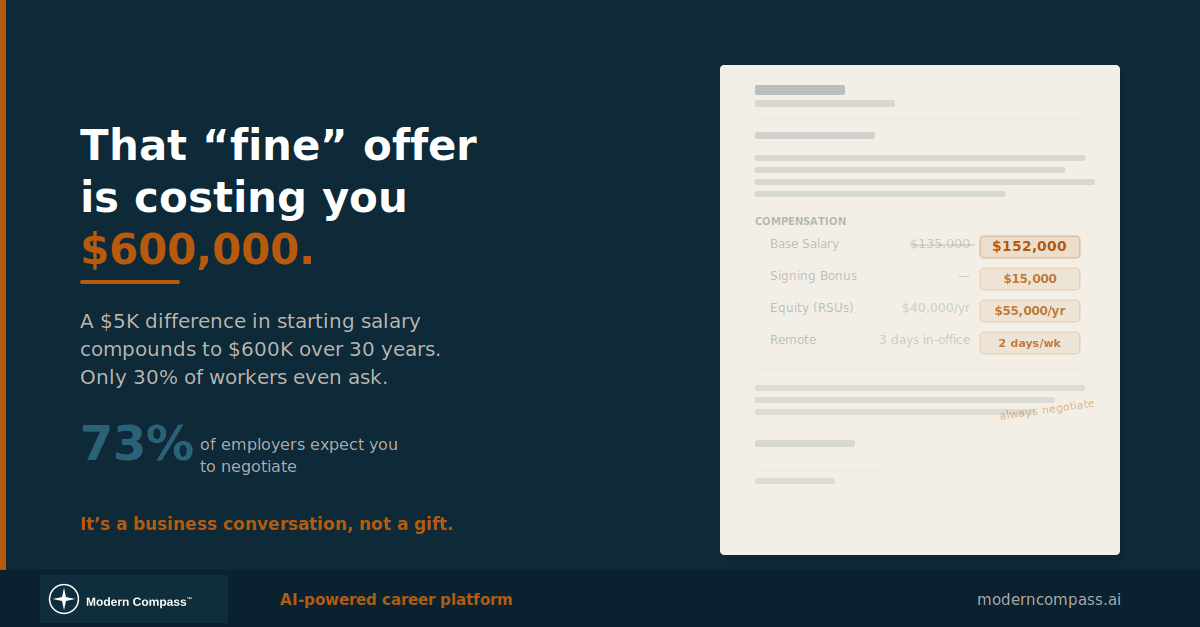
Here's the math that matters more. A $5,000 difference in starting salary, compounded over a 30-year career with standard raises, turns into roughly $600,000 in lost lifetime earnings. That's not a theoretical exercise. Carnegie Mellon researcher Linda Babcock found that professionals who don't negotiate their starting salary leave between $1 million and $1.5 million on the table over their careers.
And yet, according to Pew Research Center, only about 30% of U.S. workers even asked for higher pay the last time they were hired. Not because they didn't deserve more. Because they talked themselves out of the conversation before it started.
If you've been working for 10 or 15 years, you've probably done this at least once. You weighed the risk, decided it wasn't worth the awkwardness, and signed. Maybe you told yourself the career values you'd identified were about more than money anyway. This piece is about why that instinct is wrong and what to do instead.
Most Employers Expect You to Negotiate (Yes, Really)
Here's what most people get backwards about salary negotiation: they think they're asking for a favor. They're not. They're participating in a process the employer already anticipated.
CareerBuilder surveyed thousands of hiring managers and found that 73% are willing to negotiate a first offer. Salary.com puts the number even higher: 84% of employers actively expect candidates to counter. The initial number isn't the final number. It's the opening position.
I've been on both sides of this. When I was hiring, I'd already argued internally for a candidate's compensation before making the offer. Part of me wanted them to appreciate that. But I also understood that a strong candidate who negotiates professionally is demonstrating exactly the kind of advocacy and preparation I'd want them to bring to the role. The offer is a business conversation, not a gift.
The fear that negotiating will get your offer pulled? It happens so rarely that career experts treat it as a red flag about the employer, not the candidate. As Alison Green of Ask a Manager has noted, a company that rescinds an offer because you negotiated professionally isn't playing by normal business rules. Almost always, they'll either meet you partway or tell you the offer is firm and ask if you'd still like to accept.
And the data backs this up: CNBC reported that 85% of Americans who counteroffered received at least some improvement. You're not gambling with the offer. You're declining free money by staying silent.
Research Your Number Before You Name It
Negotiation without data is just asking for more. Negotiation with data is making a case.
Before any compensation conversation, you need three numbers: what the market pays for this role, what the company's range is (if disclosed), and what your specific experience justifies. The gap between those numbers is where the negotiation lives.
Start with public data, but don't stop at one source. Glassdoor skews toward self-reported numbers from people who are frustrated enough to post. Levels.fyi is strong for tech but thin for other industries. Payscale and LinkedIn Salary Insights round things out. Cross-reference at least two. Then adjust for the variables that actually move the number: your metro area, the company's funding stage or revenue, and the industry. A Senior Product Manager at a 50-person Series B in Austin and the same title at a Fortune 100 in New York can differ by $80,000 or more in total compensation.
Pay transparency laws have changed this equation significantly. As of 2025, roughly 16 states require employers to disclose salary ranges in job postings, covering over 60 million workers. Colorado, California, New York, Washington, and New Jersey all have active requirements, with Illinois, Minnesota, and others joining recently. If the posting includes a range, you already know the playing field. Your job shifts from discovering the range to positioning yourself in the top third of it.
When I've negotiated my own compensation, I came in direct but supported everything with research. I asked questions about where I fell in the band and what the growth trajectory looked like in the role. What I deliberately avoided was comparing myself to peers. That reframes the conversation as "someone else gets more than me," which puts the hiring manager on the defensive. Keeping the focus on your situation, your contribution, and the market data keeps it professional and forward-looking.
The Total Package Is Worth More Than the Base Number
This is the mistake I see experienced professionals make most often: they fixate on base salary and ignore everything else. Worse, they take the first offer at a new company because they're so relieved to have gotten past the interview gauntlet.
If you've gotten that far, the company wants you. They have backup candidates, sure, but they don't want to go back to that well if they don't have to. You have more negotiating power than you think.
Base salary is one line on the offer letter. The reason experienced professionals fixate on it is understandable: it's the number you can compare. But hiring managers think in budgets, not base salaries, and different budget categories have different levels of flexibility.
A signing bonus is a one-time expense that doesn't permanently increase headcount cost. That makes it dramatically easier for a manager to approve than a $10K base bump, which compounds every year. If the base is firm, this should be your first counter.
Equity works similarly. At public companies, RSUs can represent 20-40% of total comp at senior levels, and an extra grant often comes from a different budget pool than salary. I've seen candidates leave $50,000+ in equity on the table because they never asked. That still surprises me.
Then there's remote flexibility, which most people undervalue because it doesn't show up on a pay stub. Harvard Business School research found tech professionals value full remote work at roughly 25% of their salary. Even at two or three days a week, workers save an estimated $12,000+ annually in commuting and related costs. That's real money.
Title is the one nobody thinks about until it's too late. A Director title versus Senior Manager affects every recruiter conversation, every future negotiation, and your earning trajectory for the next five years. If you're wondering whether the gap between Director and VP is worth fighting for, it absolutely is. It costs the company nothing to give you the right title. Ask.
The thread connecting all of these: think about what's easy for the company to say yes to. That's where the room is.
How to Handle the Actual Conversation
Most salary negotiation advice is either too vague ("know your worth!") or too scripted ("say these exact words"). Neither works because the right approach depends on who you're talking to and how the company handles compensation. This is where executive presence actually matters: the same ask, delivered with different levels of clarity and confidence, gets completely different results.
Some organizations are transparent and collaborative about compensation. Your recruiter walks you through the bands, explains where you'd fall, and genuinely asks what would make the offer work. In those environments, directness and honesty are the best strategy. Tell them what you're looking for and why.
Other companies put HR between you and the hiring manager specifically to limit the conversation. They want a barrier. In those cases, you need to be more strategic: put your counter in writing, anchor it to market data, and give them a specific number rather than a vague "I was hoping for more."
That said, a few principles hold regardless of context.
Lead with enthusiasm, then pivot. Something like: "I'm excited about this role and the team. I'd like to discuss compensation to make sure we're aligned." This signals good faith. You're not shopping for the highest bidder. You're trying to make the deal work.
Give a range, not a single number, and set the bottom of your range at your actual target. The other side will gravitate toward the lower end and feel like they met you in the middle. Let them.
Then stop talking. I mean it. After you state your ask, close your mouth. Silence feels unbearable. Most people fill it by walking back their own number or adding qualifiers that weaken their position. Don't be most people. Let the other side respond first.
And whatever you do, don't apologize. "I hate to ask, but..." or "I know this is a lot..." tells the hiring manager you don't believe your own number. You're having a business conversation. Act like it.
Among workers who do negotiate, Pew found that 28% get exactly what they asked for and another 38% get more than the original offer. That's a 66% success rate. The odds are on your side.
Get the Final Offer in Writing (Then Actually Read It)
Verbal agreements in hiring are worth the paper they're not printed on. I've seen this go wrong in specific, predictable ways. The recruiter who promised a signing bonus didn't have approval from finance. The hiring manager who verbally agreed to remote Fridays left eight months later, and the new manager said "I don't know anything about that arrangement." The VP who committed to a title bump at six months got reorganized out before it happened.
These aren't edge cases. They're what happens when smart people rely on good faith instead of documentation.
Request the complete written offer: base, bonus structure and targets, equity details (vesting schedule, grant size, cliff), benefits enrollment timeline, PTO policy, and start date. If you negotiated anything beyond standard terms, whether that's remote flexibility, a title, a review timeline, or a development budget, it needs to be in the letter or a documented email addendum. Not a text. Not a verbal confirmation on a call.
Take 48 hours minimum. A company that pressures you to sign same-day is telling you something about how they'll treat you as an employee. Any reasonable employer understands that you're evaluating what might be the most consequential financial decision you make this year.
And the step most people skip: if you negotiate changes after receiving the initial written offer, get the revised version in writing before you give notice at your current job. Not after. Before.
What to Do This Week
Pick one of these based on where you are right now.
If you're mid-search: Open Glassdoor and Levels.fyi. Pull compensation data for your target role, level, and metro area. Build a one-page comp research doc you can reference before any offer conversation.
If you're sitting on an offer: Before you respond, list every component of the package, not just base. Identify the two or three items where there's likely room. Draft your counter with specific numbers and a brief rationale for each.
If you're not looking but want to be ready: Run your resume through the Modern Compass Resume Audit. It takes about five minutes and will show you whether your resume actually reflects the seniority and impact that justifies top-of-range compensation. Because negotiation starts long before the offer call. It starts with how you position yourself on paper.
Grow as a Leader
Why Your Best Directors Aren't Getting Promoted to VP
Discover the 6 overlooked factors that determine Director-to-VP promotions. Learn why strong performance alone won't get you promoted and what executives actually evaluate.