You've read both headlines. AI is eliminating white-collar jobs. AI is creating more jobs than it destroys. Depending on the week, both stories cite credible data, and if you have 15 years of experience in a field AI touches, neither one tells you what to do on Monday.
The problem is that both headlines describe an average, and the 2026 AI job market has stopped behaving like an average. PwC's latest Global AI Jobs Barometer analyzed over a billion job ads across 27 countries and found something more useful than "exposed vs. safe": the market has split into two tracks, and the same AI exposure that shrinks one role is expanding another.
Once you see the split, the question changes. Not "will AI take my job?" but "which track is my role on, and can I move?"
The split: professionalised roles vs. democratised roles
PwC's framing is worth learning because it will shape hiring for the next decade. Every AI-exposed role is drifting toward one of two outcomes.
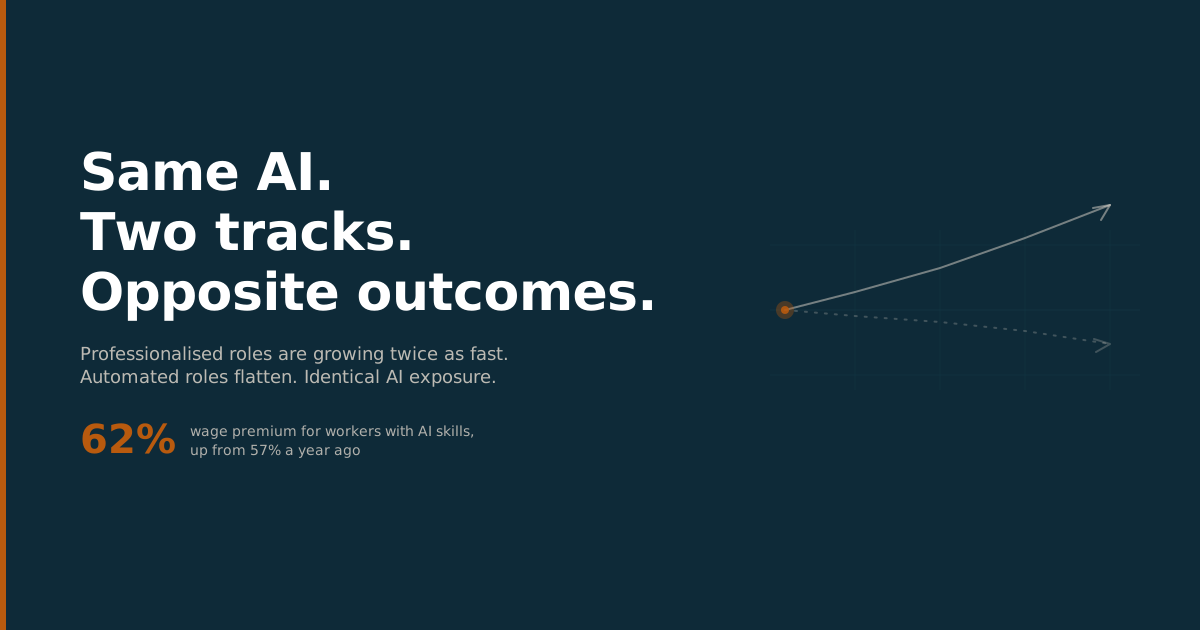
Professionalised roles are ones where AI absorbs the routine work and what remains is judgment, expertise, and accountability. Think of a radiologist whose imaging AI flags anomalies, or a recruiter whose screening tools surface candidates. The human's job gets harder and more valuable at the same time. These roles are growing twice as fast as their counterparts, with 42% faster salary growth.
Democratised roles are ones where AI makes the core skill easier for non-experts to perform. The tool doesn't assist the specialist. It replaces the need for one. Basic copywriting, routine reporting, first-pass market research, standard IT service management. Wages flatten, experience requirements drop, and the moat you spent a decade digging gets filled in by a prompt.
Here's the uncomfortable part. Exposure level doesn't predict which track you're on. A radiologist and a medical secretary are both heavily exposed. One is being professionalised, the other democratised. So every "10 most AI-exposed jobs" listicle you've read was measuring the wrong axis.
The wage data makes the stakes concrete. Workers with AI skills now earn a 62% premium over peers in similar roles, up from 57% a year ago. Gaps like that compound. Two professionals with identical titles today can be an income class apart in five years.
Which jobs are being professionalised and which are being democratised?
Professionalised jobs are those where AI handles routine tasks while human judgment, accountability, and client trust become the core of the role, such as radiologists, recruiters, and senior analysts. Democratised jobs are those where AI lets non-experts produce acceptable output, such as routine copywriting, basic reporting, and standard IT administration. The dividing line is whether your value comes from producing the work or from being answerable for it.
That's the short version. The honest version is that the split runs through job titles, not between them. Two marketing managers at different companies can sit on opposite tracks depending on how their organization deploys AI and what their actual task mix looks like. Which is why you need to diagnose your role specifically, not look your title up on a list.
If there's a specific posting in front of you, that diagnosis doesn't have to be guesswork. Paste it into the match analyzer along with your resume and get a concrete read on how you stack up against what the role actually asks for — it takes about a minute and doesn't require an account.
Signal
Professionalised track
Democratised track
What AI does in your workflow
Drafts, flags, summarizes; you decide
Produces the finished output
Who reviews the output
You, and your name is on it
Nobody, or a cheaper generalist
Experience required in new job posts
Rising
Falling
Your scarce asset
Judgment, relationships, accountability
Familiarity with a tool others can learn
Wage trajectory
+42% faster growth
Flat or declining
Five signals your role is sliding toward the democratised track
I built Modern Compass's job analyzer to read job descriptions the way a skeptical insider would, and the pattern that keeps surfacing in 2026 postings is quiet de-skilling. Companies rarely announce that a role has been democratised. They just rewrite the requirements.
Watch for these five signals in your own role.
1. Your output is being templated. If the deliverable you're known for now starts from an AI-generated draft that anyone on the team can produce, the differentiated part of your job has moved. The question is whether it moved to your judgment or out of your role entirely.
2. New hires around you need less experience. Pull up your company's recent postings for roles adjacent to yours. If a job that required eight years now asks for three, the org has decided AI closes the gap. The World Economic Forum found the inverse pattern too: entry-level roles in AI-exposed fields are now seven times more likely to demand senior-level skills like leadership and judgment. Both patterns are the same event. The middle of the skill curve is being squeezed from both ends.
3. Your expertise is becoming the tool's training data. When your best practices get encoded into prompts, playbooks, or fine-tuned models that others use without you, you're professionalising someone else's role. I've watched teams celebrate this as knowledge sharing. It is, and it's also a transfer of your moat.
4. Nobody senior reviews the AI's work in your area. This one sounds backwards. Review burden feels like friction. But accountability is exactly what the professionalised track pays for. If your organization ships AI output in your domain without a named human answerable for it, the domain itself is being priced as a commodity.
5. Your sector is shedding while the market grows. Zoom out from your company. Tech and finance, the two sectors with the fastest AI adoption, lost an average of 28,000 jobs per month through the first half of 2026 even while the broader economy kept adding jobs. Sector-level drift matters because it sets the denominator for your next search.
None of these signals alone is a verdict. Three or more, and you should treat the next 12 months as a repositioning window rather than business as usual.
How to move tracks without changing jobs
The good news for anyone with 8 to 20 years of experience: track mobility favors you. The professionalised track pays for judgment, accountability, and trust, which are precisely the assets that take a decade to build. A 2026 GMAC survey of 600 corporate recruiters ranked AI skills 14th on their priority list. Communication, problem-solving, and adaptability topped it. Recruiters aren't sentimental. They rank what they can't hire cheaply.
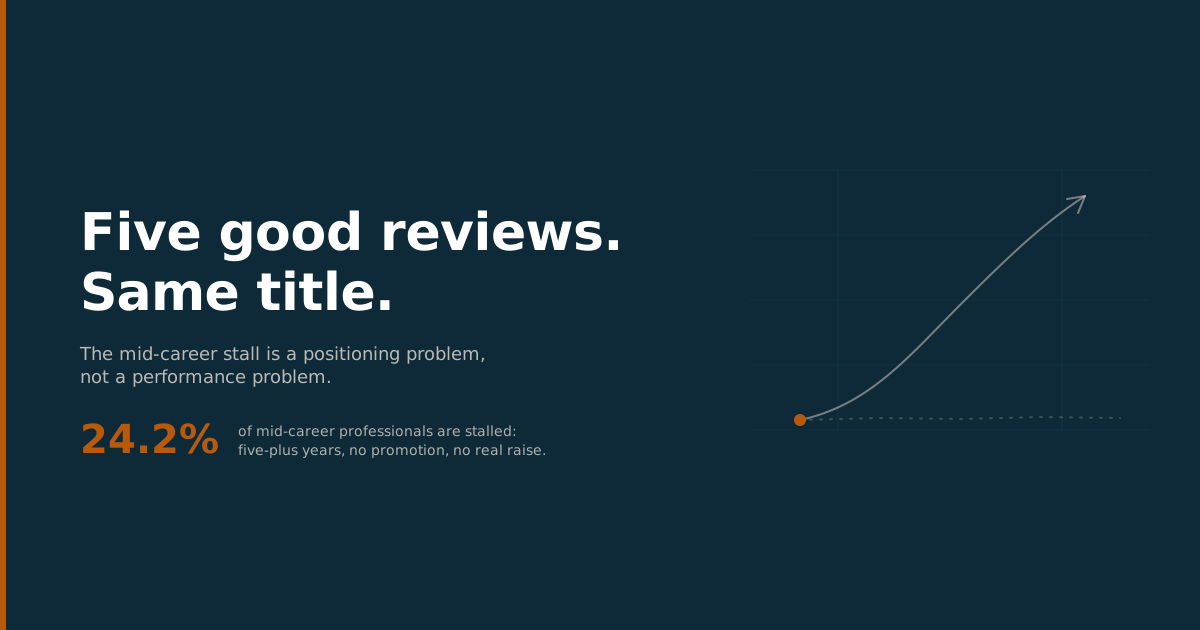
Moving tracks is mostly a change in task mix and evidence, not title.
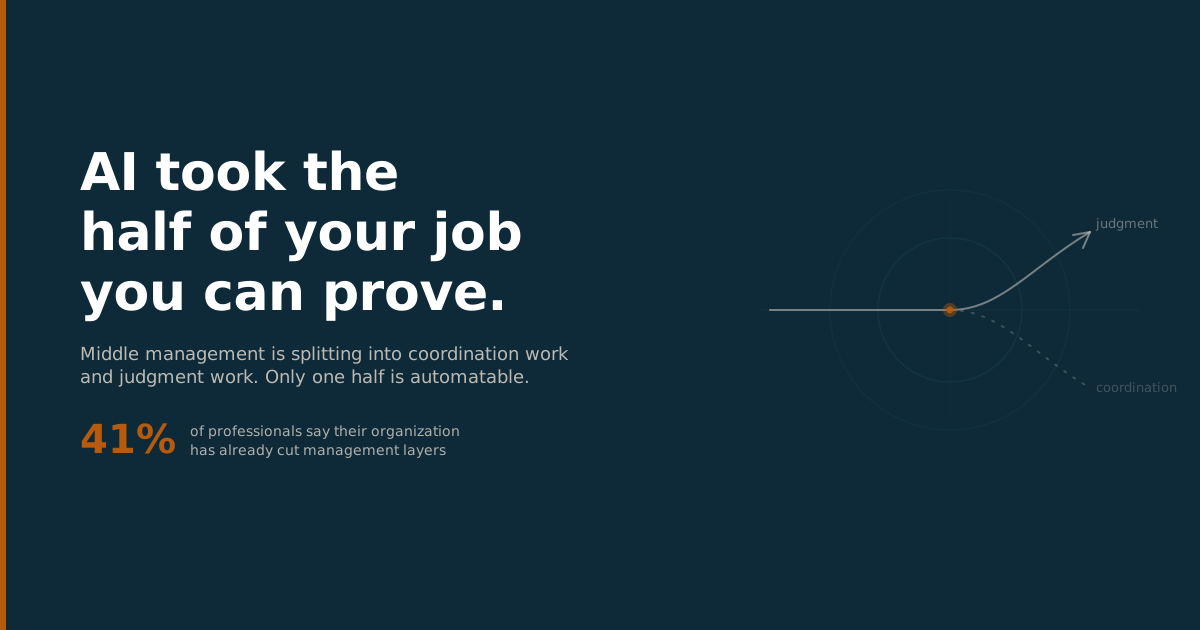
Start with the task audit. List what you actually did last month and sort it into three buckets: work AI already does, work AI drafts but you decide, and work only you can be accountable for. Most mid-career professionals I talk to find the third bucket is bigger than they feared and less visible than it should be. Honestly, that visibility gap is the real problem. Your performance review probably still measures output volume, which is the exact thing AI deflated.
Then move your time deliberately. Volunteer for the decisions nobody wants to own: the vendor call, the escalation, the judgment call with a client's name attached. Push the templated work into the tools without apology. The anti-hustle version of this matters. You're not adding hours, you're trading deflating tasks for appreciating ones inside the same week.
One warning about timing. Your employer's measurement systems will lag this shift by years. Recent HBR reporting found that 90% of HR leaders say AI has redefined what high performance means, yet only 42% of organizations have updated their review criteria. So for a while, the official scorecard will keep rewarding democratised-track output even as the market stops paying for it. Don't wait for your company's rubric to catch up. Reposition against where the wage data says value is moving, not against last year's review template.
Finally, change your evidence. Rewrite your accomplishments around decisions and outcomes rather than deliverables. "Produced the quarterly forecast" is democratised-track language. "Called the Q3 inventory drawdown two months early, saving $400K" is professionalised-track language. If your resume still lists tool proficiencies as your headline skills, you're advertising the part of your job that's depreciating. Your AI fluency matters more than your job title right now, but fluency means directing the machine, not operating it.
What the two-track split means for your next job search
If you're searching now or expect to be within a year, the split changes tactics more than most search advice admits.
Read postings for track signals, not just requirements. A posting that emphasizes review, sign-off, client ownership, and cross-functional judgment is a professionalised role. One that lists tool proficiencies and output volume is democratised, whatever the title says. In June 2026 the US added just 57,000 jobs, and hiring is concentrated in a handful of sectors. In a market this thin you cannot afford to spend interview cycles on roles that will deflate under you. Targeting beats volume, a case I've made before about spray-and-pray applying, and the two-track lens sharpens the target.
Ask the track question in interviews. Something like: "Where does AI sit in this team's workflow today, and who signs off on its output?" The answer tells you whether the org is professionalising the role you'd hold or quietly commoditizing it. Hiring managers respect the question. It signals you've thought about the next five years, not the next five months.
And weight accountability over scope in offers. A slightly smaller role where your judgment is the product will appreciate. A bigger-sounding role built on output that AI is learning to produce will not. The white-collar roles most exposed to AI aren't the ones to fear on their own. The ones to fear are exposed roles with no accountability attached.
Your move this week
Run the task audit on your last month of work. Three buckets: AI does it, AI drafts and you decide, only you can own it. Count the hours in each. That ratio is your track position, and it's more honest than any exposure index.
If the third bucket looks thin, or you can't articulate what's in it, that's worth a structured look before it becomes a problem someone else names for you. The Career Audit takes about 10 minutes, costs nothing, and maps where your judgment is and isn't showing up in how you present your career. Start there, then decide what to reposition.
The two-track market isn't waiting for anyone's five-year plan. But it is, for once, a shift that rewards exactly what you've spent your career building. Make that legible.