Middle Management Is Splitting in Two. AI Took the Half You Can Document.
The layoff notices say "flattening." The org charts say "reducing layers." Neither phrase describes what actually happened, which is that middle management and AI collided this year and the job broke cleanly along a seam that was always there.
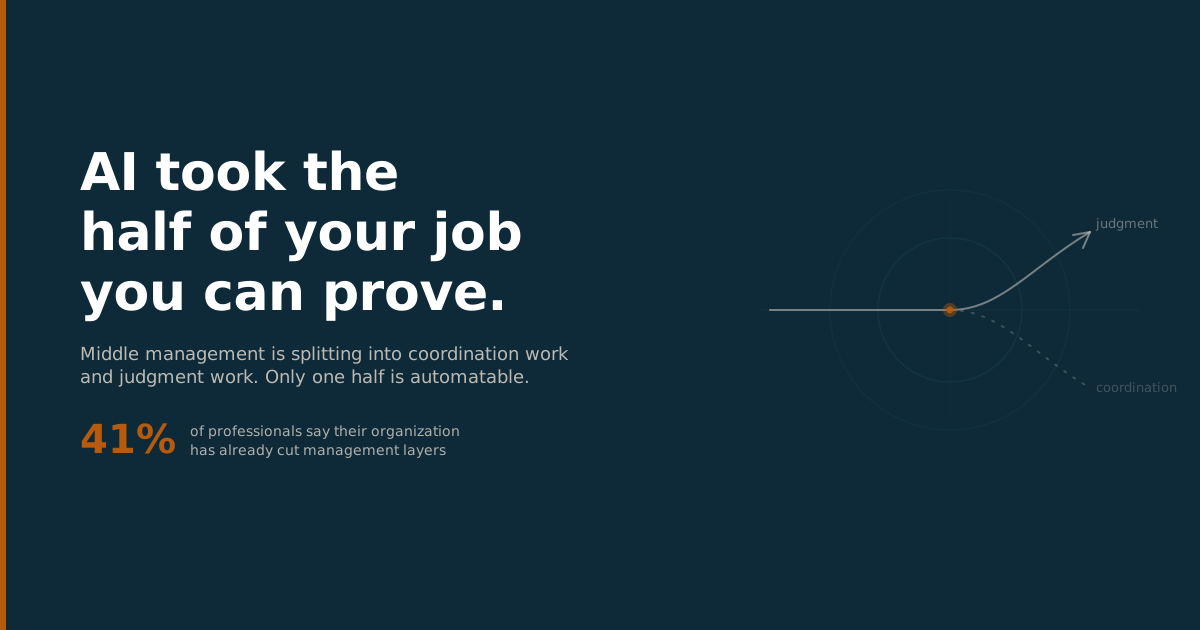
One half of your job was moving information between people who could not easily reach each other. Status up, context down, priorities sideways. The other half was judgment. Deciding what to do when the data was ambiguous, telling someone a hard truth, absorbing risk so your team could move.
Companies just figured out they can buy the first half. They still cannot buy the second.
And most managers have spent a decade building a record that documents the first half almost exclusively. That is the actual problem. Not the flattening.
The 2026 cuts are not hitting managers. They are hitting one specific job.
Look at what the companies said, not what the headlines said.
monday.com disclosed in an SEC Form 6-K on July 22 that it was cutting roughly 630 of about 3,000 roles, close to one in five, and framed it as a re-architecture around AI agents rather than a cost exercise. Amazon cut 14,000 middle-management positions. GitLab exited 22 countries and flattened its layers on the way out. Korn Ferry surveyed 15,000 professionals and found 41% saying their organization had already stripped out management layers in the past year. Gartner expects one in five organizations to use AI to eliminate more than half of their middle-management positions through 2026.
Now put that next to a number almost nobody quotes in the same breath. Indeed's Hiring Lab found senior-level job postings up nearly 15% between May 2025 and May 2026, breaking away from every other experience level.
Companies are cutting managers and buying seniority at the same time. That is not a war on experience. That is an organization deciding it needs fewer people to route information and more people to make calls.
The work that made you promotable is the work that got automated
Here is the trap, and it is not your fault.
Gallup's data shows the average manager's span of control has roughly doubled since 2013. More reports, same day, no additional support. The rational response was to get extremely good at throughput. You built the status template. You ran the standup that kept four teams from colliding. You became the person who could reconstruct any decision from memory because you sat in every room where it was made.
That competence got you promoted. It also produced a perfectly machine-readable description of your value.
Status reporting, schedule and workflow coordination, first-pass review, information relay between layers. Recent analyses put that bundle at somewhere near 60% of a manager's working week. Every item on that list is a task an agent now performs at acceptable quality for a rounding error in cost. Not brilliantly. Acceptably. Acceptable is enough when the alternative costs $180,000 a year.
I have sat in the meetings where these decisions get made, in product and AI leadership roles at Disney, Salesforce, and Royal Caribbean. Nobody in the room ever says "let's cut the managers." What they say is "how much of this coordination can the system absorb," and then someone builds a slide showing which layers exist mainly to move information. If your name only appears next to information movement, the slide makes the decision for you.
If you are reading this while quietly updating your resume, it helps to know how a real posting reads your actual experience before you rewrite anything. Paste the posting you are weighing and see where you actually stand. The match analyzer is free, takes about 60 seconds, and does not ask you to create an account.
Which parts of a manager's job is AI actually taking?
AI is absorbing the transactional layer of management: status compilation, meeting scheduling, workflow routing, first-pass document and code review, and translating updates between teams. It is not absorbing the judgment layer: ambiguous prioritization, performance conversations, political navigation, coaching, and decisions made with incomplete information under real consequence.
The split is cleaner than the discourse suggests, and you can run it against your own calendar this week. Pull last week. Put every block into one of two columns.
Coordination half (automatable now)
Judgment half (not automatable now)
Compiling status for leadership
Deciding which of two underfunded priorities dies
Running recurring sync meetings
Telling a strong performer their scope is shrinking
Routing questions between teams
Choosing to escalate against your own manager's read
First-pass review and QA
Setting the standard for what "good enough" means here
Translating exec priorities into tickets
Reading a room and changing the plan mid-meeting
Tracking dependencies and dates
Absorbing a bad quarter so your team keeps taking risks
Most managers I talk to expect the split to land 50/50. It usually lands closer to 70/30 against them, and the 30 is the part that never made it into a single artifact.
[INSERT: annotated screenshot of a real (anonymized) week of calendar blocks sorted into the two columns, with the coordination percentage called out]
Your performance record documents the wrong half
This is where it gets uncomfortable.
Go read your last two performance reviews and the top third of your resume. Count how many lines describe throughput: shipped, coordinated, aligned, drove, managed, delivered on time. Now count how many describe a decision that would have gone the other way without you.
For most mid-career managers the ratio is brutal. Ten to one. Twenty to one, sometimes.
That is not because you lack judgment. It is because judgment is invisible in the artifacts our companies produce. Nobody writes a Jira ticket for "declined to build the feature the SVP wanted, correctly." Nobody puts "protected the team from a reorg that would have cost us two senior engineers" in a quarterly OKR. The performance system was designed to measure output, and output is exactly what AI now produces.
So when a leadership team runs the flattening analysis, they are reading a record you did not know you were writing.
Two years ago the fix was slow and optional. Now it is fast and it is not.
The specific move is this. For every significant decision you made in the last eighteen months, write one sentence in this shape: the situation was ambiguous in this specific way, I chose X over Y, here is what happened and here is what would have happened otherwise. Four or five of those beat a page of accomplishment bullets, because they describe a capability that cannot be bought as a subscription.
Do it for your resume. Do it for your next review. Do it, honestly, for yourself, because a lot of managers discover during this exercise that they have not made a real call in a year, and that is worth knowing before someone else discovers it.
The three moves that actually change your position
Not "become more strategic." That advice is useless because it names an outcome, not an action.
Take the ambiguous problem nobody wants. Every organization has two or three problems that are genuinely unclear, politically loaded, and unassigned. They are unassigned because they cannot be delegated to a process. Volunteering for one is the fastest way to generate judgment evidence, and it works even in a flat organization where there is no promotion to compete for.
Attach yourself to the layer above the automation. If your team's work is being reshaped by AI tooling, be the person deciding what the tooling should do, what quality bar it must clear, and where it must never be trusted. Workflow redesign is judgment work. It is also, as HBR's 2026 research on employer expectations found, one of the three capabilities that now separates people who compound from people who plateau.
Stop optimizing the coordination you still own. This one is counterintuitive and I mean it seriously. If you spend the next quarter making your status process 20% more efficient, you have made yourself 20% easier to replace, because you have documented and systematized exactly the thing a system can take. Automate it yourself, hand it off, or let it be mediocre. Spend the recovered hours on the other column.
There is a real cost to the flattening that companies are only now noticing. Korn Ferry found 37% of employees who lost their manager report feeling directionless, and senior leaders are absorbing coaching and context work on top of their own load. The judgment half is not going away. It is getting concentrated into fewer people. Being one of those people is a positioning question, and positioning is something you can still change.
What to do this week
Pull last week's calendar and sort it into the two columns. Just that. No plan, no framework, no thirty-day challenge.
If coordination is over half your week, you now know the number your leadership team will eventually compute about you, except you know it first. Then write the four decision sentences. If you cannot find four real ones from the last eighteen months, that is the most useful thing this article can tell you, and you have time to fix it.
The managers who come through this reorganized are not the ones who worked harder at the job they had. They are the ones who noticed which half of it was still theirs.
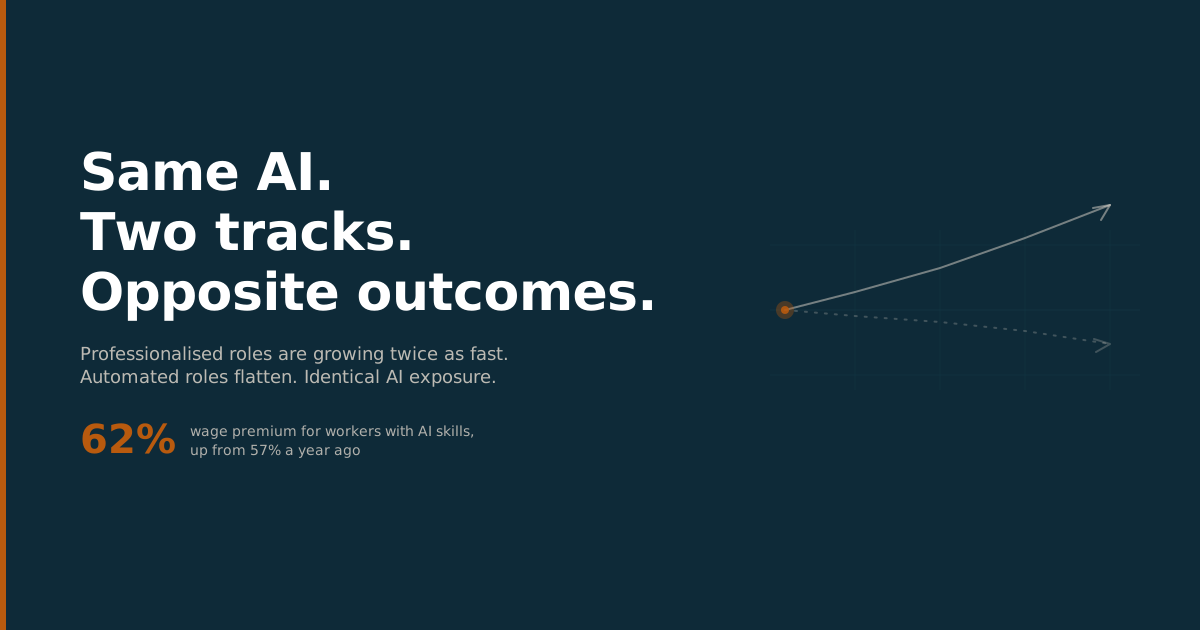
If you want a structured version of this exercise across your whole role rather than one week, the career audit walks the same logic across scope, positioning, and trajectory. And if you are weighing whether to move now or reposition where you are, the two-track AI job market is the piece to read next. Managers already stuck at the director level should also read why strong directors stall before VP, because the mechanism is related and the fix overlaps.