From Individual Contributor to Manager: The Decision Has Changed
Grow as a LeaderFebruary 6, 20269 min read
individual contributor to managerIC to managershould I become a managermanagement transitionplayer-coachcareer-transitionleadership
The last time you seriously considered moving from individual contributor to manager, the script was simple. Say yes, get the title bump, start running 1:1s. The alternative was stagnation.
That script is broken. Not softly broken. Structurally broken.
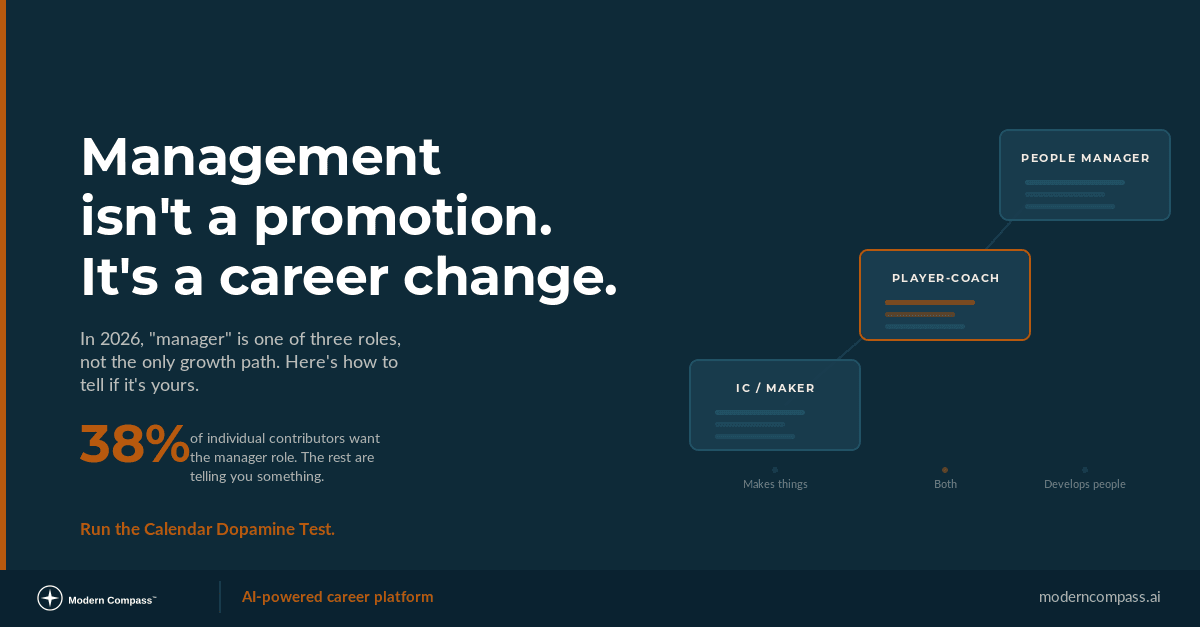
In April 2026, Jack Dorsey and Roelof Botha published an essay arguing that two thousand years of hierarchical org structure, traceable back to the Roman army, were about to be replaced. Block backed the argument by cutting roughly 4,000 of its 10,000 employees and publicly committing to rebuild the company as what they called a "mini-AGI." Three roles instead of a pyramid. Individual contributors who build the system. Directly responsible individuals who own an outcome on a 90-day cycle. Player-coaches who stay hands-on technically while developing people.
If you're mid-career and your boss is asking "when are you going to move up to management," you're being asked a 2018 question in 2026.
Here is what's actually changed and how to make the decision now.
The Three Roles Replacing the Manager Ladder
The old question was binary. IC or manager. The new question has three answers, and they don't map cleanly to the org chart you've been staring at for the last decade.
Individual contributors who build the system. Not "senior engineers doing tickets." Senior operators who wire humans, agents, and tools together so work ships. A Staff or Principal on this track outputs what a team of three or four produced in 2022.
Directly responsible individuals (DRIs). Own a specific outcome on a 90-day cycle. They might have two people reporting to them. They might have none. They have a number they own and a deadline. Less about a team, more about a result.
Player-coaches. Hands-on technical or functional work paired with people development. The hidden cost nobody mentions: you become a generalist. Your team is delivering, you're kind of participating, and when performance review time comes, showing direct attribution for your accomplishments gets harder. Not impossible. Harder.
Traditional middle management, the role that exists mainly to aggregate status updates and route information between layers, is the role most at risk. That's the role Block cut 4,000 of.
If you're evaluating a manager offer, the first question isn't "am I ready for this." It's "which of the three roles is this actually?"
The Calendar Dopamine Test
Here is the filter I'd apply tonight, before any self-reflection exercises or conversations with your manager. I call it the Calendar Dopamine Test because it doesn't rely on your self-image or your current boss's agenda. It relies on evidence.
Step one. Pull up your calendar, your commit history (or whatever artifact trail your role leaves), and your Slack or Teams messages from the last two weeks.
Step two. Identify the three exact moments that gave you the biggest rush of satisfaction, energy, or pride at work.
Step three. Honest count: how many of those three were tied to your direct execution? Shipping a piece of code. Writing a clean strategy doc. Single-handedly solving a complex technical problem. How many were tied to facilitating someone else's success?
If all three were personal execution wins, and zero were tied to unblocking or coaching someone, decline the promotion.
Management is not a promotion. It is a career change. It requires shifting from being a Maker to being a Multiplier. Makers get dopamine from crossing items off a list and delivering concrete artifacts. Multipliers get dopamine from unblocking a team, fixing a broken process, or coaching someone through a hard problem so they can ship.
If a full week of 1:1s, resource allocation, and alignment meetings sounds like a distraction from "real work," that is your signal. Stay on the IC track and push into the Staff, Principal, or Distinguished path where your maker instincts compound.
People who fail this test and take the role anyway don't just become unhappy. They become a specific kind of bad manager. They micromanage, compete with their own reports for the interesting work, and quietly resent the endless 1:1s that are actually the job.
However the test comes out, look at the actual role next, not the title. If the position you're weighing has a job description attached, run it through the match analyzer with your resume — seeing what the posting really emphasizes makes 'which of the three roles is this?' a much easier question. It's free and takes about a minute.
The Wrong Reasons Mid-Career People Still Say Yes
A Visier survey found that only 38% of individual contributors are interested in becoming managers, and 31% said they'd consider quitting if pushed into the role. In tech specifically, LinkedIn data puts the preference for specializing over managing at roughly 60%.
And yet offers keep getting accepted. Two reasons I've watched repeatedly.
Default-path thinking. The belief that "growth" means "up" and "up" means "people responsibilities." For a long time this was structurally correct. It isn't anymore. A senior IC with real agent fluency carries scope that used to require a team, and some companies are starting to compensate accordingly. If you're accepting the role because you assume there's no other ladder, check the actual ladder at your company. If it's still single-track, that's a signal about your company, not about you.
Ego comparison. This one I've watched more times than I want to count. Someone expresses zero interest in mentoring or developing people for years. Then a peer gets the manager title. Suddenly "growth" feels urgent. The sense of failure is real, but it's a comparison fault, not a vocation. You don't actually want to coach anyone. You want to not have lost.
Both paths lead to managers who are secretly checked out, and teams that eventually notice.
What Managing Agents Taught Me About Managing Humans
I'm building Modern Compass with AI agents as part of the daily workflow. It's changed how I think about what management actually is.
With agents, you get dense data and direct influence. You know exactly which input produced which output. You can tune the prompt, switch the model, change the tool, and see the effect inside of minutes. It's closer to engineering than to leadership.
With humans, you get almost none of that. You get coaching, listening, and indirect influence. You try a phrase in a 1:1 and you might see the effect six weeks later, maybe, if your report didn't also get advice from their partner, a friend, and a podcast in between. The feedback loop is foggy. The instrumentation is bad.
What this means for the manager decision: the skill set has split. Orchestrating agents looks less and less like coaching people. If you love the precise, instrumented, direct-influence work, the player-coach role or the DRI role will feel natural. If you love the slow, foggy, indirect-influence work of growing people, pure people management is still a real vocation, and a scarcer one than it used to be. Pick the one that matches what you actually want to practice for the next five years.
A Better Way to Trial-Run It
Standard advice says mentor someone and run a retro. Fine. It's also thin. It doesn't simulate the part of management that most people bounce off of: owning a portfolio with dependencies and people whose work you can't do yourself.
A sharper test. Take a junior team member under your wing with a real stretch assignment. Not "shadow me." Give them a deliverable, a deadline, and a stakeholder. Then watch yourself. Do you naturally unblock them, or do you get itchy and pull the work back? Do you enjoy their growth, or do you mostly notice the parts they're doing slower than you would?
The more complete test, if you can pull it off: informally lead a small group through a set of programs for six to eight weeks. Two or three people. Genuine scope. I've used this with my own teams to see how someone thinks and connects when they're accountable for more than their own deliverables. You learn in four weeks what a coaching course can't teach in four months.
When I first stepped into people leadership, I was building a team from scratch while standing up major programs at the same time. Double duty for six months before the new hires could carry their own weight. That experience taught me something the stretch assignment can't: management stops being theoretical the moment you're responsible for outcomes you can't personally deliver. The trial run won't replicate the weight, but it will tell you whether you want to be near it.
If You've Already Been a Manager and You're Reconsidering
One group this is specifically for: people who've already done the role, lost the team in a reorg, and are now deciding whether to re-enter. Your context is different. You know you can do it. The question isn't capability. It's whether the 2026 version of the role matches the version you used to like.
Ask specifically. Is this a manager-of-managers role, which is shrinking? A player-coach role, which is expanding? Or a classic middle-manager role routing information up and down a chain, which has a real risk of being restructured inside eighteen months? You are not obligated to re-enter as a manager just because you've been one. The IC track, especially with agent fluency, is not a step backward. A lot of the most interesting work in the next three years will be done by senior operators who never touched a reporting line.
One Thing to Do This Week
Don't start by talking to your manager about your trajectory. Start by figuring out what you actually value in your work, because the IC-vs-manager-vs-player-coach question is downstream of that.
Take the Values Prioritization exercise. It takes about ten minutes and costs nothing. It surfaces which of your stated values you'd actually trade off against each other under pressure, which is the data most people don't have about themselves.
If you want a broader read on your career before that, two tools are worth the time. The Career Audit covers direction, confidence, and skill fit. The Career Quick Check is a five-minute version that flags where you're most and least prepared for your next move.
Then book one conversation with a career coach (internal mentor, external coach, whoever you trust) with a specific agenda: Given my values ranking and the Calendar Dopamine Test results, is the people leader track right for me, and if not, what's the better move this year?
That is a more useful Friday than another hour of LinkedIn posts about authentic leadership.
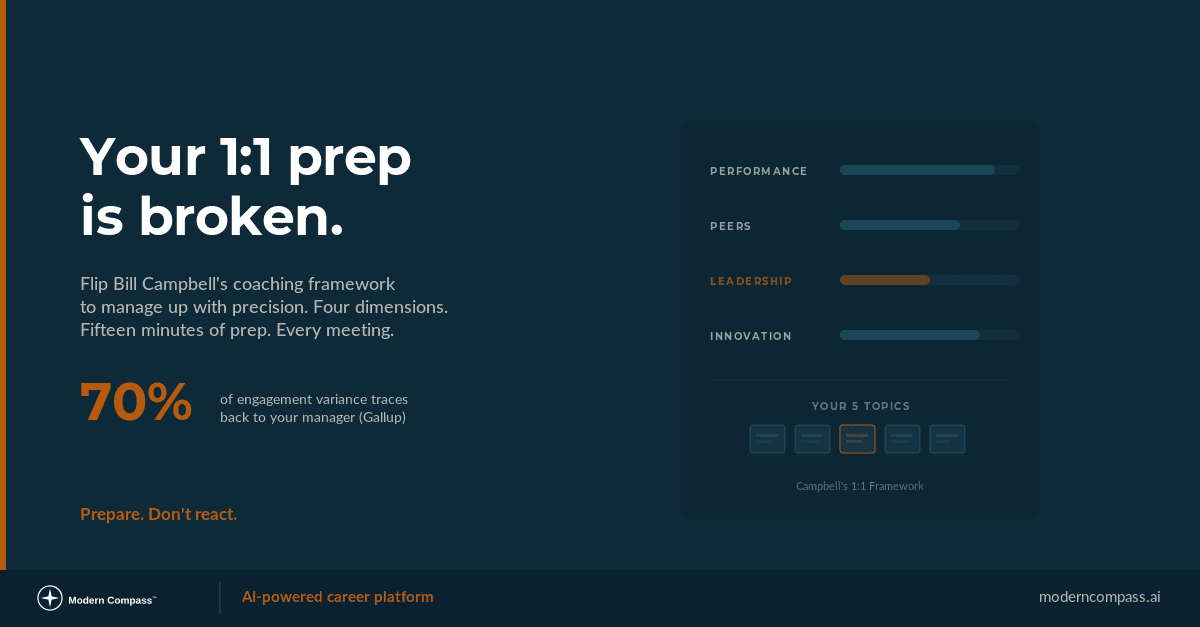
Two skills that don't show up in management books but matter immediately. The first is managing up. Your relationship with your skip-level changes everything. The second is executive presence, which is less about charisma and more about how you show up when the stakes are high.
Grow as a Leader
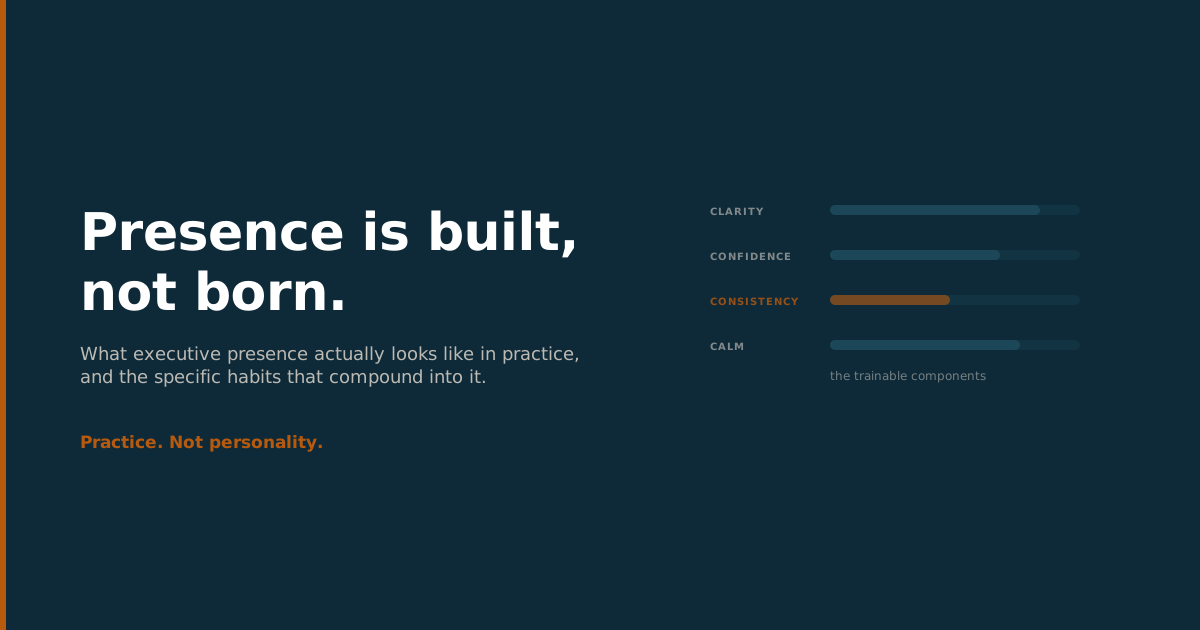
Developing Executive Presence: A Complete Guide
What executive presence actually looks like in practice, and the specific habits that build it over time.