Managing Up Effectively: How to Build Strategic Relationships with Leadership
Grow as a LeaderFebruary 6, 20269 min read
managing up effectivelymanaging upmanage up1:1 meeting preparationmanaging your bossleadership
You just got out of a 1:1 with your boss and you're not sure what happened. You talked about status updates. They seemed distracted. You left without clarity on whether your project has their support or not.
This is not a communication problem. It's a preparation problem. And most mid-career professionals, even ones managing teams of their own, never learn how to solve it.
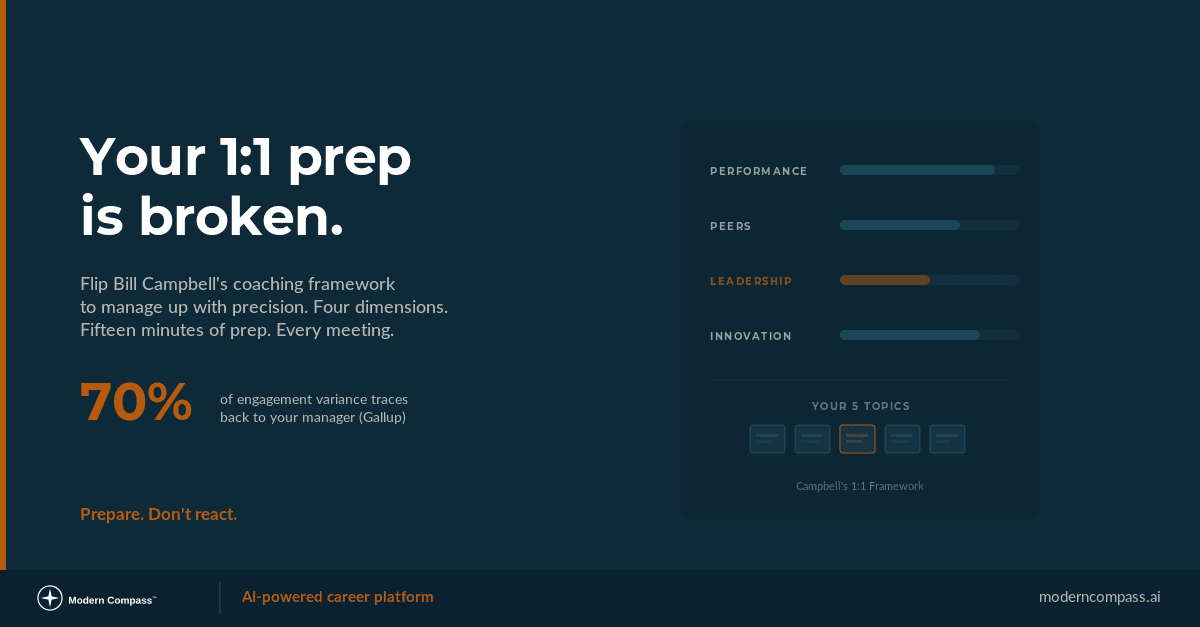
Managing up effectively is one of those skills that separates people who get promoted from people who get told they're "not ready yet" without any specifics. Gallup's research across 2.5 million work units found that managers account for 70% of the variance in employee engagement. The relationship you build with your manager isn't a soft skill. It's the single biggest factor in whether you thrive or stall.
What Managing Up Actually Is (And What It Isn't)
Managing up is understanding what your leader needs before they have to ask for it, and consistently delivering in a way that builds trust. That's it. Not politics. Not flattery. Not doing your manager's job.
The professionals who manage up well do four things: they learn how their boss processes information, they communicate proactively when things go sideways, they make it easy for their manager to advocate for them, and they treat the relationship like a strategic partnership rather than a reporting line.
The ones who don't? Half of all Americans have left a job specifically to get away from a bad manager, according to Gallup's study of 7,272 U.S. adults. But here's what that statistic doesn't say: many of those relationships could have been saved. Not all, but many. The employee who learns to manage up doesn't just survive a difficult boss. They learn to work effectively with almost any leadership style, which is a career skill that compounds for decades.
Use Bill Campbell's Framework (But Flip It)
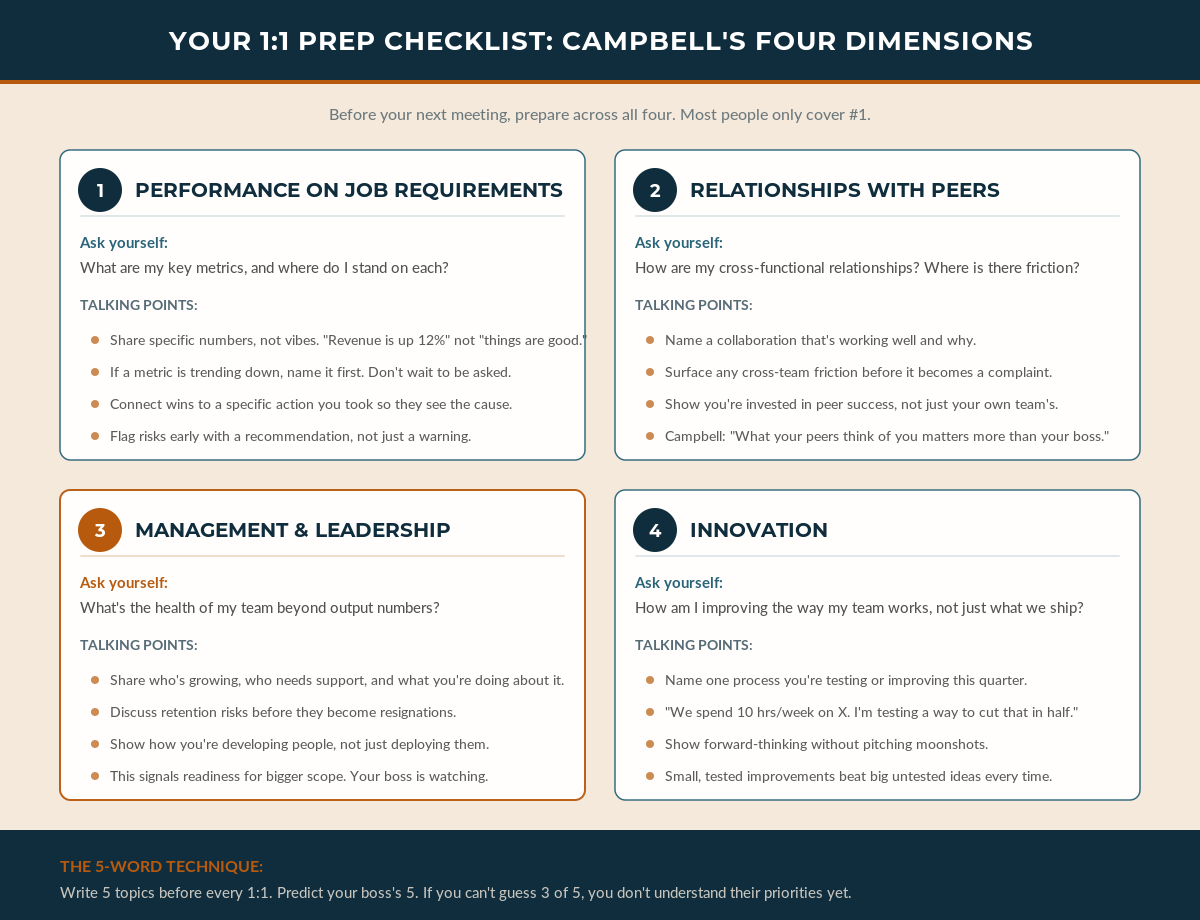
Bill Campbell coached Steve Jobs, Eric Schmidt, and dozens of Silicon Valley's most influential leaders. His book, , details the framework he used to structure every 1:1 meeting. It covers four dimensions: performance against job metrics, relationships with peer groups, management and leadership of their people, and innovation.
Most people read that framework from the manager's perspective. Here's how to flip it and use it to prepare for your next 1:1 with your boss.
Performance on job requirements. Before your meeting, know your numbers. Not a vague sense of "things are going well," but the actual metrics your role is measured against and where you stand on each one. If a metric is trending down, say so before your boss has to ask. If it's trending up, connect it to a specific action you took so they can see the cause, not just the result.
Relationships with peer groups. Your boss cares about this more than you think. Campbell's coaching emphasized that what your peers think of you matters more than what your manager thinks. Come to your 1:1 ready to discuss cross-functional work: where collaboration is strong, where there's friction, and what you're doing about it. A director who can't work across teams never becomes a VP.
Management and leadership. If you manage people, your boss wants to know about your team's health, not just their output. Who's performing? Who's struggling? What are you doing about retention risks? Showing leadership maturity in how you develop your team signals readiness for bigger scope.
Innovation. This doesn't mean pitching moonshot ideas. It means showing that you're evaluating how your team works and actively looking for better approaches. A simple "I noticed we're spending 10 hours a week on X, and I'm testing a way to cut that in half" demonstrates the forward-thinking perspective senior leaders value.
Campbell also used a preparation technique worth stealing: before each meeting, both the manager and the person they coached would independently write down five topics they wanted to discuss. They'd compare lists at the start. Significant overlap meant alignment. Gaps meant the meeting just got more valuable, because now you're surfacing the things that might otherwise go unsaid.
Try this before your next 1:1. Write your five topics. Then ask yourself what your boss would write. If you can predict three out of five, you understand their priorities. If you can't, that's your signal to spend more time learning what keeps them up at night.
Preparation like this compounds — and it also gives you an honest way to test whether the role still deserves it. If you've been quietly wondering, paste a posting you're curious about into the match analyzer along with your resume; knowing where you actually stand turns 'should I stay?' from a mood into a decision. Free, no account needed.
The Status Update Most People Get Wrong
Here's a pattern I've seen repeatedly across large organizations: someone sends a status update that lists what they did this week. Their manager reads it, acknowledges it, and moves on. No strategic conversation happens. No advocacy gets built.
The problem isn't frequency. It's framing.
A useful status update answers four questions: what you accomplished and why it matters (not just what you did), what you're focused on next and how it connects to the team's priorities, what risks or blockers exist and what you're already doing about them, and where you need your manager's input or air cover.
That last one is critical. Managers who manage up well know exactly what to escalate. Early in my career managing a $20 million capital program, I made a point of keeping my leader consistently informed, including transparently sharing where the budget was trending over plan. Because we'd built that rhythm of proactive updates, we identified a likely overrun early enough to secure additional funding before it became a crisis. No surprises. No confrontations. The relationship between transparency and trust isn't theoretical. It plays out in real budget conversations and real career consequences.
Bad news does not age well. The director who flags a risk in week three gets support. The one who surfaces it in week ten gets questioned.
Understand the Context Your Boss Operates In
Managing up doesn't happen only in 1:1s. It requires understanding the broader context your boss operates in.
Who influences your manager's decisions? What initiatives currently have executive support, and which are quietly losing priority? Where is budget flowing? What language does the leadership team use when they talk about strategy? These aren't political games. This is context that lets you position your work in terms your boss can immediately relay upward.
McKinsey's research on middle managers found that more than 90% of U.S. employees report to a middle manager, and the single most important determinant of their performance and satisfaction is that manager. Your boss is a middle manager too, even if their title says VP. They have pressures coming from above, just like you do. When you understand those pressures, you stop bringing them problems in isolation and start bringing them solutions framed in the language their boss uses.
Use AI to Walk Into Every Meeting Prepared
This is where managing up gets a modern upgrade. Most professionals spend zero minutes preparing for 1:1s with their boss. They show up and react. AI tools change that equation entirely.
Here's a practical weekly prep workflow that takes about 15 minutes:
Review your accomplishments. Before your meeting, ask an AI assistant to help you review what you shipped, decided, or unblocked in the past week. It's easy to forget the small wins when you're buried in execution. A quick AI-assisted review turns a scattered memory into a clear narrative of impact.
Get a read on your team's pulse. This one's underrated. If you manage people, use tools that help you synthesize what your team is actually talking about: what concerns are surfacing in standups, what's getting energy versus what's dragging. Walking into a 1:1 with a sense of team sentiment, not just their output numbers, shows a level of leadership awareness that stands out.
Track what's top of mind for your boss. Pay attention to what your manager is posting, commenting on, or sharing in channels like Slack. AI tools can help you spot patterns in what topics they keep returning to, which tells you where their attention (and their boss's attention) is focused. When you align your talking points with what's already on their radar, your updates land differently. I've been surprised how much signal you can pick up just by scanning a week's worth of a leader's Slack activity.
Rehearse the hard conversations. If you need to surface a risk, push back on a decision, or ask for something uncomfortable, practice it first. AI coaching tools let you role-play scenarios, refine your framing, and stress-test your arguments before the stakes are real. This isn't about scripting a performance. It's about walking in with clarity instead of anxiety.
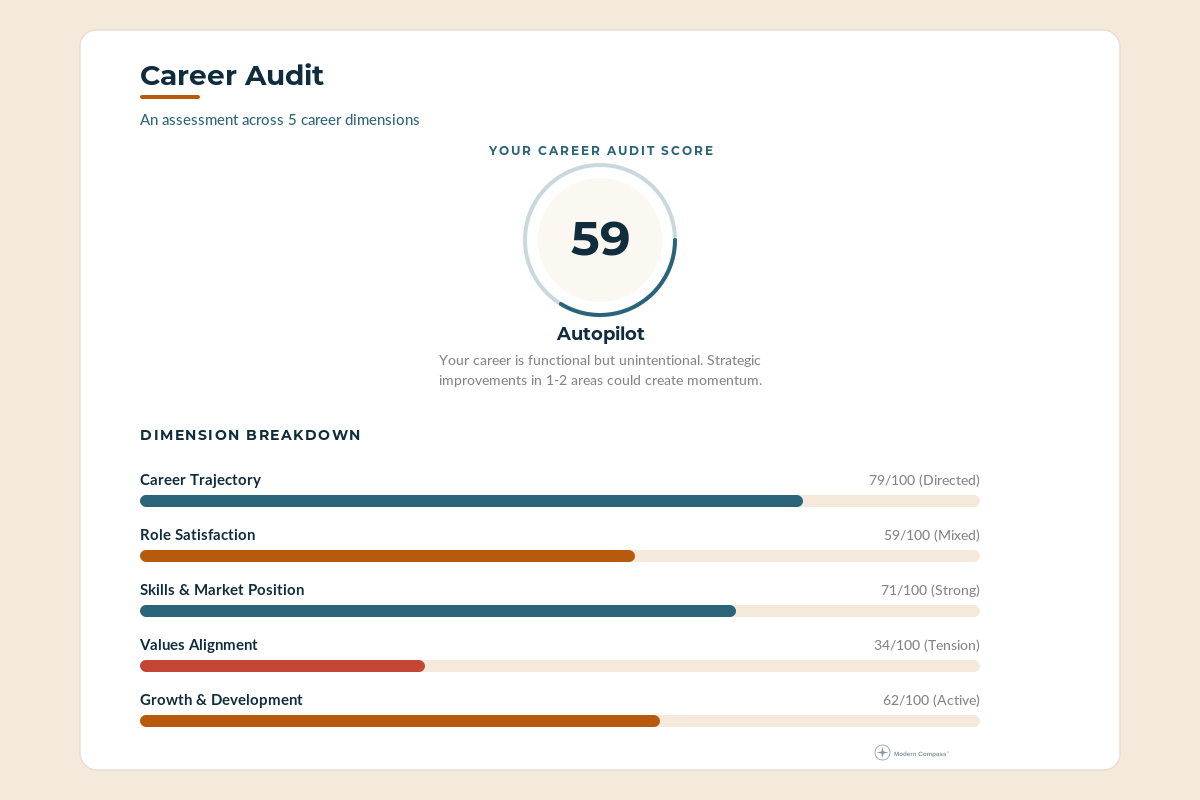
The Career Audit can also help you step back and assess how well you're managing these relationships overall. Sometimes the issue isn't one conversation but a pattern you haven't noticed. The audit takes about 10 minutes and gives you a structured view of where your career relationships stand.
Building Relationships Beyond Your Direct Manager
Skip-level relationships matter, and they're easier to build than most people assume.
Accept every skip-level 1:1 invitation. Volunteer for cross-functional work that gives you visibility with senior leaders. When you're in all-hands meetings, ask a question or share an insight that demonstrates you think beyond your immediate scope. Be responsive and helpful when senior leaders reach out, even for small things.
The goal isn't visibility for its own sake. It's building a network of leaders who know your judgment and your work ethic firsthand. When promotion conversations happen, your boss shouldn't be the only person in the room who can vouch for you. If you're not sure what your career values actually are, it's harder to know which relationships to invest in.
Your Move This Week
Pick your next 1:1 with your boss. Before that meeting, write down five topics you want to cover. Then, using Campbell's four dimensions, check yourself: are you addressing performance, peer relationships, your team's development, and at least one way you're improving how work gets done? If your list only covers status updates, rewrite it.
Managing up isn't a one-time skill you learn and check off. It's a practice that compounds. The trust you build in week five makes the hard conversation in week twenty possible. The pattern of transparency you establish when things are fine is what saves you when things aren't.
If you want to assess where you stand in your career relationships and leadership presence more broadly, the Career Audit gives you a structured starting point. Managing up well requires the same composure and clarity that defines executive presence. And if you're aiming for VP or above, it's worth understanding why strong directors often stall, because the gap is rarely about skill.
Future-Proof Your Career
Setting Career Goals That Actually Compound: Beyond Basic SMART
SMART goals work, but most mid-career professionals use them wrong. Learn how to build goals that compound on each other instead of chasing titles.