You've spent a decade building expertise, managing teams, and earning credibility in your field. Now you're Googling "career change at 35" at 11pm, half-convinced you're about to throw it all away.
You're not. And the advice you're finding, the listicles telling you to "identify your transferable skills" and "build a financial runway," is written for someone ten years younger with a fraction of your professional capital. Most career change advice treats you like a recent graduate who picked the wrong major. At 35+, the playbook is different. Not slightly different. Structurally different.
You don't need permission to start over. You need a strategy to reposition.
Why Most Career Change Advice Fails Mid-Career Professionals
The standard career change framework goes something like: take a personality assessment, explore your interests, do informational interviews, build new skills, apply for entry-level roles. It's fine if you're 24 with no mortgage and a tolerance for ramen dinners.
At 35+, you're operating under different constraints and with different assets. You have financial obligations that won't pause while you figure things out. You have a professional reputation worth protecting. And you have something most career change guides completely overlook: a decade of organizational knowledge, relationship capital, and pattern recognition that transfers whether or not your job title does.
The World Economic Forum estimates that 39% of existing skill sets will be transformed by 2030. But here's the detail buried in that data: entry-level roles face the steepest disruption, while managerial and strategic roles face only 9-21% automation risk. Your experience isn't just portable. It's becoming more valuable, not less, as the job market shifts.
The real question isn't "Can I change careers at 35?" It's "How do I change careers without giving back the ground I've already gained?"
The Biggest Mistake: Hiding the Pivot
I've hired across product management, AI, and program management at Disney, Salesforce, and Royal Caribbean. I've reviewed hundreds of resumes and sat through more interviews than I can count. The single most common mistake career changers make? They try to disguise the change.
They bury their previous career in vague language. They swap specific accomplishments for buzzwords. They write resumes that sound like they asked a thesaurus to explain their career (our flags this pattern constantly). "Cross-functional synergy" and "stakeholder alignment" don't tell me anything. They tell me you're uncomfortable with your own story.
The career changers who got hired told me exactly what happened. "I spent eight years in logistics, realized I was spending all my energy on the people problems, and decided to formalize that into HR leadership." That's a story I can evaluate. That's a candidate I can advocate for in a hiring meeting.
Own the pivot. When I see a candidate who has done their homework, earned relevant certifications, and built connections in their target field, the career change becomes an asset, not a liability. It signals initiative, self-awareness, and the kind of professional courage that organizations actually need.
Compare that to the candidate who pretends they've always been in the new field and hopes nobody checks LinkedIn dates. That person gets a polite rejection email.
I had my own version of this. Early in my career, I drifted toward a marketing role. I recognized quickly that it wasn't the right fit and repositioned back to my roots in program management. The lesson wasn't that the move was wrong. The lesson was that I could name what wasn't working, act on it, and come back stronger. A career change doesn't have to be permanent to be valuable, and it doesn't have to be hidden to be professional.
The Identity Problem Nobody Warns You About
Here's what the "10 Steps to Your Dream Career" articles skip: when you've been "the marketing director" or "the operations lead" for a decade, your job title isn't just what you do. It's part of how you think about yourself.
I watched my father go through this. After years in his career, he struggled with the transition. Tried a few different paths. Nothing clicked until something that started as a hobby, a part-time side interest, evolved into what became his late-in-life career pivot. The path wasn't linear. It rarely is.
Research backs this up. Studies from Frontiers in Psychology show that career transitions involve shifts in identity, values, and life orientation, not just a change in job duties. About 35% of mid-career professionals report career stagnation or a disconnection between their work and their sense of purpose. That feeling isn't a crisis. It's a signal.
People who handle this well share one trait: they stop demanding certainty before they act. They accept a period of exploration. The discomfort of not having a clear title? Temporary. The regret of staying in the wrong career for another five years? That one compounds.
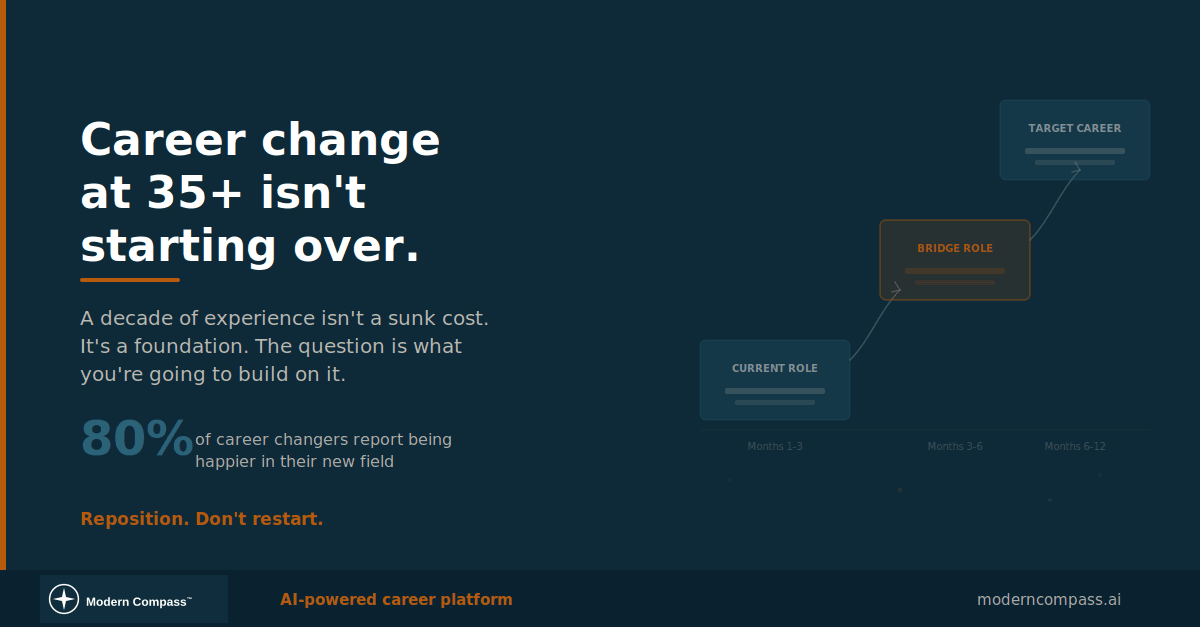
If you're feeling the weight of "but this is who I am," know that it's a normal part of the process, and the data shows that 80% of career changers report being happier in their new field. The transition is hard. The outcome, for those who approach it strategically, is usually worth it.
Bridge Roles: The Strategy That Actually Works
A clean break makes for a good story. "I quit my corporate job and started a bakery!" sounds great in a magazine profile. In practice, bridge roles produce better outcomes and let you keep your income intact while you transition.
A bridge role uses your existing skills in a new context. Same function, different industry. Or same industry, different function. You change one variable at a time instead of two.
Here's what this looks like in practice:
Current Role
Bridge Role
Target Career
Operations Manager (Retail)
Operations Manager (Healthcare)
Healthcare Administration
Software Engineer
Technical Product Manager
Product Leadership
Finance Analyst (Corporate)
Finance Analyst (Startup)
Startup Operations/COO
Marketing Director (B2C)
Marketing Director (B2B SaaS)
Tech Go-to-Market Strategy
Notice the pattern. In each case, the person changes one variable, industry or function, not both at once. That's what makes it work. You're not asking an employer to bet on potential. You're showing them a professional who already does the core job, just in a different context. That's a much easier yes in a hiring meeting.
Research shows lateral movers see approximately a 20% increase in promotion rates. Moving sideways into the right context often accelerates your career faster than trying to jump directly into an unfamiliar role at a lower level and working your way back up. You didn't spend a decade building seniority to restart at step one.
Bridge roles also solve the income problem that kills most career transitions. Instead of taking a 30% pay cut to "break into" a new industry, you transfer at your current level and learn the new domain on the job. Three years later, you're a veteran in the new field with no gap in your earnings history.
How AI Changes the Career Change Calculus
If you're considering a career change right now and you're not factoring in AI, you're making a decision with incomplete information.
This isn't about whether AI will "take your job." For mid-career professionals, the bigger question is whether your target field will look the same in three years. Entry-level work in content writing, basic data analysis, and routine coding is already being compressed. The roles expanding are the ones that require judgment, relationship management, and the ability to direct AI tools toward business outcomes.
That's good news for career changers at 35+. Your ability to manage ambiguity, read organizational dynamics, and make decisions with imperfect information is exactly what AI can't replicate. But you need to pair that experience with fluency in how AI tools work in your target field.
The people who will struggle are the ones who treat AI as someone else's problem. Use AI tools to research target industries, analyze job descriptions for specific skill gaps, and identify patterns in your own career history you might be too close to see. AI won't make your career decision. But it can compress months of research into days.
If you want a clear picture of where your career stands right now and where the gaps are, the Career Audit takes about 10 minutes and gives you a structured readout of your strengths, risk areas, and potential directions. It won't make the decision for you, but it might clarify what you're actually working with.
A Realistic Timeline (Not the One You Want to Hear)
Most career change articles promise transformation in 90 days. Most actual career transitions take 6-18 months when done well. The variance depends on how different your target field is and how much repositioning your professional narrative needs.
Months 1-3: Get honest with yourself. Figure out whether you're running from something or toward something. Research from The Muse shows that the number one predictor of career change regret isn't making the wrong choice. It's making a reactive choice. Talk to people in your target field. Not informational interviews where you ask polite questions, but real conversations where you ask, "What do you hate about this work?" and "What would make you leave?"
Months 3-6: Build your bridge. Get the certifications that matter (not the ones that are easy). Start contributing to your target industry through writing, volunteering, or consulting projects. Update your narrative, not your resume yet, but the story you tell about why this move makes sense. Practice saying it out loud until it doesn't feel like an apology.
Months 6-12: Execute with patience. Revamp your resume to lead with relevance, not chronology. If you're not sure how your resume reads to someone in your target field, run it through an audit before you start sending it out. Apply to bridge roles where your existing skills solve a clear problem. Use your network, the one you built over the last decade, for warm introductions. Accept that the first role might not be the dream role, but it should be pointed in the right direction.
Month 12+: Recalibrate. You may land something in month 7. You may still be searching at month 14. Both are normal. The professionals who succeed are the ones who treat this as a campaign, not a lottery ticket.
What To Do This Week
Pick one person in the field you're considering and ask them to coffee. Not a formal informational interview. A conversation. Ask them what surprised them about the work, what the job is actually like on a Tuesday afternoon, and whether they'd do it again.
Then write down, in plain language, why you're considering this change. Not the polished version. The honest one. If you can't articulate it clearly to yourself, you're not ready to articulate it to a hiring manager.
Your career at 35+ isn't a sunk cost. It's a foundation. The question is what you're going to build on it.
Before you start reaching out to people in your target field, make sure your LinkedIn profile tells the right story. A profile that still screams your old career will confuse every new connection. Here's how to update it in 30 minutes.
Grow as a Leader
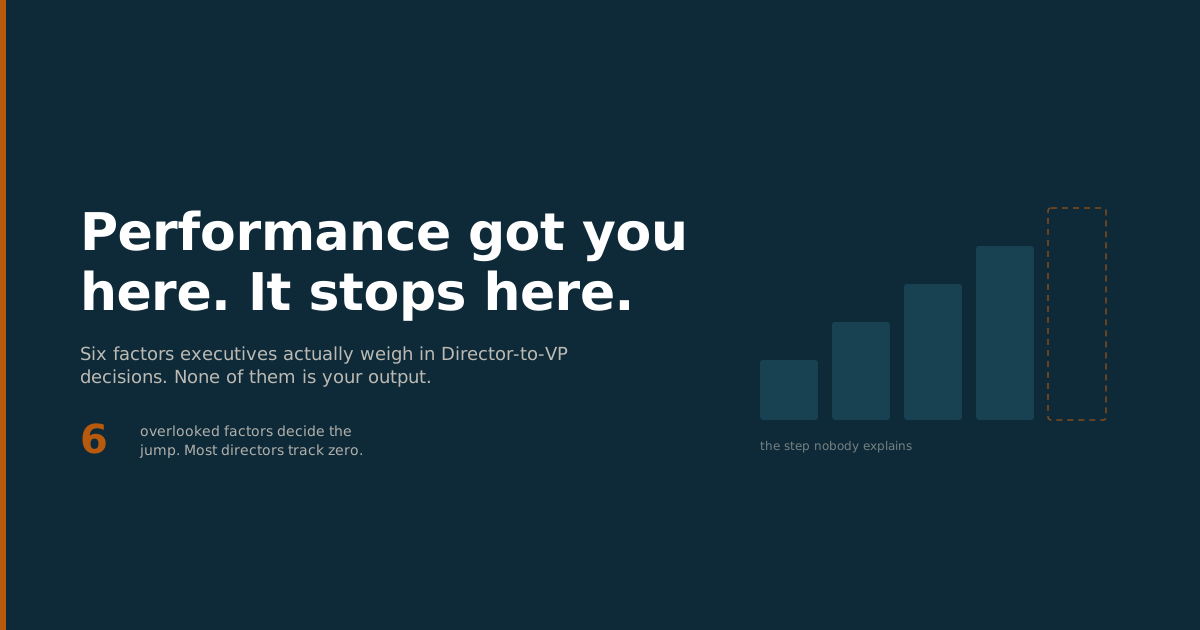
Why Your Best Directors Aren't Getting Promoted to VP
Discover the 6 overlooked factors that determine Director-to-VP promotions. Learn why strong performance alone won't get you promoted and what executives actually evaluate.