Can Recruiters Tell If You Used AI on Your Resume?
Land Your Next RoleJuly 27, 20267 min read
resumeaijob-searchhiring
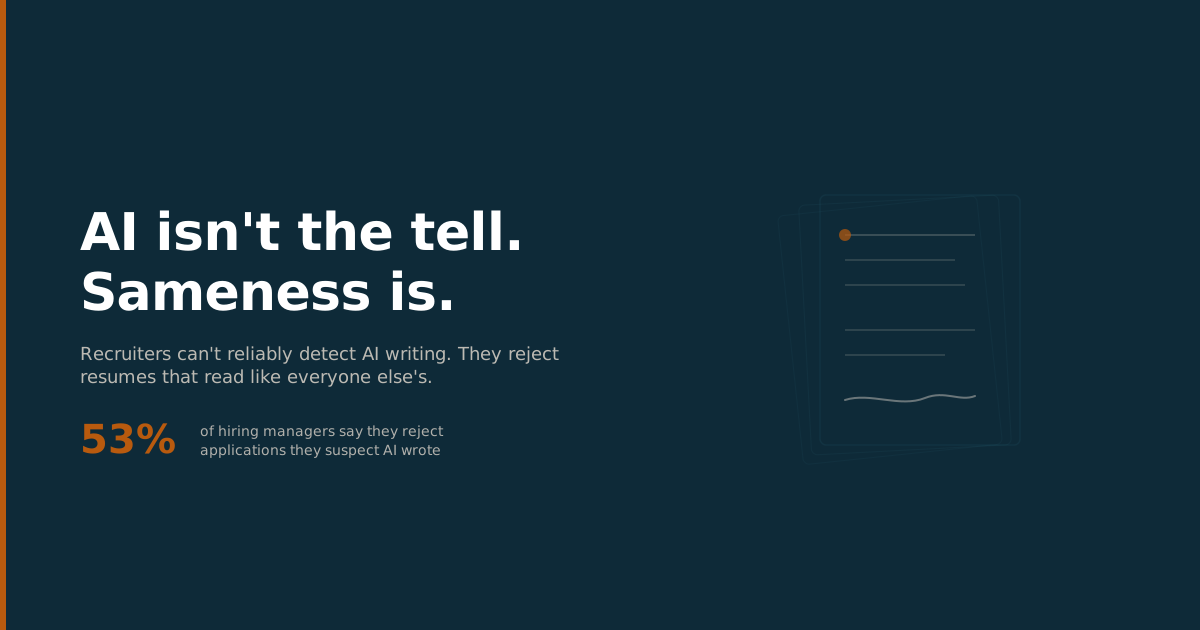
Somewhere in your job search, you've probably had this exact hesitation: you paste your resume into an AI tool, watch it produce something smoother than what you wrote, and then wonder whether that polish is going to get you rejected. It's a fair worry. In 2026, 53% of hiring managers say they'll reject an application they suspect was written by AI.
So can recruiters tell if you used AI on your resume? Not the way you think. And the honest answer matters more for mid-career professionals than for anyone else, because you have the most to lose from sounding generic and the most raw material to avoid it.
No, recruiters can't detect AI. They detect something else.
There is no reliable AI detector for resumes. OpenAI shut down its own AI-text classifier because it caught barely a quarter of AI-written text, and no major applicant tracking system flags authorship. Nobody is running your resume through a machine that stamps it "ChatGPT" and bounces it.
What recruiters detect is sameness.
I've read thousands of resumes across hiring roles at Disney, Salesforce, and Royal Caribbean, and the pattern a screener reacts to isn't a watermark. It's the fifth "results-driven leader with a passion for cross-functional collaboration" in a row. Before AI, weak resumes were at least weak in individual ways. Now they're weak identically, because the same handful of models produce the same handful of phrasings for millions of applicants.
When a hiring manager says "I can spot AI," what they mean is: I can spot a resume with no specific decisions, no odd details, no evidence that a particular human lived this career. AI didn't invent that failure. It industrialized it.
That distinction should change how you use these tools. The goal was never to hide AI use. It's to make sure the thing on the page couldn't have been generated for anyone but you.
The double bind: machines reward what humans punish
Here's what makes 2026 genuinely confusing. Roughly 88% of employers now use some form of AI screening, and controlled tests show AI screeners favoring AI-polished resumes by wide margins, in some studies up to 82%. The machine layer likes clean structure, dense keyword coverage, and standardized phrasing. Exactly the qualities that make a human reader's eyes glaze over.
Then land the interview: a tailored resume + matching cover letter for $5.99$12(launch pricing).
Meanwhile 62% of hiring managers say personalization is what wins them over, and over half say suspected AI authorship is grounds for rejection.
None of this is new dysfunction, just accelerated. Wharton's Peter Cappelli was documenting how automated hiring filters screen out qualified candidates in Harvard Business Review years before generative AI arrived. What's new is that the candidates are now automated too.
Your resume now has two readers with opposite tastes. The first reader is software that rewards conformity. The second is a person who rewards distinctiveness. Write purely for the machine and you die in the human round. Write purely for the human and you may never reach one.
There's one more piece of data worth sitting with. When researchers ran identical candidate pools through different AI screening tools, the shortlists overlapped by only 14%. Read that again. The same resumes, different software, almost entirely different "top candidates." If you've been treating each rejection as a verdict on your worth, a good chunk of it is closer to a coin flip between vendors.
That's not a reason to despair. It's a reason to stop taking screening outcomes personally and start engineering for both readers deliberately.
What the two-reader strategy looks like in practice
The resumes that survive both filters share a structure: machine-legible skeleton, unmistakably human muscle.
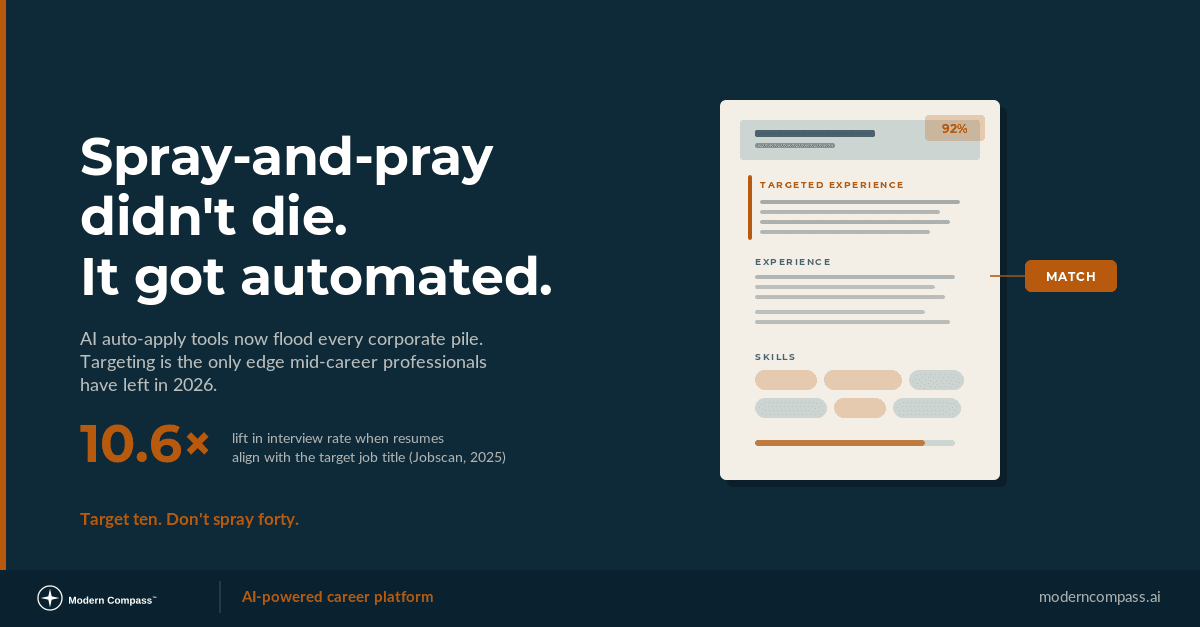
The skeleton is where AI helps. Clean section headings. Standard reverse-chronological format. The actual vocabulary of the job posting, because semantic keyword matching is how the first reader decides you're relevant. Asking AI to map your experience against a posting's language is a legitimate and smart use. This is mechanical work, and outsourcing mechanical work to software is what mid-career professionals do all day.
The muscle is where AI fails you. Numbers only you know. The budget you actually managed, the team size before and after the reorg, the retention figure that made your case for promotion. A model can't invent these, and when it tries to compensate it produces the buzzword sludge that gets you rejected. In my own screening years, the line that earned a phone call was never elegant. It was specific. "Cut vendor onboarding from 6 weeks to 9 days" beats any adjective ever written.
This is also where most mid-career resumes quietly fail before AI even enters the picture. The experience is real but the page reads generic, because after 15 years you've stopped noticing which of your accomplishments are actually distinctive. If you want an outside read on where your resume lands today, the free resume audit scores it in about 60 seconds and shows you which bullets read as evidence and which read as filler.
[INSERT: screenshot of a resume audit result highlighting a flagged generic bullet next to a rewritten specific one]
Why 15 years of experience is an unfair advantage here
The standard advice on this topic is written for early-career applicants, and it mostly amounts to "have AI write it, then edit." That advice inverts at mid-career.
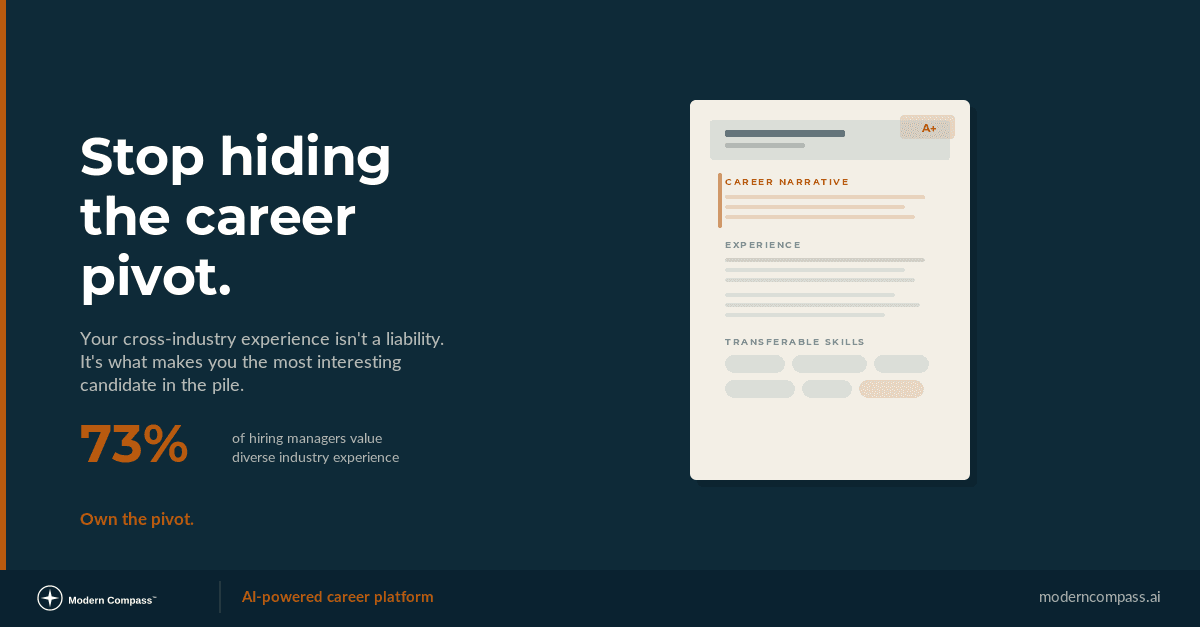
An early-career applicant has thin material, so AI generation genuinely adds substance, and that substance is generic because their history is short. You have the opposite problem. Two decades of decisions, failures, turnarounds, and numbers. Your risk isn't too little material. It's that AI summarization flattens distinctive material into oatmeal.
So invert the workflow. Don't ask AI to write and then inject yourself into the output. Write the ugly, specific version first: every project, every number, every mess you cleaned up, in plain language nobody else could have produced. Then hand AI the tightening job. Sentence economy, keyword alignment, format consistency. AI as editor preserves your fingerprints. AI as author erases them.
One test I trust: read each bullet and ask whether a competent stranger in your field could have written it about their own career. If yes, it's filler, no matter how polished. If no, it stays, no matter how awkward. A resume where most bullets pass that test has nothing to fear from any hiring manager's AI suspicion, because suspicion was never really about tools. Recruiters reject the absence of a person.
The deeper pattern, the one I keep returning to since the AI job market split into two tracks, is that judgment is becoming the differentiator while production becomes cheap. Your resume is now a demonstration of exactly that split. Anyone can produce polished text. Deciding what's worth saying is the part that signals seniority.
What to do with your resume this week
Skip the full rewrite. Do this instead.
Open your resume next to a job posting you actually want. Highlight every bullet a stranger in your role could claim. Those are your rewrite targets, and the rewrite is usually just replacing an adjective with a number you already know.
Then run the two-reader check: does the posting's actual vocabulary appear in your skeleton, and does at least one detail per role prove a specific human did the work?
If you use AI, use it on the second draft, never the first. Feed it your specifics and ask it to tighten, not to generate. You'll keep the polish that helps with the machine reader and the fingerprints that win the human one.
And the next time a rejection lands with no explanation, remember the 14% overlap number before you rewrite anything. Sometimes the resume isn't the problem. The lottery is. Your job is to make sure that when your resume does reach a human, it reads like it could only belong to you. That part has never been automatable, which is exactly why it works. For a deeper look at the fundamentals underneath all of this, resume basics that actually work for experienced professionals covers the structural layer, and if an AI is on the other side of your next interview too, here's how to prepare for an AI video interview.