How Long Does a Job Search Take? The Average Is Hiding Two Different Searches
Ask how long does a job search take and you will get a number. Five months. Six months. Six-point-six months, if the survey was thorough enough to add a decimal. Every article that quotes one of these numbers then promises to help you shrink it.
The number is real. It also describes almost nobody.
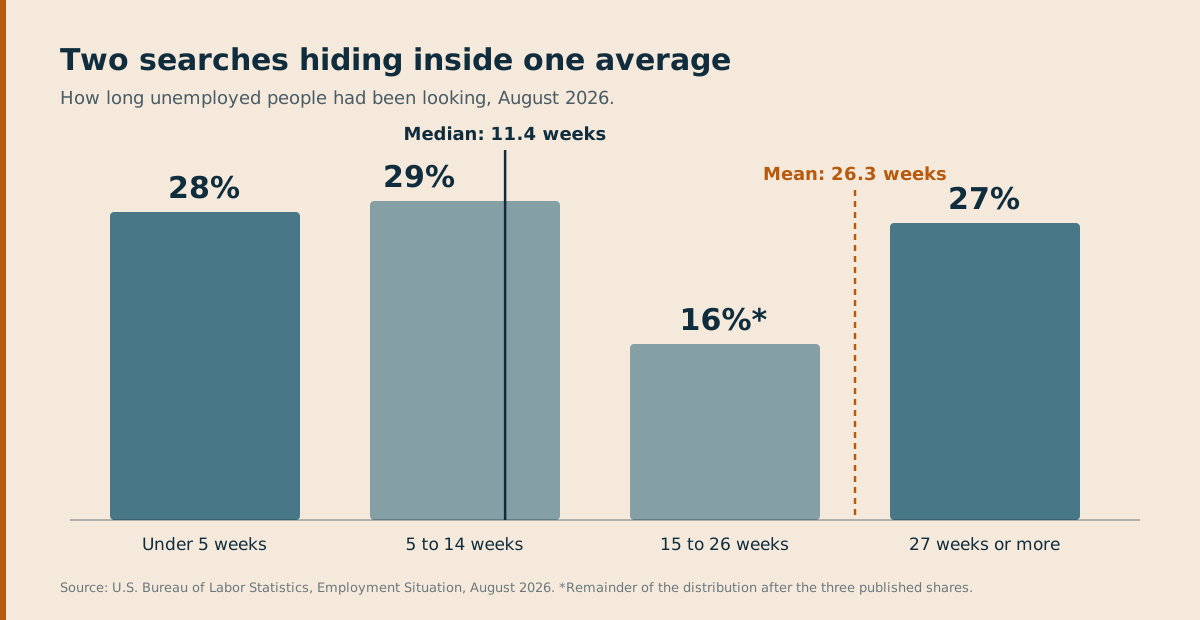
In August 2026, the average duration of unemployment in the United States was 26.3 weeks. The median was 11.4. Both figures come from the same Bureau of Labor Statistics table, released the same morning, measuring the same population. When a mean sits at more than double its median, you are not looking at one group of people who took a while. You are looking at two very different experiences averaged into a single misleading figure.
Which one you are in should change almost everything about how you run the next three months. Nobody tells you that, because the average is easier to put in a headline.
The number everyone quotes is a statistical artifact
A mean of 26.3 weeks against a median of 11.4 means the distribution has a long right tail. Some people are searching for a very long time, and they drag the average up for everyone else.
The BLS breakdown makes the shape visible. In August, 28% of unemployed people had been looking for under five weeks. Another 29% were in the five-to-fourteen week range. Then 27% had been searching for 27 weeks or more.
So the population splits roughly into thirds: recently displaced, mid-process, and long-term. The "average" searcher sitting at 26 weeks is a mathematical composite of a person four weeks in and a person a year in. Nobody actually lives at that number.
This matters because you are probably making plans against it. If you budgeted six months of savings and you are in the short group, you spent months bracing for something that was never coming. If you assumed you would be done by Thanksgiving and you are in the long group, you will hit week 20 with no financial cushion and no emotional one either, which is a far worse place to be than simply having known.
Then land the interview: a tailored resume + matching cover letter for $5.99$12(launch pricing).
What a hiring manager's calendar actually looks like
Here is the part that reframed this for me.
Across product and AI leadership roles at Disney, Salesforce, and Royal Caribbean, I rarely held a requisition open for an extended stretch. When my teams were genuinely hiring, we closed in 10 to 12 weeks. Post the role, screen, interview, debrief, offer. Twelve weeks was the outside edge of a normal, healthy, not-especially-fast process.
Now put that next to the median job search of 11.4 weeks.
They are the same number. Which means the median job seeker is not slow, or unlucky, or doing anything wrong. The median job seeker is simply inside one hiring cycle, running at the speed hiring actually runs. Eleven weeks feels like forever from the candidate's chair and looks completely routine from mine.
That reframe has a sharp consequence. If a single well-run cycle takes about three months, then a search that has gone 27 weeks is not one slow process. It is two or three completed cycles that ended without an offer.
Those are different problems with different fixes. A person at week eight needs patience, because the process they are in has not finished yet. A person at week 24 does not need more patience. They need to know why two full cycles closed without converting, because a third round of the same approach will produce the same result.
The advice industry collapses these two people into one and tells them both to apply to more jobs.
You cannot know your outcome in advance. You can read the signals well before month six, and the signals are behavioral rather than emotional.
Count conversions, not applications. By week six, a search that is tracking toward a normal cycle has produced real motion: recruiter screens that led to hiring manager calls, at least one process that reached a panel or a take-home. The specific number matters less than the direction. Applications going out and nothing coming back is a different situation from applications going out and three processes moving.
Some honest markers that you are in the long track:
Recruiter screens happen, then go quiet after the hiring manager stage. Twice or more.
You are getting rejected at the same round repeatedly, which usually points at one fixable thing rather than a general verdict on you.
Roles you are excited about are ones where you meet maybe half the stated requirements.
Your applications are mostly to postings less than 48 hours old, and you still hear nothing. That combination suggests a targeting problem, not a timing one.
If two or more of those describe you at week six, plan for a long search now, while you still have the resources to plan well. That is not pessimism. It is the same thing you would do in any project where the early indicators diverged from the estimate.
And if none of them describe you, stop reading anxiety into a process that is behaving normally. The silence between a hiring manager call and a panel invite is usually a calendar problem, not a signal about you.
What actually costs you the offer in month five
I want to be careful here, because this can be misread.
A long search does not disqualify you. I never looked at a resume, saw a gap, and moved the candidate to the no pile for that reason alone. What I could see, and what did affect decisions, was when someone had stopped being engaged. Going through the motions shows. It shows in a candidate who has not looked past the job description, who asks nothing specific about the team, who gives competent answers with no interest behind them.
That is not a character flaw. It is what months of rejection do to a person, and it happens to good candidates constantly.
But it means the risk in a long search is not the length. It is arriving at month five with nothing left for the interviews you do get. Which turns pacing from a wellness suggestion into a conversion strategy.
A survey by Resume Genius found 72% of applicants say job searching has harmed their mental health, and more than half have paused a search to protect it. Treat those numbers as directional rather than precise. The direction is the point: the depletion is normal, widespread, and it arrives right when you need to perform.
So the practical move is to run at a sustainable rate from week one rather than sprinting until you crash. Fewer applications, better matched, with enough left over to prepare properly for the three processes that actually move. Ten thoughtful applications that produce two real conversations beat sixty that produce none, and they cost you far less of the thing you cannot replenish quickly.
This is also the argument against the auto-apply tools. They optimize the metric that does not convert while spending the resource that does. Our piece on why spray-and-pray stopped working covers the mechanics of that in more detail.
The week-one work that pays off in month four
Most of what determines a long search happens early, before anyone feels urgency about it.
Two things are worth doing in the first week, and both have a specific ceiling.
Reconnect with your network before you need anything. Not a broadcast post announcing your search. Individual notes to people you actually worked with, ideally ones where you are offering something or genuinely curious rather than asking. The reason to do this in week one is that these conversations take six to ten weeks to produce anything, which means the version of you at month three is entirely dependent on what the version of you at week one set in motion.
Refresh your professional presence, then stop. Update the headline, make sure the recent role is accurate and reads like the job you want next. Do not rebuild your entire profile, do not start a daily posting habit, do not spend three weeks on a personal site. Overdoing this is a way of feeling productive while avoiding the harder work, and I have watched capable people disappear into it for a month.
The asymmetry is what makes both worth it. A few hours in week one, compounding quietly, against a month four where your options are only as good as the pipeline you built when you had energy.
There is a third thing, and it is the one people skip because it feels like admin. Decide now what your weekly rhythm is going to be, and write it down where you will see it. How many hours, on which days, doing what. Not a target number of applications, which measures the wrong thing, but a container: Tuesday and Thursday mornings for outreach, Wednesday afternoon for one properly researched application, Friday for follow-ups.
The container is what survives contact with a bad month. When week 14 arrives and you have had two rejections in five days, the question stops being whether you feel like working on your search. It becomes whether it is Tuesday morning. That sounds mechanical because it is, and mechanical is exactly what you want from the part of the process that has to keep running while your motivation does not.
Set the rhythm at a level you could hold in February. If it feels slightly too easy in week one, it is probably about right.
If your search is long because the role you are aiming at no longer exists in the shape you remember, that is a different diagnosis again, and our piece on the mid-career stall is the better starting point.
Do this before Friday
Work out which number you are actually planning against.
Open your tracker, or your sent folder if you never made a tracker. Count two things for the last six weeks: applications submitted, and processes that reached a human conversation. Write the ratio down.
If the ratio is healthy and you are under twelve weeks, you are inside a normal hiring cycle and the correct move is to keep going without changing anything. If you are past twelve weeks, or the ratio is close to zero, you are running the long search whether or not you have admitted it. Build the plan for that one instead: fewer targets, more preparation per target, and a weekly rhythm you could sustain until February if you had to.
The average will not tell you which of those you are. Six weeks of your own numbers will.